How does negative feedback regulate enzyme activity in metabolic pathways?
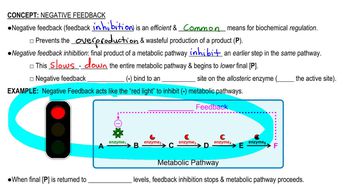
Negative feedback, or feedback inhibition, regulates enzyme activity by having the final or a later product of a metabolic pathway inhibit an earlier step in the same pathway. This is typically achieved when the product binds to an allosteric site on an allosteric enzyme, reducing the production rate and preventing overproduction and wasteful accumulation of the product.
What is another term commonly used for negative feedback in biochemical regulation?
Negative feedback is also referred to as feedback inhibition. Both terms describe the same regulatory process in cells.
Why do cells utilize negative feedback mechanisms in metabolic pathways?
Cells use negative feedback to prevent overproduction and wasteful accumulation of products. This helps maintain cellular efficiency and balance.
Where does a negative feedback inhibitor typically bind on an enzyme?
A negative feedback inhibitor binds to an allosteric site on an allosteric enzyme. It does not bind to the enzyme's active site.
How does the final product in a metabolic pathway influence its own production through negative feedback?
The final product can inhibit an earlier step in the pathway, usually by binding to an allosteric enzyme. This slows down the pathway and reduces its own concentration.
What visual analogy is used in the video to describe the effect of negative feedback on metabolic pathways?
Negative feedback is compared to a red light that slows down metabolic pathways. This analogy emphasizes its inhibitory role.
What happens to the metabolic pathway when the concentration of the final product returns to normal levels?
Feedback inhibition stops when the product concentration normalizes. The metabolic pathway then resumes its normal function.
Which type of enzyme is specifically mentioned as being inhibited by negative feedback in the example provided?
An allosteric enzyme is inhibited by negative feedback in the example. This enzyme catalyzes the first step in the pathway.
What symbol is commonly used to represent inhibition in metabolic pathway diagrams?
A negative symbol (minus sign) is used to represent inhibition. It indicates where the inhibitor acts in the pathway.
What will be discussed in later parts of the course regarding negative feedback?
Later in the course, more examples of negative feedback will be explored. This will provide a deeper understanding of its role in biochemical regulation.