Back

Neurotransmitter Release definitions

Control buttons has been changed to "navigation" mode.
1/15
  • Neurotransmitter

    Chemical substance released by neurons to transmit signals between cells, often triggering responses like muscle contraction.
  • Acetylcholine

    Molecule composed of acetyl and choline groups, stored in vesicles and released to initiate muscle contraction.
  • Vesicle

    Membrane-bound compartment at neuron ends, storing neurotransmitters for release during exocytosis.
  • Exocytosis

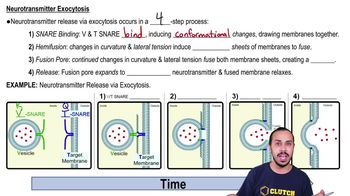
    Cellular process where vesicles fuse with the plasma membrane to release contents, such as neurotransmitters.
  • Calcium

    Intracellular signal that triggers vesicle fusion with the plasma membrane, enabling neurotransmitter release.
  • Plasma Membrane

    Cell boundary composed of phospholipids, site of vesicle fusion and neurotransmitter release.
  • Synaptic Gap

    Extracellular space between neuron and target cell where neurotransmitters are released and bind to receptors.
  • Acetylcholine Receptor

    Protein embedded in muscle cell membrane that binds acetylcholine, initiating muscle contraction.
  • SNARE Fusion Protein

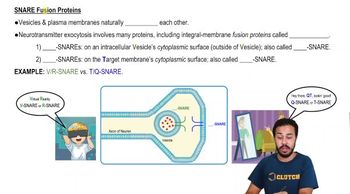
    Integral membrane protein facilitating vesicle and plasma membrane fusion by overcoming repulsion.
  • V-SNARE

    Fusion protein located on vesicle cytoplasmic surface, also known as R-SNARE due to arginine residue.
  • T-SNARE

    Fusion protein found on target membrane cytoplasmic surface, also called Q-SNARE due to glutamine residue.
  • Phospholipid

    Molecule forming cell membranes, with negatively charged phosphate groups causing membrane repulsion.
  • Hemifusion

    Intermediate stage where only the outer sheets of vesicle and target membranes partially fuse.
  • Fusion Pore

    Small opening formed after complete membrane fusion, allowing neurotransmitters to exit into extracellular space.
  • Axon

    Neuron extension ending in bulbs, site of vesicle storage and neurotransmitter release.