Back

Neurotransmitter Release quiz

Control buttons has been changed to "navigation" mode.
1/15
  • What is the process by which neurotransmitters are released from neurons?

    Neurotransmitters are released via exocytosis, where vesicles fuse with the plasma membrane to release their contents.
  • Which neurotransmitter is a classic example used to illustrate neurotransmitter release?

    Acetylcholine is a classic example, stored in vesicles and released to trigger muscle contraction.
  • What triggers the fusion of vesicles with the plasma membrane during neurotransmitter release?

    Calcium acts as an intracellular signal that triggers vesicle fusion with the plasma membrane.
  • Where are acetylcholine molecules stored before their release?

    Acetylcholine is stored in vesicles at the end of a neuron's axon.
  • What happens when acetylcholine binds to its receptor on a muscle cell?

    Binding of acetylcholine to its receptor initiates muscle contraction.
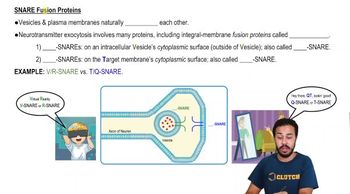
  • What is the main function of SNARE fusion proteins in neurotransmitter release?

    SNARE fusion proteins help overcome the natural repulsion between vesicle and plasma membranes, allowing them to fuse.
  • Where are v-SNAREs (or R-SNAREs) located?

    V-SNAREs are found on the cytoplasmic surface of the vesicle membrane.
  • Where are t-SNAREs (or Q-SNAREs) located?

    T-SNAREs are found on the cytoplasmic surface of the target (plasma) membrane.
  • What amino acid is critical for v-SNARE function and gives it the alternative name R-SNARE?

    Arginine is critical for v-SNARE function, hence the alternative name R-SNARE.
  • What amino acid is critical for t-SNARE function and gives it the alternative name Q-SNARE?

    Glutamine is critical for t-SNARE function, hence the alternative name Q-SNARE.
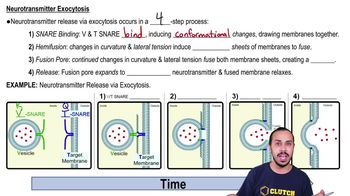
  • What is the first step in the four-step process of neurotransmitter exocytosis?

    The first step is SNARE binding, where v-SNARE and t-SNARE bind and induce conformational changes to draw membranes together.
  • What occurs during the hemifusion step of neurotransmitter exocytosis?

    During hemifusion, only the outer sheets of the vesicle and target membranes fuse, resulting in partial fusion.
  • What is created in the third step of neurotransmitter exocytosis?

    A fusion pore is created, allowing both membrane sheets to merge and forming a small opening for neurotransmitter release.
  • What happens in the final step of neurotransmitter exocytosis?

    The fusion pore expands, releasing neurotransmitters into the extracellular space, and the fused membrane relaxes.
  • Why do vesicles and plasma membranes naturally repel each other?

    Both are made of phospholipids with negatively charged phosphate groups, causing repulsion.