Back

Noncompetitive Inhibition quiz

Control buttons has been changed to "navigation" mode.
1/15
  • What type of inhibition is noncompetitive inhibition considered to be a specific case of?

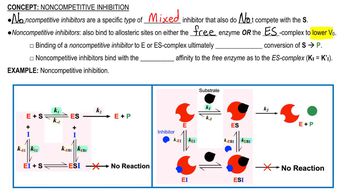
    Noncompetitive inhibition is a specific type of mixed inhibition.
  • Where do noncompetitive inhibitors bind on the enzyme?

    Noncompetitive inhibitors bind to allosteric sites on either the free enzyme or the enzyme-substrate complex.
  • Do noncompetitive inhibitors compete with the substrate for the active site?

    No, noncompetitive inhibitors do not compete with the substrate for the active site.
  • How does noncompetitive inhibition affect the apparent Vmax of an enzyme-catalyzed reaction?

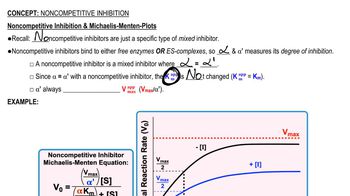
    Noncompetitive inhibition decreases the apparent Vmax of the reaction.
  • What effect does noncompetitive inhibition have on the apparent Km of an enzyme?

    Noncompetitive inhibition does not change the apparent Km of the enzyme.
  • What is unique about the binding affinity of noncompetitive inhibitors compared to other mixed inhibitors?

    Noncompetitive inhibitors have the same binding affinity for both the free enzyme and the enzyme-substrate complex.
  • What happens to the equilibrium between free enzyme and enzyme-substrate complex in noncompetitive inhibition?

    The equilibrium remains unchanged because the inhibitor affects both forms equally (alpha = alpha prime).
  • Can increasing substrate concentration overcome noncompetitive inhibition?

    No, increasing substrate concentration cannot overcome noncompetitive inhibition.
  • How does noncompetitive inhibition affect the initial reaction velocity (vā‚€)?

    Noncompetitive inhibition decreases the initial reaction velocity (vā‚€).
  • On a Michaelis-Menten plot, what changes are observed in the presence of a noncompetitive inhibitor?

    The Vmax decreases while the Km remains unchanged on a Michaelis-Menten plot.
  • How does the slope of a Lineweaver-Burk plot change with noncompetitive inhibition?

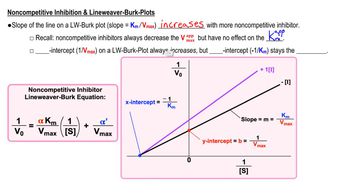
    The slope increases due to the decreased Vmax and unchanged Km.
  • What happens to the y-intercept of a Lineweaver-Burk plot in noncompetitive inhibition?

    The y-intercept increases because it is the reciprocal of the decreased Vmax.
  • Does the x-intercept of a Lineweaver-Burk plot change with noncompetitive inhibition?

    No, the x-intercept remains the same, indicating no change in Km.
  • What mnemonic can help you remember the effect of noncompetitive inhibitors on Km?

    The 'no' in noncompetitive can remind you that there is no change in Km.
  • Why does noncompetitive inhibition decrease Vmax but not Km?

    Because the inhibitor binds equally to both the free enzyme and the enzyme-substrate complex, reducing the number of active enzymes but not affecting substrate binding affinity.