Nucleic Acids quiz #1 Flashcards

Nucleic Acids quiz #1
1 student found this helpful
Control buttons has been changed to "navigation" mode.
1/40
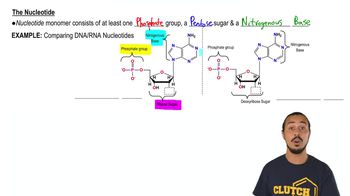
  • What are the three main components of a nucleotide?
    A phosphate group, a pentose sugar, and a nitrogenous base.
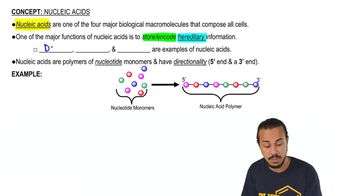
  • What is the primary function of DNA in cells?
    To encode and store hereditary information.
  • Which sugar is found in RNA nucleotides?
    Ribose.
  • Which sugar is found in DNA nucleotides?
    Deoxyribose.
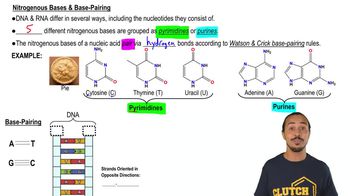
  • What are the two types of nitrogenous bases found in nucleic acids?
    Purines and pyrimidines.
  • Name the purine bases found in nucleic acids.
    Adenine and guanine.
  • Name the pyrimidine bases found in nucleic acids.
    Cytosine, thymine, and uracil.
  • Which nitrogenous base is found in RNA but not in DNA?
    Uracil.
  • Which nitrogenous base is found in DNA but not in RNA?
    Thymine.
  • How many hydrogen bonds form between adenine and thymine in DNA?
    Two hydrogen bonds.
  • How many hydrogen bonds form between cytosine and guanine in DNA?
    Three hydrogen bonds.
  • What is meant by the directionality of nucleic acids?
    Nucleic acids have a 5' end and a 3' end, indicating the direction in which the sequence is read or synthesized.
  • What does it mean that DNA strands are antiparallel?
    The two DNA strands run in opposite directions, with one strand running 5' to 3' and the other 3' to 5'.
  • What is the typical structure of DNA?
    A double-stranded double helix.
  • What is the typical structure of RNA?
    Usually single-stranded, but can form complex structures through self-hydrogen bonding.
  • What is the function of RNA besides encoding hereditary information?
    RNA can have catalytic functions, such as acting as ribozymes.
  • What is a ribozyme?
    An RNA molecule with catalytic activity.
  • What is the difference between ribose and deoxyribose?
    Ribose has a hydroxyl group at the 2' carbon, while deoxyribose has a hydrogen atom at the same position.
  • Which base pairs with adenine in DNA?
    Thymine.
  • Which base pairs with adenine in RNA?
    Uracil.
  • Which base pairs with cytosine in both DNA and RNA?
    Guanine.
  • What is the monomer unit of nucleic acids?
    Nucleotide.
  • What are the four nitrogenous bases found in DNA?
    Adenine, thymine, cytosine, and guanine.
  • What are the four nitrogenous bases found in RNA?
    Adenine, uracil, cytosine, and guanine.
  • What is the main role of ATP in the cell?
    ATP serves as the high-energy molecule used for cellular energy.
  • How are nucleotides linked together in nucleic acids?
    By phosphodiester bonds between the phosphate group of one nucleotide and the sugar of the next.
  • What is the size range of DNA molecules?
    DNA molecules typically contain millions of nucleotides.
  • What is the size range of RNA molecules?
    RNA molecules generally range from hundreds to thousands of nucleotides.
  • What is the difference in base pairing between DNA and RNA?
    In DNA, adenine pairs with thymine; in RNA, adenine pairs with uracil.
  • What is the significance of the 5' and 3' ends in nucleic acids?
    They determine the direction in which nucleic acids are synthesized and read.
  • What is the function of DNA in heredity?
    DNA stores genetic information that is passed from one generation to the next.
  • What is the function of RNA in protein synthesis?
    RNA acts as a messenger and a catalyst in the process of translating genetic information into proteins.
  • What is the difference in the number of strands between DNA and RNA?
    DNA is usually double-stranded, while RNA is usually single-stranded.
  • What is the chemical difference between thymine and uracil?
    Thymine has a methyl group at the 5' position, while uracil does not.
  • What is the role of hydrogen bonds in nucleic acid structure?
    Hydrogen bonds hold complementary nitrogenous bases together in the double helix.
  • What is the backbone of a nucleic acid composed of?
    Alternating sugar and phosphate groups.
  • What is the difference in function between DNA and RNA?
    DNA primarily stores genetic information, while RNA has diverse roles including protein synthesis and catalysis.
  • What is the significance of antiparallel strands in DNA?
    Antiparallel orientation allows for complementary base pairing and proper replication.
  • What is a nucleotide composed of in DNA?
    A phosphate group, deoxyribose sugar, and a nitrogenous base (A, T, C, or G).
  • What is a nucleotide composed of in RNA?
    A phosphate group, ribose sugar, and a nitrogenous base (A, U, C, or G).