Pearson+ LogoPearson+ Logo

Nucleic Acids quiz #4 Flashcards

Back
Nucleic Acids quiz #4
Control buttons has been changed to "navigation" mode.
1/29
  • Is ATP a macromolecule?

    ATP itself is not a macromolecule; it is a nucleotide, which is a monomer of nucleic acids.
  • What are the parts of an ATP molecule?

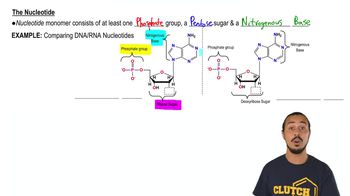
    The parts of an ATP molecule are a phosphate group, a ribose sugar, and an adenine base.
  • Three parts of ATP molecule

    The three parts of an ATP molecule are a phosphate group, a ribose sugar, and an adenine base.
  • What three main things make up an ATP molecule?

    An ATP molecule is made up of a phosphate group, a ribose sugar, and an adenine base.
  • What are the three components of ATP?

    The three components of ATP are a phosphate group, a ribose sugar, and an adenine base.
  • ATP is a type of what?

    ATP is a type of nucleotide.
  • What type of biological molecule is ATP?

    ATP is a nucleotide, which is a type of nucleic acid monomer.
  • ATP is structurally similar to what?

    ATP is structurally similar to a nucleotide found in RNA.
  • Three parts of an ATP molecule

    The three parts of an ATP molecule are a phosphate group, a ribose sugar, and an adenine base.
  • What is the name of the sugar in ATP?

    The sugar in ATP is ribose.
  • ATP is this kind of macromolecule

    ATP is a nucleotide, which is a monomer of nucleic acids.
  • What type of molecule is ATP?

    ATP is a nucleotide.
  • Which type of biomolecule is ATP?

    ATP is a nucleotide, which is a type of nucleic acid monomer.
  • Which type of biomolecule is ATP most like?

    ATP is most like a nucleotide found in RNA.
  • Which type of macromolecule is ATP?

    ATP is a nucleotide, which is a component of nucleic acids.
  • Which enzyme covalently links nucleotides together?

    DNA polymerase or RNA polymerase covalently links nucleotides together during nucleic acid synthesis.
  • ATP is what type of macromolecule?

    ATP is a nucleotide, which is a monomer of nucleic acids.
  • What is ATP classified as?

    ATP is classified as a nucleotide.
  • What kind of macromolecule is ATP?

    ATP is a nucleotide, which is a type of nucleic acid monomer.
  • What are the parts of ATP molecule?

    The parts of an ATP molecule are a phosphate group, a ribose sugar, and an adenine base.
  • What type of organic molecule is ATP?

    ATP is an organic molecule classified as a nucleotide.
  • What enzyme joins nucleotides together?

    DNA polymerase or RNA polymerase joins nucleotides together during nucleic acid synthesis.
  • What enzyme bonds nucleotides together?

    DNA polymerase or RNA polymerase bonds nucleotides together during nucleic acid synthesis.
  • What enzyme unwinds or unzips the parent strand during DNA replication?

    Helicase is the enzyme that unwinds or unzips the parent DNA strand during replication.
  • What type of macromolecule are ATP and ADP?

    ATP and ADP are nucleotides, which are monomers of nucleic acids.
  • Which nucleic acid provides the master code for protein synthesis?

    DNA provides the master code for protein synthesis.
  • Which type of macromolecule are ATP and ADP?

    ATP and ADP are nucleotides, which are monomers of nucleic acids.
  • Which three components make up both ADP and ATP?

    Both ADP and ATP are made up of a phosphate group, a ribose sugar, and an adenine base.
  • What is a restriction enzyme?

    A restriction enzyme is a protein that cuts DNA at specific nucleotide sequences.