Back

Passive vs. Active Transport definitions

Control buttons has been changed to "navigation" mode.
1/14
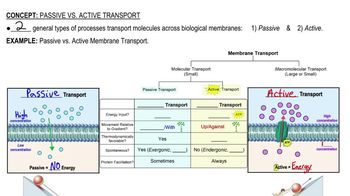
  • Passive Transport

    Movement of molecules across membranes without energy input, following concentration gradients from high to low.
  • Active Transport

    Movement of molecules across membranes requiring energy, typically from ATP, against concentration gradients.
  • ATP

    Primary energy source used to drive processes that move molecules against their natural concentration gradients.
  • Concentration Gradient

    Difference in molecule concentration across a membrane, dictating the direction of spontaneous molecular movement.
  • Exergonic Process

    Thermodynamically favorable event with negative Gibbs free energy, occurring spontaneously without energy input.
  • Endergonic Process

    Thermodynamically unfavorable event with positive Gibbs free energy, requiring energy input to proceed.
  • Protein Facilitation

    Assistance by membrane proteins in transporting molecules, sometimes needed for passive, always for active transport.
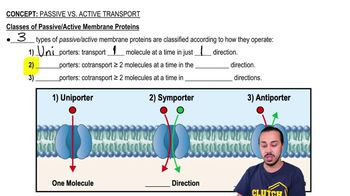
  • Uniporter

    Membrane protein that transports a single molecule in one direction across the membrane.
  • Symporter

    Membrane protein that co-transports two molecules simultaneously in the same direction across the membrane.
  • Antiporter

    Membrane protein that co-transports two molecules in opposite directions across the membrane.
  • Biological Membrane

    Barrier composed of lipid bilayers and proteins, regulating molecular movement into and out of cells.
  • Thermodynamic Favorability

    Characteristic of a process that occurs spontaneously, often associated with passive transport and negative delta G.
  • Spontaneity

    Quality of a process to occur without external energy input, typical of passive transport across membranes.
  • Molecular Transport

    Movement of small molecules across biological membranes, categorized as passive or active based on energy requirements.