Back

Passive vs. Active Transport quiz

Control buttons has been changed to "navigation" mode.
1/15
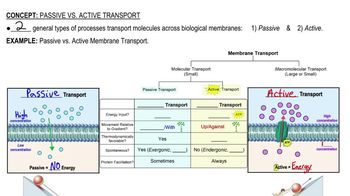
  • What is the main difference between passive and active transport across biological membranes?

    Passive transport requires no energy input, while active transport requires energy, usually from ATP.
  • In which direction do molecules move during passive transport relative to their concentration gradient?

    Molecules move from areas of high concentration to areas of low concentration, down their concentration gradient.
  • How do molecules move during active transport relative to their concentration gradient?

    Molecules move from areas of low concentration to areas of high concentration, against their concentration gradient.
  • Is passive transport thermodynamically favorable and spontaneous?

    Yes, passive transport is thermodynamically favorable and spontaneous (exergonic).
  • Is active transport thermodynamically favorable and spontaneous?

    No, active transport is not thermodynamically favorable and is not spontaneous (endergonic).
  • What molecule commonly provides energy for active transport?

    ATP commonly provides the energy required for active transport.
  • Is protein facilitation always required for passive transport?

    No, protein facilitation is only sometimes required for passive transport.
  • Is protein facilitation always required for active transport?

    Yes, protein facilitation is always required for active transport.
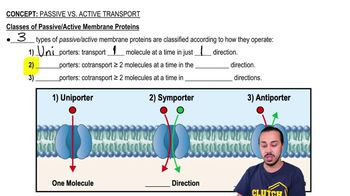
  • What does the term 'uniporter' refer to in membrane transport proteins?

    A uniporter transports one molecule at a time in one direction across the membrane.
  • What is the function of a symporter in membrane transport?

    A symporter co-transports at least two molecules in the same direction across the membrane.
  • How does an antiporter operate in membrane transport?

    An antiporter co-transports at least two molecules in opposite directions across the membrane.
  • What is the typical direction of movement for molecules in passive transport?

    Molecules move downhill, from high to low concentration, requiring no energy.
  • What is the typical direction of movement for molecules in active transport?

    Molecules move uphill, from low to high concentration, requiring energy input.
  • What is the sign of delta G for passive transport processes?

    Passive transport has a negative delta G, indicating an exergonic process.
  • What is the sign of delta G for active transport processes?

    Active transport has a positive delta G, indicating an endergonic process.