Back

Peptidoglycan quiz

Control buttons has been changed to "navigation" mode.
1/15
  • What are the two repeating sugar units found in peptidoglycan?

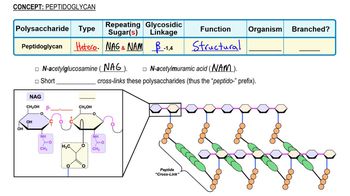
    The two repeating sugar units are N-acetylglucosamine (NAG) and N-acetylmuramic acid (NAM).
  • How are NAG and NAM linked together in peptidoglycan?

    They are linked by beta-1,4 glycosidic linkages.
  • What is the main structural function of peptidoglycan in bacteria?

    Peptidoglycan provides structural support to bacterial cell walls.
  • Is peptidoglycan a branched or unbranched polysaccharide?

    Peptidoglycan is an unbranched polysaccharide.
  • What does the 'peptido' prefix in peptidoglycan refer to?

    It refers to the short peptide cross-links that connect the polysaccharide chains.
  • Which sugar unit in peptidoglycan is also found in chitin?

    N-acetylglucosamine (NAG) is found in both peptidoglycan and chitin.
  • What distinguishes NAM from NAG in peptidoglycan structure?

    NAM has a carboxylic acid group and is linked to a peptide, while NAG does not.
  • What is the thickness of the peptidoglycan cell wall in gram positive bacteria?

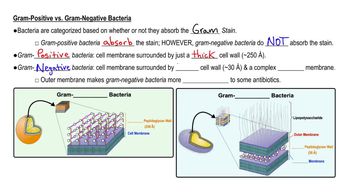
    The peptidoglycan cell wall in gram positive bacteria is about 250 angstroms thick.
  • How do gram positive bacteria react to the gram stain?

    Gram positive bacteria absorb the gram stain and react positively.
  • What is the thickness of the peptidoglycan cell wall in gram negative bacteria?

    The peptidoglycan cell wall in gram negative bacteria is about 30 angstroms thick.
  • What additional structure surrounds the peptidoglycan layer in gram negative bacteria?

    Gram negative bacteria have a complex outer membrane surrounding the peptidoglycan layer.
  • What makes gram negative bacteria more resistant to some antibiotics?

    Their complex outer membrane, which contains lipopolysaccharides, makes them more resistant.
  • What are lipopolysaccharides and where are they found?

    Lipopolysaccharides are polysaccharides with lipids attached, found in the outer membrane of gram negative bacteria.
  • What mnemonic can help remember the difference between gram positive and gram negative cell walls?

    Think 'positive' is thick and 'negative' is thin to remember the cell wall differences.
  • Why do gram negative bacteria need a complex outer membrane?

    They compensate for their thin peptidoglycan cell wall by having a more complex outer membrane.