Skip to main content
Biochemistry
My Course
Learn
Exam Prep
AI Tutor
Study Guides
Flashcards
Explore
Try the app
My Course
Learn
Exam Prep
AI Tutor
Study Guides
Flashcards
Explore
Try the app
Back
pH definitions
You can tap to flip the card.
pH
You can tap to flip the card.
👆
pH
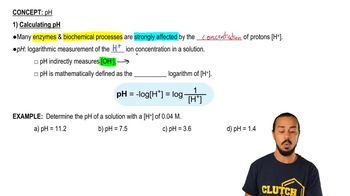
Logarithmic indicator of proton concentration in a solution, crucial for understanding enzyme activity and biochemical processes.
Track progress
Control buttons has been changed to "navigation" mode.
1/14
Related flashcards
Related practice
Recommended videos
pH quiz #1
pH
10 Terms
pH
2. Water
7 problems
Topic
Acid Dissociation Constant
2. Water
7 problems
Topic
2. Water - Part 1 of 3
4 topics
11 problems
Chapter
2. Water - Part 2 of 3
5 topics
11 problems
Chapter
2. Water - Part 3 of 3
4 topics
11 problems
Chapter
Guided course
04:24
pH Scale
1783
views
25
rank
Guided course
03:28
Calculating pH
2422
views
28
rank
Terms in this set (14)
Hide definitions
pH
Logarithmic indicator of proton concentration in a solution, crucial for understanding enzyme activity and biochemical processes.
Hydrogen Ion
Positively charged particle whose concentration determines acidity and is central to pH calculations.
Hydroxide Ion
Negatively charged particle whose concentration is inversely related to hydrogen ions and affects basicity.
Ion Constant of Water
Product of hydrogen and hydroxide ion concentrations, fixed at 1 x 10^-14 molar squared at 25°C.
Logarithm
Mathematical function used to express pH, transforming ion concentrations into manageable values.
Acidic Solution
Type of solution with pH less than 7, characterized by higher hydrogen ion concentration than hydroxide ions.
Basic Solution
Type of solution with pH greater than 7, marked by higher hydroxide ion concentration than hydrogen ions.
Neutral Solution
Solution where hydrogen and hydroxide ion concentrations are equal, corresponding to pH 7.
Molarity
Unit describing the concentration of ions in a solution, essential for pH calculations.
Negative Logarithm
Mathematical operation defining pH, applied to hydrogen ion concentration.
pH Scale
Range from 0 to 14 used to classify solutions as acidic, neutral, or basic based on ion concentrations.
Enzyme Activity
Biochemical process sensitive to proton concentration, often regulated by pH.
Biological System
Context where pH typically remains within the 0–14 range, ensuring proper biochemical function.
25 Degrees Celsius
Standard temperature for biological pH measurements, where ion constant of water is defined.
 BackBack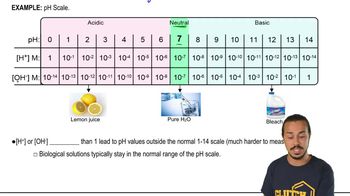
 04:24
04:24