Pearson+ LogoPearson+ Logo

Phosphorylation quiz #1 Flashcards

Back
Phosphorylation quiz #1
Control buttons has been changed to "navigation" mode.
1/19
  • What is phosphorylation, and how does it regulate protein function?

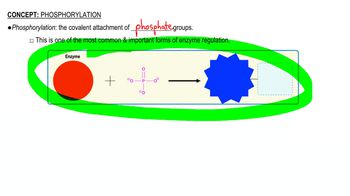
    Phosphorylation is a post-translational modification involving the covalent attachment of a phosphate group to a protein, often using ATP as the phosphate donor. This modification can activate or deactivate the protein by altering its conformation, charge interactions, and hydrogen bonding, thereby regulating its function.
  • Which enzymes are responsible for adding and removing phosphate groups during phosphorylation, and what are their specific roles?

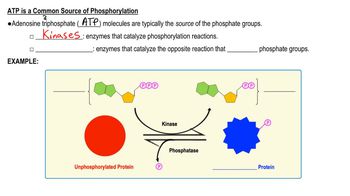
    Kinases are enzymes that add phosphate groups to proteins (phosphorylation), while phosphatases remove phosphate groups (dephosphorylation).
  • Which amino acids are most commonly phosphorylated in eukaryotic cells, and why?

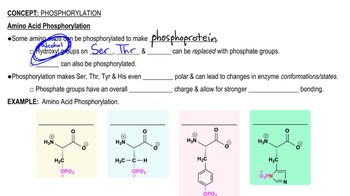
    Serine, threonine, and tyrosine are most commonly phosphorylated in eukaryotic cells because they contain hydroxyl groups in their side chains, which can be replaced by phosphate groups.
  • How does phosphorylation affect the properties of amino acids and proteins?

    Phosphorylation increases the polarity and negative charge of amino acids, which can change protein conformation and activity by affecting charge interactions and hydrogen bonding.
  • What is the primary source of phosphate groups used in phosphorylation reactions?

    ATP (adenosine triphosphate) is the primary source of phosphate groups for phosphorylation, donating a phosphate and becoming ADP (adenosine diphosphate) in the process.
  • What is phosphorylation and how does it regulate protein function?

    Phosphorylation is the covalent attachment of a phosphate group to a protein, which can activate or deactivate the protein by altering its conformation and interactions.
  • Which enzymes are responsible for adding and removing phosphate groups during phosphorylation?

    Kinases add phosphate groups to proteins (phosphorylation), while phosphatases remove them (dephosphorylation).
  • Which amino acids are most commonly phosphorylated in eukaryotic cells and why?

    Serine, threonine, and tyrosine are most commonly phosphorylated because their side chains contain hydroxyl groups that can be replaced by phosphate groups.
  • How does phosphorylation affect the properties of amino acids and proteins?

    Phosphorylation increases the polarity and negative charge of amino acids, which can change protein conformation and activity by affecting charge interactions and hydrogen bonding.
  • What is the primary source of phosphate groups used in phosphorylation reactions?

    ATP (adenosine triphosphate) is the primary source, donating a phosphate group and becoming ADP (adenosine diphosphate) in the process.
  • What is the role of activated protein kinases in cellular regulation?

    Activated protein kinases catalyze the addition of phosphate groups to specific proteins, which can activate or deactivate the target protein's function, thereby regulating cellular processes.
  • What is the function of a protein kinase in phosphorylation?

    The function of a protein kinase is to catalyze the transfer of a phosphate group from ATP to specific amino acids on a protein, altering the protein's activity.
  • What is a protein kinase?

    A protein kinase is an enzyme that catalyzes the covalent attachment of phosphate groups to proteins, typically using ATP as the phosphate donor.
  • How do protein kinases affect enzymes?

    Protein kinases affect enzymes by phosphorylating them, which can change their conformation and either activate or deactivate their enzymatic activity.
  • How does phosphorylation control protein activity?

    Phosphorylation controls protein activity by covalently attaching a phosphate group to specific amino acids, altering the protein's polarity, conformation, and interactions, which can activate or deactivate its function.
  • Which enzyme is responsible for adding phosphate groups to proteins?

    Kinases are the enzymes responsible for adding phosphate groups to proteins during phosphorylation.
  • Which amino acids are most susceptible to phosphorylation in eukaryotic cells?

    Serine, threonine, and tyrosine are the amino acids most susceptible to phosphorylation in eukaryotic cells.
  • What is the source of phosphate groups in phosphorylation reactions?

    ATP (adenosine triphosphate) is the common source of phosphate groups in phosphorylation reactions, donating a phosphate group and becoming ADP.
  • How does the addition of a phosphate group affect the properties of an amino acid?

    The addition of a phosphate group increases the polarity and negative charge of the amino acid, which can alter protein conformation and activity through changes in charge interactions and hydrogen bonding.