Back

Photophosphorylation 2 quiz

Control buttons has been changed to "navigation" mode.
1/15
  • Where does photosynthesis occur within plant cells?

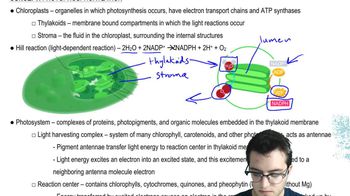
    Photosynthesis occurs in chloroplasts, which are organelles with electron transport chains and ATP synthesis.
  • What is the function of the stroma in chloroplasts?

    The stroma is the goopy fluid that fills chloroplasts and surrounds the thylakoids.
  • What are thylakoids and what do they contain?

    Thylakoids are infolded membrane structures inside chloroplasts that contain a lumen, an internal space.
  • What are the light-dependent reactions of photosynthesis responsible for producing?

    The light-dependent reactions produce ATP and NADPH using light energy.
  • What is NADPH and how is it used in photosynthesis?

    NADPH is an electron carrier similar to NADH, and it is used in the Calvin cycle for carbon fixation.
  • How is oxygen released during the light reactions of photosynthesis?

    Oxygen is released when water is split and its electrons are taken, oxidizing the oxygens to molecular oxygen.
  • What are the two main components of a photosystem?

    A photosystem consists of a light-harvesting complex and a reaction center.
  • What is the role of the light-harvesting complex in a photosystem?

    The light-harvesting complex acts as an antenna, collecting light energy and transferring it to the reaction center.
  • What is resonance energy transfer in the context of photosynthesis?

    Resonance energy transfer is the process where excited electrons in photopigments transfer energy to neighboring pigments until it reaches the reaction center.
  • What happens to an electron in the reaction center when it receives energy from the light-harvesting complex?

    The electron in the reaction center becomes so excited that it is ejected and picked up by electron carriers.
  • What types of molecules are found in the reaction center of a photosystem?

    The reaction center contains chlorophylls, cytochromes, quinones, and pheophytin, all of which are electron carriers.
  • How does the electron transport chain in chloroplasts create a proton gradient?

    Electrons move through the cytochrome complex, which pumps protons and creates a proton gradient across the thylakoid membrane.
  • What is the ultimate fate of electrons in the light reactions of photosynthesis?

    Electrons can be delivered to NADP+ reductase to form NADPH or can cycle to create a proton gradient for ATP synthesis.
  • What is the role of ferredoxin in the light reactions?

    Ferredoxin can shuttle electrons in a cyclic fashion, contributing to the creation of the proton gradient for ATP synthesis.
  • What is the chemiosmotic theory as it relates to photosynthesis?

    Chemiosmotic theory explains how the proton gradient created by electron transport drives ATP synthesis in chloroplasts.