Back

Photophosphorylation 3 quiz

Control buttons has been changed to "navigation" mode.
1/15
  • What is the primary function of Photosystem II (PSII) in photophosphorylation?

    PSII absorbs light at 680 nm, splits water to release electrons, protons, and oxygen, and initiates non-cyclic electron flow.
  • Which chlorophyll is found in the reaction center of Photosystem II and what wavelength does it absorb best?

    Chlorophyll P680 is found in PSII and it absorbs light best at 680 nm.
  • What happens to the electrons lost by Photosystem II?

    The electrons lost by PSII are replaced by splitting water and are passed to the cytochrome b6f complex.
  • What is the role of the cytochrome b6f complex in the electron transport chain?

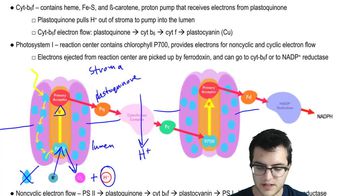
    The cytochrome b6f complex acts as a proton pump, moving protons across the thylakoid membrane to help generate a proton gradient.
  • Which electron carrier receives electrons from the cytochrome b6f complex and delivers them to Photosystem I?

    Plastocyanin receives electrons from the cytochrome b6f complex and delivers them to Photosystem I.
  • What is the name and absorption peak of the chlorophyll in Photosystem I?

    Photosystem I contains chlorophyll P700, which absorbs light best at 700 nm.
  • What is the fate of electrons after they reach Photosystem I?

    Electrons from PSI are transferred to ferredoxin, which can reduce NADP+ to NADPH or cycle electrons back to generate more ATP.
  • What is the difference between cyclic and non-cyclic electron flow?

    Cyclic electron flow cycles electrons back to PSI and only produces ATP, while non-cyclic flow produces both ATP and NADPH.
  • Which process, cyclic or non-cyclic electron flow, produces NADPH?

    Non-cyclic electron flow produces NADPH; cyclic flow does not.
  • What is the ultimate purpose of the proton gradient generated during photophosphorylation?

    The proton gradient powers ATP synthase to generate ATP.
  • How is the energy source for photophosphorylation different from oxidative phosphorylation?

    Photophosphorylation uses sunlight energy, while oxidative phosphorylation uses energy from nutrient oxidation.
  • What is released as a byproduct when water is split in Photosystem II?

    Oxygen is released as a byproduct when water is split in PSII.
  • Which protein uses all five redox states of manganese during water splitting?

    The protein in PSII that splits water uses all five redox states of manganese.
  • Where does the proton gradient build up during photophosphorylation?

    The proton gradient builds up in the lumen of the thylakoid.
  • Why is photophosphorylation essential for the Calvin cycle?

    Photophosphorylation provides ATP and NADPH, which are required for the anabolic reactions of the Calvin cycle.