Back

Positive Feedback quiz

Control buttons has been changed to "navigation" mode.
1/15
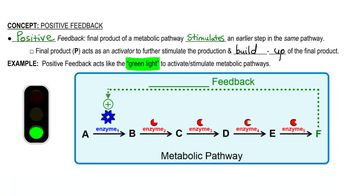
  • What is the main function of positive feedback in a metabolic pathway?

    Positive feedback activates earlier steps in the pathway, enhancing the production of the final product.
  • How does the final product act in positive feedback regulation?

    The final product acts as an activator for an allosteric enzyme, increasing the reaction rate.
  • What role does an allosteric enzyme play in positive feedback?

    An allosteric enzyme can be activated by the final product, leading to increased conversion of substrates and higher product levels.
  • Why might a cell use positive feedback to maintain high concentrations of a product?

    Some products are essential for cell survival, so positive feedback ensures their concentrations remain high.
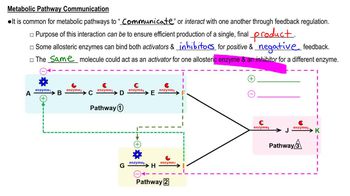
  • What is meant by metabolic pathway communication?

    It refers to the interaction between different metabolic pathways through feedback mechanisms to efficiently produce a final product.
  • How can allosteric enzymes support both positive and negative feedback?

    Some allosteric enzymes can bind both activators and inhibitors, allowing them to participate in both types of feedback.
  • Can a single molecule act as both an activator and an inhibitor in metabolic pathways?

    Yes, the same molecule can activate one enzyme and inhibit another in different pathways.
  • What happens when the concentration of a final product becomes too high?

    The product can act as an allosteric inhibitor to decrease its own production, demonstrating negative feedback.
  • How does positive feedback affect the speed of a metabolic pathway?

    It acts like a green light, allowing the pathway to proceed faster and produce more product.
  • What is the significance of positive and negative signs in pathway diagrams?

    Positive signs represent activators (positive feedback), while negative signs represent inhibitors (negative feedback).
  • How do metabolic pathways ensure efficient production of a single final product?

    They communicate through feedback mechanisms, adjusting enzyme activity to optimize product formation.
  • What is the effect of low concentrations of a product in a pathway?

    Low concentrations can stimulate production by activating enzymes in the pathway or in connected pathways.
  • How can the final product of one pathway influence another pathway?

    It can act as an activator or inhibitor for enzymes in a different pathway, facilitating metabolic communication.
  • What is the role of enzyme 1 in the positive feedback example described?

    Enzyme 1 is an allosteric enzyme activated by the final product, increasing the conversion of the initial substrate.
  • Why is it important for metabolic pathways to have both positive and negative feedback mechanisms?

    Having both allows the cell to finely regulate product concentrations, ensuring balance and efficient resource use.