Back

Practice - Glycolysis 2 definitions

Control buttons has been changed to "navigation" mode.
1/15
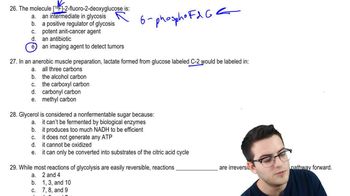
  • 2-Fluoro-2-deoxyglucose

    A glucose analog with fluorine at carbon 2, used in tumor imaging due to its cellular trapping during glycolysis.
  • F18

    A radioactive isotope of fluorine detectable by CT scans, enabling visualization of metabolic activity in tissues.
  • Hexokinase

    An enzyme catalyzing the phosphorylation of glucose, initiating glycolysis and trapping glucose derivatives inside cells.
  • Phosphofructokinase

    A glycolytic enzyme responsible for an irreversible step, regulating pathway flux and requiring ATP.
  • Pyruvate Kinase

    A glycolytic enzyme catalyzing the final irreversible step, generating ATP and driving pathway completion.
  • Glycolysis

    A metabolic pathway converting glucose to pyruvate, producing ATP and involving both reversible and irreversible steps.
  • ΔG

    A thermodynamic value indicating reaction favorability; highly negative values drive glycolytic steps irreversibly forward.
  • Phosphoglucoisomerase

    An enzyme converting glucose-6-phosphate to fructose-6-phosphate via ring rearrangement, requiring magnesium ions.
  • Glucose-6-phosphate

    A phosphorylated glucose molecule, serving as a substrate for isomerization in glycolysis.
  • Fructose-6-phosphate

    A glycolytic intermediate formed from glucose-6-phosphate, marking a key step in energy metabolism.
  • Lactate

    A product of anaerobic glycolysis, formed by reduction of pyruvate and used to track carbon flow in fermentation.
  • NADH

    A reduced electron carrier generated during glycolysis and fermentation, influencing cellular redox balance.
  • NAD+

    An oxidized electron carrier regenerated during fermentation, essential for continued glycolytic activity.
  • Glycerol

    A three-carbon molecule considered non-fermentable due to excessive NADH production, requiring aerobic metabolism.
  • Magnesium

    A divalent cation necessary for enzymatic activity in glycolytic isomerization reactions.