Back

Practice - Glycolysis 2 quiz

Control buttons has been changed to "navigation" mode.
1/15
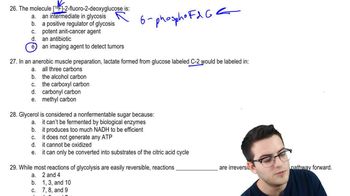
  • What is the purpose of using 2-fluoro-2-deoxyglucose (F18-labeled) in tumor imaging?

    It is used because cancer cells have high glycolysis rates, trapping the labeled molecule inside and making tumors visible on scans.
  • Which enzyme phosphorylates glucose upon entry into the cell, trapping it inside?

    Hexokinase phosphorylates glucose, trapping it in the cell and facilitating further glucose uptake.
  • What happens to 2-fluoro-2-deoxyglucose after it enters a cell?

    It is converted into 6-phospho-FHDG, which becomes trapped inside the cell, especially in cancer cells.
  • Why do cancer cells appear bright in CT scans when using F18-labeled glucose analogs?

    Cancer cells sequester large amounts of the labeled molecule due to their high glycolysis rates, resulting in a strong signal.
  • During anaerobic fermentation, which carbon from glucose is labeled in lactate if the C2 position is labeled?

    The alcohol carbon in lactate will be labeled, corresponding to carbon 2 from glucose.
  • How is pyruvate converted to lactate during anaerobic fermentation?

    Pyruvate is reduced by NADH, regenerating NAD+ and forming lactate by converting the ketone to an alcohol.
  • Why is glycerol considered a non-fermentable sugar?

    Glycerol produces excess NADH, making it inefficient for fermentation since NAD+ cannot be replenished at the same rate.
  • Under what conditions can glycerol be metabolized efficiently?

    Glycerol is used in aerobic conditions where NADH can be consumed in the electron transport chain.
  • Which glycolytic reactions are irreversible and drive the pathway forward?

    Reactions 1, 3, and 10, catalyzed by hexokinase, phosphofructokinase, and pyruvate kinase, are irreversible.
  • What is the significance of the negative ΔG in glycolysis?

    A very negative ΔG makes certain reactions highly favorable and irreversible, pushing glycolysis forward.
  • Which glycolytic enzymes require new enzymes for gluconeogenesis to reverse their reactions?

    Hexokinase, phosphofructokinase, and pyruvate kinase require new enzymes for reversal in gluconeogenesis.
  • What does phosphoglucoisomerase catalyze in glycolysis?

    It catalyzes the conversion of glucose-6-phosphate to fructose-6-phosphate via ring rearrangement.
  • What cofactor is required by phosphoglucoisomerase for its reaction?

    Magnesium (Mg²⁺) is required by phosphoglucoisomerase for the conversion.
  • What structural change occurs during the phosphoglucoisomerase reaction?

    A ring rearrangement occurs, shifting the position of carbon 2 in the molecule.
  • Why are most glycolytic reactions reversible except for a few key steps?

    Most reactions have small ΔG values, but steps 1, 3, and 10 are irreversible due to their highly negative ΔG.