Back

Practice - Membrane Transport 2 quiz

Control buttons has been changed to "navigation" mode.
1/15
  • What drives facilitated diffusion through biological membranes?

    Facilitated diffusion is driven by differences in solute concentrations across the membrane.
  • What is the main energy source for primary active transport?

    Primary active transport is driven by ATP hydrolysis.
  • How does a potassium channel achieve specificity for potassium over sodium?

    The selectivity filter of the potassium channel interacts differently with potassium and sodium, favoring potassium.
  • Why are ion channels typically hydrophilic?

    Ion channels are hydrophilic to better interact with ions, unlike hydrophobic molecules such as phospholipids or cholesterol.
  • What plot is used to analyze transport kinetics similar to enzyme kinetics?

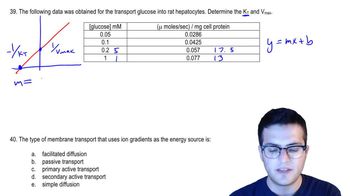
    The Lineweaver-Burk plot is used to analyze transport kinetics, allowing determination of Vmax and KT.
  • What does the y-intercept represent in a Lineweaver-Burk plot for transport kinetics?

    The y-intercept represents 1/Vmax in the Lineweaver-Burk plot.
  • How is the x-intercept related to KT in a Lineweaver-Burk plot?

    The x-intercept is equal to -1/KT in the Lineweaver-Burk plot.
  • What equation is used to calculate slope and intercept in transport kinetics problems?

    The equation y = mx + b is used, where m is the slope and b is the y-intercept.
  • How do you calculate Vmax from the y-intercept in a Lineweaver-Burk plot?

    Vmax is calculated as the reciprocal of the y-intercept (Vmax = 1/b).
  • How is KT calculated from the x-intercept in a Lineweaver-Burk plot?

    KT is calculated as the reciprocal of the negative x-intercept (KT = -1/x-intercept).
  • What is the energy source for secondary active transport?

    Secondary active transport uses ion gradients as its energy source.
  • How are ion gradients typically established for secondary active transport?

    Ion gradients are usually established by primary active transport, which uses ATP.
  • What does passive transport rely on to move substances across membranes?

    Passive transport relies on concentration gradients to move substances.
  • What happens in a membrane scenario where two transporters are inhibited by each other's substrates?

    Each transporter is inhibited by the other's substrate, so only half of each amino acid gets through via the non-inhibited transporter.
  • What is competitive inhibition in the context of membrane transporters?

    Competitive inhibition occurs when the presence of one amino acid inhibits the transport of another, affecting overall transport efficiency.