Back

Practice - Nucleic Acids 1 quiz

Control buttons has been changed to "navigation" mode.
1/15
  • What is the structural difference between purines and pyrimidines?

    Purines have a fused 6-membered and 5-membered ring, while pyrimidines contain only a 6-membered ring.
  • Which atoms are shared in the ring structure of purines and pyrimidines?

    Both purines and pyrimidines share a 6-membered ring containing two nitrogens.
  • How are purines attached to the sugar in nucleotides?

    Purines are attached at the 9 position to the 1' carbon of the sugar.
  • How are pyrimidines attached to the sugar in nucleotides?

    Pyrimidines are attached at the 1 position to the 1' carbon of the sugar.
  • What are the two purines found in nucleic acids?

    The two purines are adenine and guanine.
  • What are the three pyrimidines found in nucleic acids?

    The three pyrimidines are cytosine, uracil, and thymine.
  • What mnemonic can help remember purines and pyrimidines?

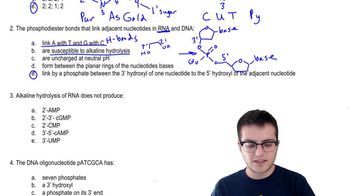
    Purines: 'pure as gold' (adenine and guanine); Pyrimidines: 'cut pie' (cytosine, uracil, thymine).
  • How are nucleotides linked together in nucleic acids?

    Nucleotides are linked by phosphodiester bonds between the 3' hydroxyl of one sugar and the 5' carbon of another.
  • What type of bond links nucleotide bases together?

    Nucleotide bases are linked by hydrogen bonds, not phosphodiester bonds.
  • Why is RNA susceptible to alkaline hydrolysis?

    RNA has a 2' hydroxyl group, which allows cyclization between the 2' and 3' positions under alkaline conditions.
  • What happens to RNA under alkaline conditions?

    RNA can cyclize between the 2' and 3' positions, breaking down into equal amounts of 2' and 3' nucleotide monophosphates.
  • At which end does DNA synthesis occur?

    DNA synthesis occurs at the 3' end, which always contains a hydroxyl group.
  • How is DNA conventionally written?

    DNA is conventionally written from the 5' end to the 3' end.
  • What is the shape and stacking arrangement of nucleic acid bases?

    Nucleic acid bases are roughly planar and stack parallel to each other, maintaining the uniform width of the DNA molecule.
  • Which bases pair together in DNA and RNA?

    Adenine pairs with thymine (or uracil in RNA), and cytosine pairs with guanine; purines always pair with pyrimidines.