Back

Pyruvate Oxidation definitions

Control buttons has been changed to "navigation" mode.
1/14
  • Pyruvate

    Three-carbon molecule produced from glucose during glycolysis, transported into the mitochondrial matrix for further metabolic processing.
  • Mitochondrial Matrix

    Internal compartment of mitochondria where pyruvate oxidation and subsequent metabolic reactions occur.
  • Pyruvate Dehydrogenase Complex

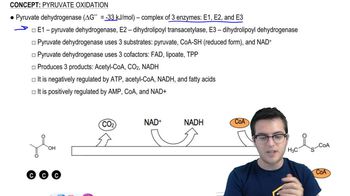
    Multi-enzyme structure catalyzing the conversion of pyruvate to acetyl CoA, involving several cofactors and regulatory mechanisms.
  • Acetyl CoA

    Two-carbon molecule formed from pyruvate, serving as a key substrate for the citric acid cycle.
  • Coenzyme A

    Essential cofactor that binds to acetyl groups during pyruvate oxidation, facilitating their entry into metabolic cycles.
  • NAD+

    Electron carrier molecule that accepts electrons during pyruvate oxidation, becoming reduced to NADH.
  • NADH

    Reduced form of NAD+, generated during pyruvate oxidation, later used in electron transport for ATP production.
  • FAD

    Cofactor involved in electron transfer during pyruvate oxidation, temporarily reduced to FADH2 and then regenerated.
  • FADH2

    Reduced form of FAD, briefly produced during pyruvate oxidation before transferring electrons to NAD+.
  • CO2

    Gaseous byproduct released during the decarboxylation of pyruvate in the mitochondrial matrix.
  • Citric Acid Cycle

    Metabolic pathway following pyruvate oxidation, utilizing acetyl CoA for further energy extraction.
  • Cytosol

    Cellular fluid where glycolysis occurs, prior to pyruvate's transport into the mitochondria.
  • Decarboxylation

    Chemical process removing a carbon atom as CO2 from pyruvate, crucial for acetyl CoA formation.
  • Carbon Numbering

    System tracking carbon atoms from glucose through metabolic transformations, important for understanding substrate fate.