Back

Reversible Inhibition quiz

Control buttons has been changed to "navigation" mode.
1/15
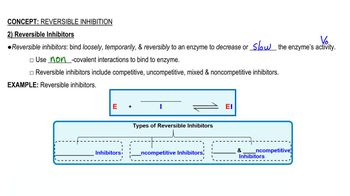
  • What type of interactions do reversible inhibitors use to bind to enzymes?

    Reversible inhibitors use non-covalent interactions to bind to enzymes.
  • How do reversible inhibitors affect enzyme activity?

    Reversible inhibitors decrease or slow down enzyme activity but do not completely halt it.
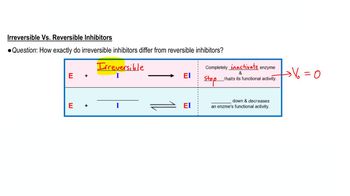
  • What happens to enzyme activity when an irreversible inhibitor binds to an enzyme?

    Enzyme activity is completely stopped or halted, and the initial reaction velocity becomes zero.
  • Can reversible inhibitors dissociate from the enzyme once bound?

    Yes, reversible inhibitors can dissociate easily and reversibly from the enzyme.
  • What are the four main types of reversible inhibitors?

    The four main types are competitive, uncompetitive, mixed, and non-competitive inhibitors.
  • What type of bond do irreversible inhibitors form with enzymes?

    Irreversible inhibitors form covalent bonds with enzymes.
  • How is the formation of enzyme-inhibitor complexes in reversible inhibition typically represented?

    It is represented by equilibrium arrows, indicating the reversibility of binding.
  • When do reversible inhibitors inhibit the enzyme reaction?

    They inhibit the reaction only when they are bound to the enzyme.
  • What happens to enzyme function when a reversible inhibitor unbinds?

    The enzyme returns to normal function and the reaction proceeds as usual.
  • Are non-competitive inhibitors a separate class from mixed inhibitors?

    No, non-competitive inhibitors are actually a subtype of mixed inhibitors.
  • What is the main difference in the effect on initial reaction velocity between reversible and irreversible inhibitors?

    Reversible inhibitors decrease initial reaction velocity, while irreversible inhibitors reduce it to zero.
  • Why are reversible inhibitors easier to remove from enzymes than irreversible inhibitors?

    Because reversible inhibitors use weak non-covalent interactions, making them easier to break apart.
  • Can reversible inhibitors bind to both free enzymes and enzyme-substrate complexes?

    Yes, some reversible inhibitors can bind to both free enzymes and enzyme-substrate complexes.
  • What does a one-way reaction arrow indicate in the context of enzyme inhibition?

    It indicates irreversible binding, where the inhibitor cannot easily dissociate from the enzyme.
  • What is the key feature that distinguishes reversible from irreversible inhibition?

    Reversible inhibition is characterized by temporary, non-covalent binding that can be undone, while irreversible inhibition involves permanent, covalent binding.