Describe the role of calcium ions in the regulation of skeletal muscle contraction and relaxation.
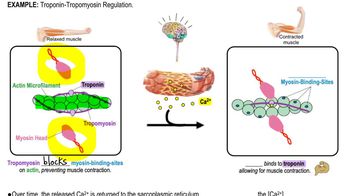
Calcium ions are released from the sarcoplasmic reticulum in response to nervous system signals. Calcium binds to troponin, causing a conformational change in the troponin-tropomyosin complex, which exposes myosin binding sites on actin and allows muscle contraction to occur. When calcium is reabsorbed into the sarcoplasmic reticulum, it dissociates from troponin, causing the troponin-tropomyosin complex to block the myosin binding sites again, leading to muscle relaxation.
Which regions of the sarcomere decrease in size during skeletal muscle contraction?
The H zone and I bands decrease in size during contraction, while the A band remains unchanged.
What is the sliding filament model in the context of muscle contraction?
The sliding filament model describes how thick myosin filaments pull thin actin filaments toward the M disc, shortening the sarcomere and causing muscle contraction.
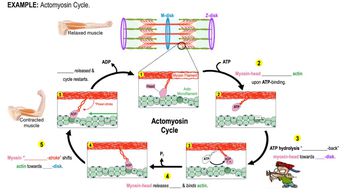
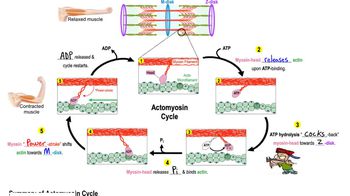
List the five steps of the actomyosin cycle involved in muscle contraction.
The five steps are: 1) Myosin binds actin without ATP, 2) ATP binds myosin causing release from actin, 3) ATP hydrolysis cocks myosin head, 4) Inorganic phosphate is released and myosin binds actin tightly, 5) Power stroke shifts actin and ADP is released.
What role does ATP play in the actomyosin cycle?
ATP binding to myosin causes it to release actin, and ATP hydrolysis cocks the myosin head into a high-energy state for the next power stroke.
How do troponin and tropomyosin regulate muscle contraction?
Troponin and tropomyosin form a complex that blocks myosin binding sites on actin, preventing contraction until calcium binds to troponin and exposes these sites.
What triggers the release of calcium ions from the sarcoplasmic reticulum in muscle cells?
A signal from the nervous system stimulates the sarcoplasmic reticulum to release calcium ions.
Describe the role of calcium ions in muscle contraction and relaxation.
Calcium binds to troponin, causing a conformational change that exposes myosin binding sites on actin for contraction; when calcium is reabsorbed, the sites are blocked again, leading to relaxation.
What happens to the troponin-tropomyosin complex when calcium levels decrease in the muscle cell?
When calcium levels decrease, calcium dissociates from troponin, causing the troponin-tropomyosin complex to block myosin binding sites on actin and resulting in muscle relaxation.
Why does the actomyosin cycle stop during muscle relaxation?
The actomyosin cycle stops because the troponin-tropomyosin complex blocks the myosin binding sites on actin, preventing myosin from binding and continuing the cycle.
Which protein is found within the thick filament of skeletal muscle?
The protein found within the thick filament of skeletal muscle is myosin.
What protein are the thin filaments of skeletal muscle primarily made of?
The thin filaments of skeletal muscle are primarily made of actin.
Thick filaments in skeletal muscle are composed of which protein?
Thick filaments in skeletal muscle are composed of the protein myosin.
Thin filaments in skeletal muscle are mostly made of which protein?
Thin filaments in skeletal muscle are mostly made of the protein actin.
Which protein makes up the thick filaments in skeletal muscle?
The thick filaments in skeletal muscle are made up of myosin.
What role does ATP play in muscle contraction?
ATP binds to the myosin head, causing it to release from actin, and its hydrolysis provides the energy needed for the myosin head to enter a high-energy state, enabling the power stroke during muscle contraction.
What happens to a skeletal muscle that is deprived of adequate ATP supplies?
A skeletal muscle deprived of adequate ATP will have myosin heads that remain tightly bound to actin, preventing muscle relaxation and leading to a state known as rigor.
Which of the following is not a protein found in thin filaments: actin, troponin, tropomyosin, or myosin?
Myosin is not a protein found in thin filaments; it is found in thick filaments.
Which protein is not present in the thin filaments of skeletal muscle?
Myosin is not present in the thin filaments of skeletal muscle.
What is the role of ATP in the cross-bridge cycling of muscle contraction?
ATP binds to the myosin head, causing it to release from actin, and its hydrolysis re-cocks the myosin head into a high-energy state, enabling repeated cycles of cross-bridge formation and muscle contraction.
What does ATP do during muscle contraction?
During muscle contraction, ATP binds to myosin, causing it to release from actin, and its hydrolysis provides the energy for the myosin head to return to a high-energy state, allowing the contraction cycle to continue.
What protein makes up the thick filaments in skeletal muscle?
The thick filaments in skeletal muscle are made up of the protein myosin.