Back

Types of Enzymes definitions

Control buttons has been changed to "navigation" mode.
1/15
  • Oxidoreductase

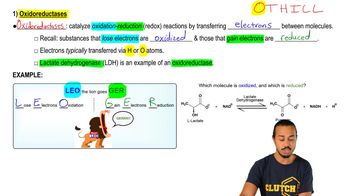
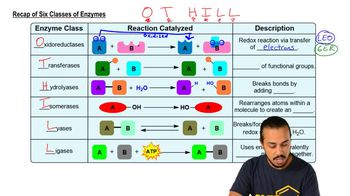
    Catalyzes electron transfer between molecules, often involving hydrogen or oxygen atoms, crucial for redox reactions in metabolism.
  • Transferase

    Facilitates movement of functional groups from one molecule to another, key in amino acid and metabolic transformations.
  • Hydrolase

    Breaks chemical bonds by adding water, generating fragments; includes enzymes like peptidases, lipases, and nucleases.
  • Isomerase

    Rearranges atoms within a molecule to produce isomers, altering structure without changing chemical formula.
  • Lyase

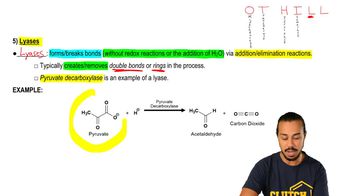
    Forms or breaks bonds without water or electron transfer, often creating or removing double bonds or rings.
  • Ligase

    Uses energy, such as ATP, to covalently join two separate molecules, essential for processes like DNA replication.
  • Activation Energy

    Represents the energy barrier that enzymes lower to accelerate chemical reactions, visualized as a 'hill' in diagrams.
  • Transition State

    A high-energy intermediate stabilized by enzymes, enabling faster conversion of reactants to products.
  • Redox Reaction

    Involves electron transfer between molecules, resulting in oxidation and reduction, often catalyzed by oxidoreductases.
  • Functional Group

    A specific cluster of atoms transferred by transferases, determining molecular properties and reactivity.
  • Hydrolysis

    A reaction breaking bonds by water addition, central to hydrolase activity in protein, lipid, and nucleic acid degradation.
  • Isomer

    A molecule with identical chemical formula but different atomic arrangement, produced by isomerases.
  • Double Bond

    A bond often created or removed by lyases, serving as a clue to lyase-catalyzed reactions.
  • Cofactor

    A non-protein molecule, such as magnesium, required for enzyme activity, exemplified by DNA ligase.
  • Peptidase

    A hydrolase subclass that cleaves peptide bonds in proteins, exemplified by trypsin's specificity for lysine or arginine.