Skip to main content
Biochemistry
My Course
Learn
Exam Prep
AI Tutor
Study Guides
Flashcards
Explore
Try the app
My Course
Learn
Exam Prep
AI Tutor
Study Guides
Flashcards
Explore
Try the app
Back
Hydrophobic Effect definitions
You can tap to flip the card.
Hydrophobic Effect
You can tap to flip the card.
👆
Hydrophobic Effect
Phenomenon where water excludes nonpolar substances, leading to separate phases and driving key biological processes.
Track progress
Control buttons has been changed to "navigation" mode.
1/15
Related flashcards
Related practice
Recommended videos
Hydrophobic Effect quiz #1
Hydrophobic Effect
10 Terms
Hydrophobic Effect
2. Water
7 problems
Topic
Acids and Bases
2. Water
7 problems
Topic
2. Water - Part 1 of 3
4 topics
11 problems
Chapter
2. Water - Part 2 of 3
5 topics
11 problems
Chapter
2. Water - Part 3 of 3
4 topics
11 problems
Chapter
Guided course
03:48
Protein Folding & Membrane Formation
1407
views
7
rank
1
comments
Guided course
06:28
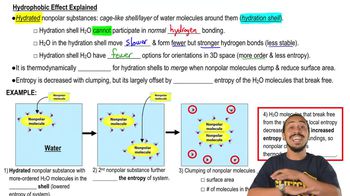
Explanation of the Hydrophobic Effect
2052
views
23
rank
2
comments
Guided course
02:33
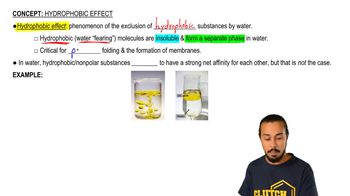
Intro to the Hydrophobic Effect
2135
views
18
rank
Terms in this set (15)
Hide definitions
Hydrophobic Effect
Phenomenon where water excludes nonpolar substances, leading to separate phases and driving key biological processes.
Hydrophobic Molecule
Nonpolar substance that resists dissolving in water, often forming distinct phases when mixed with aqueous solutions.
Protein Folding
Process where polypeptides adopt organized structures, aided by the clustering of nonpolar groups to increase universal entropy.
Membrane Formation
Assembly of phospholipids into bilayers, driven by the release of water molecules from hydration shells around nonpolar tails.
Hydration Shell
Layer of water molecules surrounding nonpolar substances, restricting hydrogen bonding and decreasing entropy.
Entropy
Measure of disorder; decreases locally when nonpolar substances clump, but increases universally as water molecules are released.
Phospholipid Bilayer
Structure formed by phospholipids clumping together, minimizing hydration shells and enabling cellular compartmentalization.
Nonpolar Substance
Molecule lacking significant charge separation, often excluded by water and central to the hydrophobic effect.
Van Der Waals Forces
Weak interactions present between all molecules, but insufficient to explain the apparent attraction among hydrophobic substances.
Hydrogen Bonding
Interaction between water molecules, disrupted in hydration shells around nonpolar substances, leading to stronger but fewer bonds.
Surface Area
Extent of exposure of nonpolar molecules to water; reduced during clumping, decreasing hydration shell size.
R Group
Side chain of an amino acid; nonpolar variants cluster during protein folding, releasing water and increasing entropy.
Thermodynamic Favorability
Condition where a process increases universal entropy, such as the clumping of nonpolar substances in water.
Phase Separation
Formation of distinct regions, such as oil and water, due to the exclusion of hydrophobic substances by water.
Universal Entropy
Overall disorder in the surroundings; increases when water molecules escape hydration shells during hydrophobic interactions.
 BackBack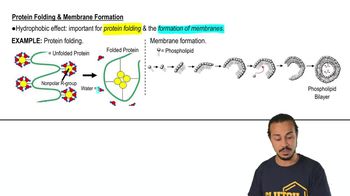
 03:48
03:48