Skip to main content
Biochemistry
My Course
Learn
Exam Prep
AI Tutor
Study Guides
Flashcards
Explore
Try the app
My Course
Learn
Exam Prep
AI Tutor
Study Guides
Flashcards
Explore
Try the app
Back
Zwitterion definitions
You can tap to flip the card.
Zwitterion
You can tap to flip the card.
👆
Zwitterion
A dipolar molecule with both a positive and negative charge, resulting from acid-base reactions, predominating at physiological pH.
Track progress
Control buttons has been changed to "navigation" mode.
1/15
Related flashcards
Related practice
Recommended videos
Zwitterion quiz #1
Zwitterion
10 Terms
Zwitterion
3. Amino Acids
7 problems
Topic
Non-Ionizable Vs. Ionizable R-Groups
3. Amino Acids
7 problems
Topic
3. Amino Acids - Part 1 of 3
5 topics
15 problems
Chapter
3. Amino Acids - Part 2 of 3
5 topics
14 problems
Chapter
3. Amino Acids - Part 3 of 3
7 topics
16 problems
Chapter
Guided course
02:22
Zwitterion
2561
views
27
rank
1
comments
Guided course
08:13
Zwitterion
2108
views
30
rank
1
comments
Guided course
02:56
Zwitterion Example 2
1688
views
24
rank
2
comments
Terms in this set (15)
Hide definitions
Zwitterion
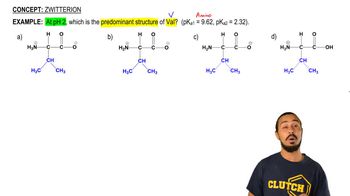
A dipolar molecule with both a positive and negative charge, resulting from acid-base reactions, predominating at physiological pH.
Amino Acid
A molecule with a central carbon, amino group, carboxyl group, hydrogen, and R group, forming the basis of proteins.
Physiological pH
A pH value around 7, typical of biological systems, where amino acids mainly exist in their zwitterion form.
Amino Group
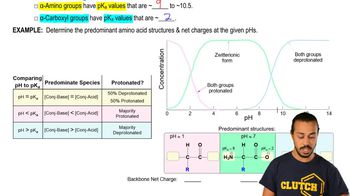
A functional group attached to the alpha carbon, carrying a positive charge when protonated, with a pKa around 9-10.5.
Carboxylate Group
A functional group on amino acids, carrying a negative charge when deprotonated, with a pKa near 2.
Alpha Carbon
The central carbon atom in amino acids, bonded to the amino group, carboxyl group, hydrogen, and R group.
R Group
The variable side chain in amino acids, determining their unique properties and classification.
pKa
A quantitative measure of acidic hydrogen strength; higher values indicate weaker acids, crucial for predicting protonation states.
Protonated Form
A state where a functional group has gained a hydrogen ion, often resulting in a positive or neutral charge.
Deprotonated Form
A state where a functional group has lost a hydrogen ion, often resulting in a negative or neutral charge.
Net Charge
The sum of all charges on a molecule, varying with pH and determining the molecule's overall electrical state.
Conjugate Acid
The species formed when a base gains a proton, predominating when pH is below the pKa.
Conjugate Base
The species formed when an acid loses a proton, predominating when pH is above the pKa.
Backbone
The main structural framework of amino acids, consisting of the alpha carbon, amino group, carboxyl group, and hydrogen.
Dipolar Molecule
A molecule with two regions of opposite charge, such as the zwitterion form of amino acids at physiological pH.
 BackBack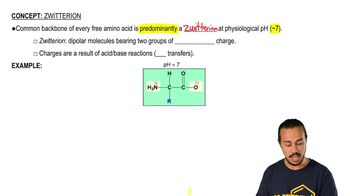
 02:22
02:22