Back

Zymogens definitions

Control buttons has been changed to "navigation" mode.
1/15
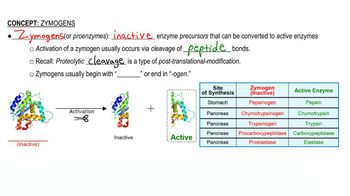
  • Zymogen

    Inactive precursor of an enzyme, stored in cells to prevent unwanted protein breakdown until activation by proteolytic cleavage.
  • Proenzyme

    Alternate name for an inactive enzyme precursor, requiring specific modification to become functional.
  • Proteolytic Cleavage

    Process involving peptide bond removal, transforming inactive enzyme precursors into their active forms.
  • Post-Translational Modification

    Cellular process altering proteins after synthesis, crucial for regulating enzyme activity and function.
  • Pepsinogen

    Inactive precursor stored in cells, later converted to a digestive enzyme active in the stomach.
  • Chymotrypsinogen

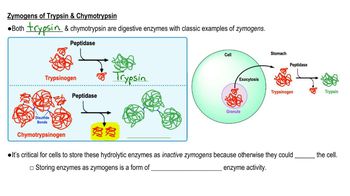
    Inactive form of a digestive enzyme, activated outside the cell to prevent self-digestion.
  • Trypsinogen

    Zymogen stored in vesicles, activated in the digestive tract to break down dietary proteins.
  • Peptidase

    Enzyme responsible for cleaving peptide bonds, often produced as inactive precursors to regulate activity.
  • Hydrolytic Enzyme

    Protein capable of breaking down molecules by hydrolysis, stored as inactive forms to protect cellular integrity.
  • Disulfide Bond

    Covalent linkage within proteins, remaining intact during activation of certain enzyme precursors.
  • Exocytosis

    Cellular mechanism for releasing stored proteins, such as zymogens, into the extracellular environment.
  • Granule

    Intracellular storage compartment where inactive enzyme precursors are kept before secretion.
  • Carboxypeptidase

    Digestive enzyme produced from an inactive precursor, involved in protein breakdown.
  • Elastase

    Active enzyme derived from a zymogen, functioning in the degradation of specific proteins.
  • Cellular Integrity

    State maintained by storing enzymes in inactive forms, preventing self-damage from premature enzyme activity.