 Back
BackAcids, Bases, and pH: Strength, Ionization, and Quantitative Analysis
Study Guide - Smart Notes
 Tailored notes based on your materials, expanded with key definitions, examples, and context.
Acids and Bases: Qualitative Strength
Strong vs. Weak Acids and Bases
Acids and bases are classified as strong or weak based on their degree of ionization in water. This classification is fundamental in biochemistry, as it influences reaction mechanisms, enzyme activity, and buffer systems.
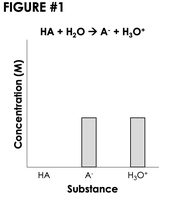
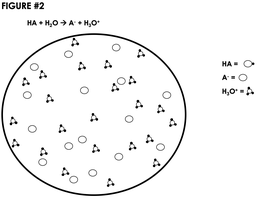
Strong Acid/Base: Completely ionizes or dissociates in aqueous solution, producing a high concentration of ions. Examples include HCl, HNO3, H2SO4 (acids) and NaOH, LiOH, Ca(OH)2 (bases).
Weak Acid/Base: Only partially ionizes in water, resulting in a lower concentration of ions. Examples include HC2H3O2, H3PO4, H2CO3 (acids) and NH3, Al(OH)3, Fe(OH)3 (bases).
Electrolyte Strength: Strong acids and bases are strong electrolytes due to complete ionization; weak acids and bases are weak electrolytes.
Example: Hydrochloric acid (HCl) in water dissociates completely, while acetic acid (CH3COOH) only partially dissociates.
Ionization of Weak Acids and Bases
Partial Ionization and Molecular Diagrams
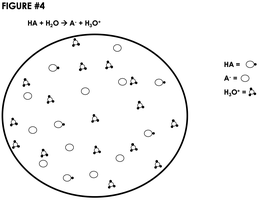
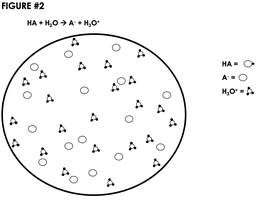
Weak acids and bases do not fully dissociate in water. The equilibrium between the undissociated and dissociated forms is a key concept in understanding buffer systems and enzyme catalysis in biochemistry.
Weak Acid: Releases only a few hydrogen ions (H3O+) in solution; most of the acid remains undissociated.
Weak Base: Releases only a few hydroxide ions (OH-) in solution; most of the base remains undissociated.
Example: Ammonia (NH3) in water forms a small amount of OH- and NH4+.
Quantitative Analysis: pH and pOH
pH Scale and Calculations
The pH scale quantitatively expresses the concentration of hydronium ions (H3O+) in solution, ranging from 0 (very acidic) to 14 (very basic). The lower the pH, the higher the acidity.
pH Formula:
Hydronium Ion Concentration:
Indicators: Chemical indicators change color at different pH values, allowing for visual estimation of acidity or basicity.
Example Calculation: For a solution with [H3O+] = 0.01 M:
(acidic solution)
pOH Scale and Calculations
The pOH scale expresses the concentration of hydroxide ions (OH-) in solution. The relationship between pH and pOH is fundamental for understanding acid-base balance in biological systems.
pOH Formula:
Hydroxide Ion Concentration:
Relationship:
Example Calculation: For a solution with pH = 8:
Summary Table: Strong vs. Weak Acids and Bases
Property | Strong Acid/Base | Weak Acid/Base |
|---|---|---|
Degree of Ionization | 100% (complete) | Less than 100% (partial) |
Electrolyte Strength | Strong electrolyte | Weak electrolyte |
Examples (Acids) | HCl, HNO3, H2SO4 | HC2H3O2, H3PO4, H2CO3 |
Examples (Bases) | NaOH, LiOH, Ca(OH)2 | NH3, Al(OH)3, Fe(OH)3 |
Additional info: Understanding acid and base strength is essential for predicting reaction direction, buffer capacity, and enzyme function in biological systems.
