 Back
Lecture 8-9: Allosterics
Study Guide - Smart Notes
 Tailored notes based on your materials, expanded with key definitions, examples, and context.
Allosteric Regulation of Hemoglobin
Allostery Defined
Allostery refers to the regulation of a protein's activity through the binding of a ligand at one site, which affects the binding properties at another site. Allosteric proteins can adopt multiple conformations, often induced by ligand binding or post-translational modifications. Hemoglobin (Hb) is a classic example of an allosteric protein, serving as a paradigm for understanding allosteric regulation in biochemistry.
Hemoglobin: Paradigm for Allosteric Regulation
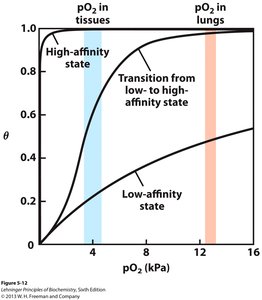
Hemoglobin is a tetrameric protein responsible for oxygen transport in blood. It exhibits cooperative binding, meaning the binding of oxygen to one subunit increases the affinity of the remaining subunits for oxygen. This property allows hemoglobin to efficiently load oxygen in the lungs and release it in tissues.
Cooperative Oxygen Binding and the Hill Equation
The cooperative binding of oxygen to hemoglobin is described by the Hill equation:
where is the fractional saturation, is the partial pressure of oxygen, is the partial pressure at which hemoglobin is 50% saturated, and is the Hill coefficient (for Hb, ). The sigmoidal shape of the oxygen binding curve reflects this cooperativity.
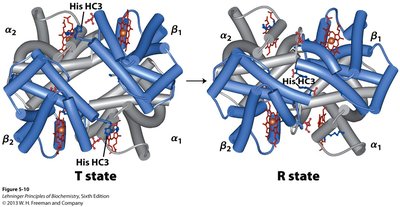
Structural Basis of Allostery: T and R States
Hemoglobin exists in two main conformational states:
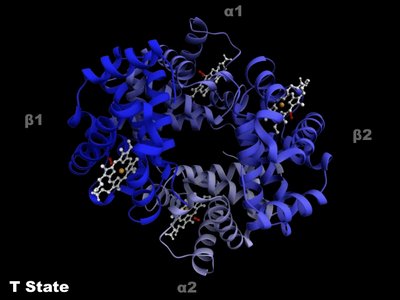
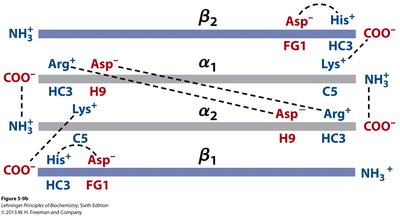
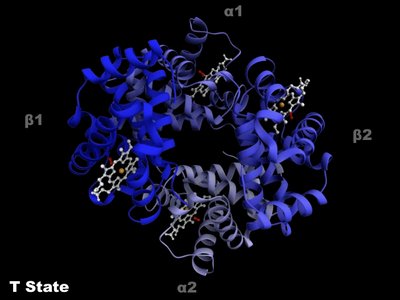
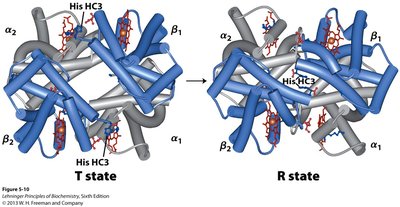
Tense (T) state: Low affinity for oxygen, stabilized by ionic interactions between subunits.
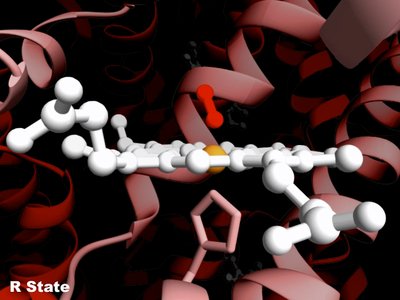
Relaxed (R) state: High affinity for oxygen, favored upon oxygen binding.
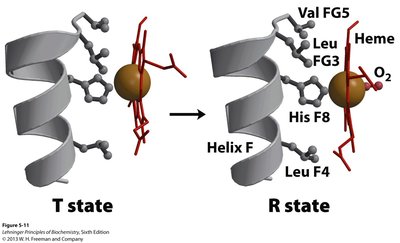
Oxygen binding induces a shift from the T to the R state, involving structural changes in the F-helix and heme environment.
Propagation of Conformational Changes
Binding of oxygen to one subunit affects the conformation of adjacent subunits, facilitating the transition to the R state. This is achieved through adjustments in the F-helix and changes in subunit-subunit interactions.
Homotropic and Heterotropic Effectors
Effectors are molecules that modulate protein activity:
Homotropic effectors: The ligand whose binding is affected is the same as the effector (e.g., O2 for hemoglobin).
Heterotropic effectors: The effector is different from the ligand whose binding is affected (e.g., H+, CO2, BPG for hemoglobin).
Bohr Effect: Regulation by pH and CO2
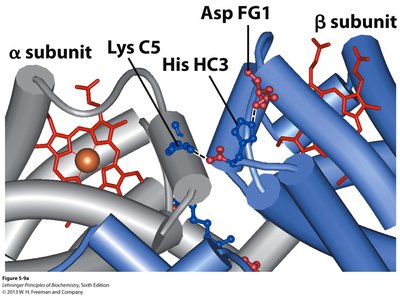
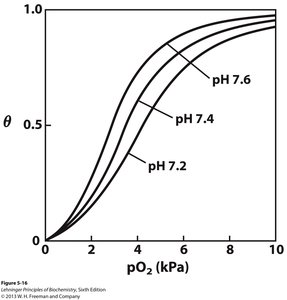
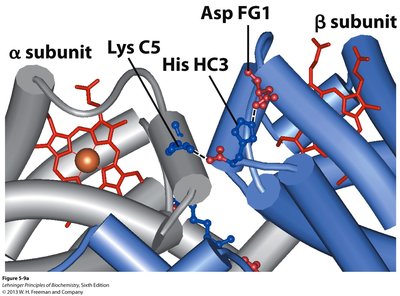
The Bohr effect describes how decreased pH (increased H+) and increased CO2 concentration promote the T state, lowering hemoglobin's affinity for oxygen and facilitating oxygen release in tissues. The major contribution is the ionization of a histidine residue at the C-terminus of the β chain, which is stabilized in the T state by nearby negative charges.
CO2 Binding and Additional Bohr Effect
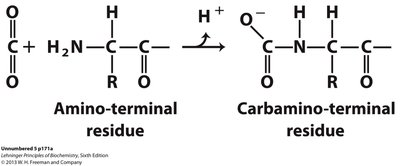
CO2 binds to the N-terminus of hemoglobin, forming carbamino-terminal residues and releasing H+. This further stabilizes the T state and promotes oxygen release in tissues.
Regulation by BPG (2,3-bisphosphoglycerate)
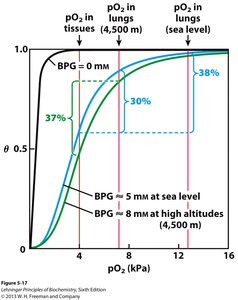
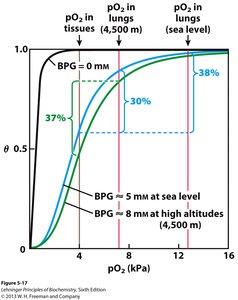
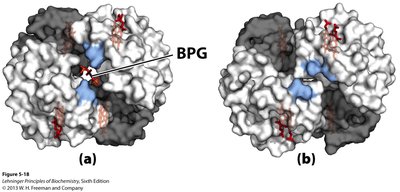
BPG is a negatively charged molecule that binds to a positively charged site in the T state of hemoglobin, stabilizing the T state and decreasing oxygen affinity. BPG levels increase at high altitude, facilitating oxygen release in tissues.
CO Poisoning: Allosteric Effects
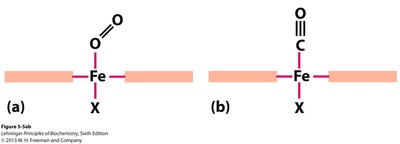
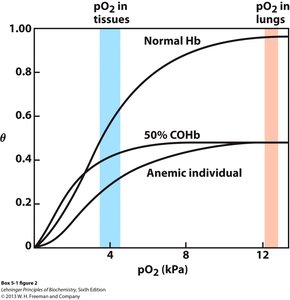
Carbon monoxide (CO) binds to the heme group in hemoglobin with much higher affinity than oxygen, occupying binding sites and reducing oxygen transport. CO binding is also allosteric, affecting the affinity of remaining sites for oxygen and causing a more hyperbolic binding curve.
Summary Table: Effectors and Hemoglobin States
Effector | Favored State | Effect on O2 Affinity |
|---|---|---|
O2 | R | Increases |
H+ (low pH) | T | Decreases |
CO2 | T | Decreases |
BPG | T | Decreases |
CO | R | Increases (but reduces O2 transport) |
Allostery as a General Mechanism
Allosteric regulation is a widespread mechanism in biochemistry, used by many proteins and enzymes to fine-tune their response to physiologically relevant ligand concentrations. Examples include IMP dehydrogenase and GTP-regulated enzymes.
Fetal Hemoglobin and BPG
Fetal hemoglobin (HbF, α2γ2) binds BPG with lower affinity than adult hemoglobin (HbA, α2β2). This allows the fetus to have higher oxygen affinity, facilitating oxygen transfer from mother to fetus. BPG crosses the placenta, but the difference in affinity ensures efficient oxygen delivery.
Key Equations and Concepts
Hill Equation:
Bohr Effect: Lower pH and higher CO2 promote T state and oxygen release.
BPG Regulation: Increased BPG stabilizes T state, decreases O2 affinity, and adapts hemoglobin function to altitude.
Example: At high altitude, increased BPG levels shift the oxygen binding curve to the right, promoting oxygen release in tissues despite lower atmospheric oxygen.
Additional info: The notes expand on the structural and functional aspects of hemoglobin allostery, including the physiological relevance of effectors and the adaptation to environmental changes.
