 Back
BackAmino Acids: Structure, Stereochemistry, and Properties
Study Guide - Smart Notes
 Tailored notes based on your materials, expanded with key definitions, examples, and context.
Amino Acids: The Building Blocks of Proteins
General Structure of α-Amino Acids
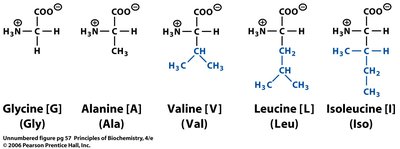
Amino acids are organic molecules that serve as the fundamental building blocks of proteins. Each amino acid contains a central (α) carbon atom bonded to four distinct groups: an amino group (–NH2), a carboxyl group (–COOH), a hydrogen atom, and a unique side chain (R group) that determines the amino acid's identity and properties.
α-Carbon: The central carbon atom to which all functional groups are attached.
Amino Group: Acts as a weak base and can participate in hydrogen bonding and peptide bond formation.
Carboxyl Group: Acts as a weak acid, resonance stabilized, and participates in peptide bond formation.
Side Chain (R group): Unique for each amino acid, conferring specific chemical properties.
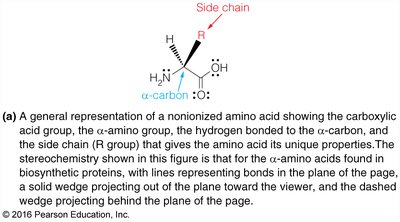
Example: Glycine (R = H) is the simplest amino acid, while tryptophan (R = indole group) is one of the most complex.
Numbering of Carbon Atoms in Amino Acids
The carbon atoms in amino acids are labeled using Greek letters, starting from the carboxyl group. The α-carbon is the first carbon atom attached to the carboxyl group, followed by β, γ, etc.
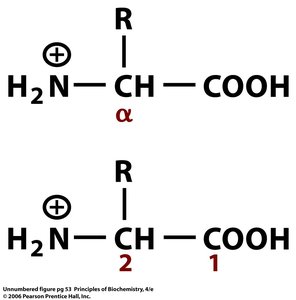
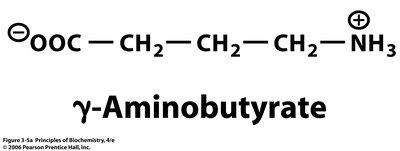
Example: In γ-aminobutyric acid (GABA), the amino group is attached to the γ-carbon.
Chemistry of the Carboxyl and Amino Groups
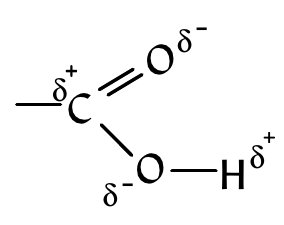
The carboxyl group is polar, resonance stabilized, and acts as a weak acid with a typical pKa of 1.8–2.4. The amino group is also polar, acts as a weak base, and has a typical pKa of 9.0–10.7. Both groups can participate in non-covalent interactions such as hydrogen bonds, ion-dipole, and dipole-dipole interactions.

Zwitterions and Amphoteric Nature
At physiological pH (~7), amino acids exist as zwitterions, where the carboxyl group is deprotonated (–COO–) and the amino group is protonated (–NH3+). This dual ionization allows amino acids to act as buffers and ampholytes (amphoteric compounds).
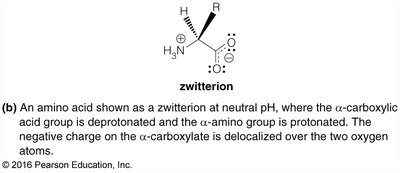
Key Point: The zwitterionic form is electrically neutral but contains both positive and negative charges.
Stereochemistry and Chirality of Amino Acids
Chirality and Stereocenters
All amino acids (except glycine) have a chiral α-carbon, meaning it is attached to four different groups. This gives rise to two possible stereoisomers (enantiomers): L- and D-forms. In proteins, only L-amino acids are found.
Chiral Center: A carbon atom bonded to four different groups.
Enantiomers: Non-superimposable mirror images (like left and right hands).
Optical Activity: Enantiomers rotate plane-polarized light in opposite directions.
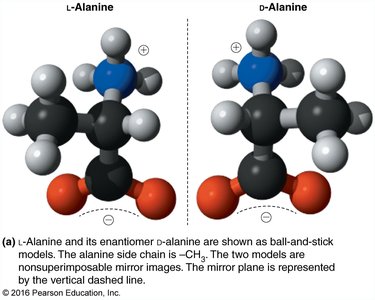
Example: L-alanine and D-alanine are enantiomers; only L-alanine is incorporated into proteins.
Fischer Projections and Configuration Assignment
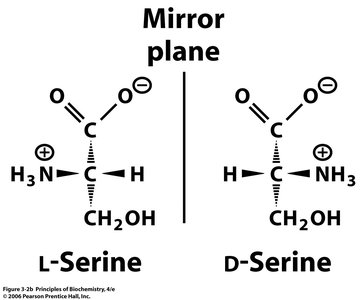
Fischer projections are used to represent the stereochemistry of amino acids and sugars. The configuration is assigned by comparing the arrangement to reference molecules (glyceraldehyde for sugars, serine for amino acids).
L-isomer: Amino group on the left in Fischer projection.
D-isomer: Amino group on the right in Fischer projection.
Number of Stereoisomers
The number of possible stereoisomers for a molecule with n chiral centers is given by the formula:
where n is the number of chiral carbon atoms.
Example: Isoleucine has two chiral centers, resulting in four possible stereoisomers.

Biological Importance of L-Amino Acids
Functional Consequences of Chirality
The exclusive use of L-amino acids in proteins imparts asymmetry to protein structure, which is critical for specific molecular recognition and function. This chirality enables precise interactions such as enzyme-substrate binding, receptor-ligand recognition, and the formation of regular secondary structures (α-helices and β-sheets).
Specificity: Only one enantiomer fits the active site of enzymes or receptors.
Secondary Structure: Chirality promotes the formation of α-helices and β-strands in proteins.
Practice: Assigning Configuration
Exercise
Given the Fischer projections below, assign the configuration (L, D, or achiral) to each amino acid:
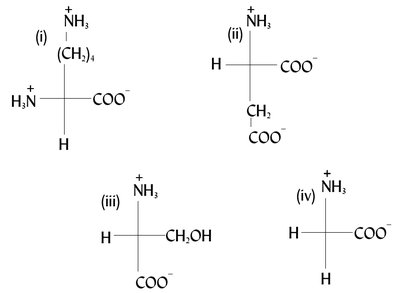
(i) L
(ii) L
(iii) D
(iv) Achiral (glycine)
Summary Table: Key Properties of Amino Acids
Property | Description |
|---|---|
Chirality | All except glycine are chiral; L-isomers predominate in proteins |
Zwitterion Formation | At neutral pH, amino acids exist as zwitterions |
Buffering Capacity | Can act as buffers due to amphoteric nature |
Peptide Bond Formation | Carboxyl and amino groups form peptide bonds in proteins |
Optical Activity | Enantiomers rotate plane-polarized light in opposite directions |
