 Back
BackAtoms and Elements: Foundations of Biochemistry
Study Guide - Smart Notes
 Tailored notes based on your materials, expanded with key definitions, examples, and context.
Atoms and Elements of Life
Essential Elements for Human Health
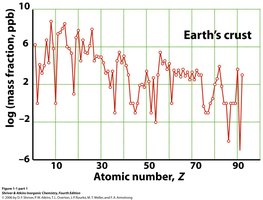
Biochemistry focuses on the elements that are essential for life, which are fewer than 30. These elements are selected based on their abundance in the Earth's crust and their physical and chemical properties, which determine their bioavailability. For example, iron (Fe) is abundant, but many Fe(III) compounds are insoluble in water, making them difficult to absorb.
Key Point: Life relies on abundant and bioavailable elements.
Key Point: Physical and chemical properties influence element selection.
Example: Iron's solubility affects its absorption in biological systems.
Atomic Structure
Basic Structure of the Atom
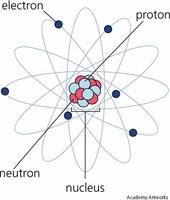
An atom consists of a nucleus containing protons and neutrons, surrounded by electrons in orbitals. The atomic number is the number of protons (and electrons in a neutral atom), while the mass number is the sum of protons and neutrons.
Key Point: Atomic number defines the element.
Key Point: Mass number varies due to different numbers of neutrons.
Example: Carbon-12 and Carbon-13 are isotopes of carbon.
Seeing Atoms
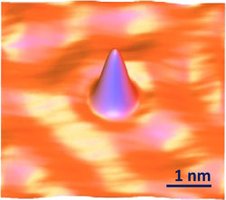
Atoms can be visualized using advanced techniques such as Scanning Tunneling Microscopy (STM), which provides topographic images at the atomic scale.
Key Point: STM allows direct observation of individual atoms.
Isotopes and Radioactivity
Isotopes
Isotopes are atoms of the same element with different mass numbers due to varying numbers of neutrons. Isotope abundances affect the relative atomic mass, which is a weighted average based on natural occurrence.
Key Point: Isotopes have identical atomic numbers but different mass numbers.
Key Point: Relative atomic mass is not a whole number due to isotope mixtures.
Example: Chlorine has isotopes Cl-35 and Cl-37, leading to an average atomic mass of 35.5.
Radioactivity and Nuclear Stability
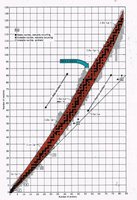
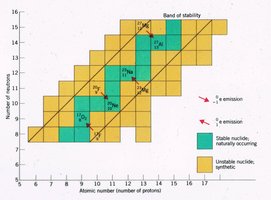
Some isotopes are unstable (radioisotopes) and undergo radioactive decay, emitting alpha, beta, gamma particles, or positrons. Stable isotopes persist indefinitely, while unstable ones have characteristic half-lives.
Key Point: Radioactive decay changes the chemical identity of the atom.
Key Point: Half-life (t1/2) is the time for 50% of a sample to decay.
Example: C-14 has a half-life of 5730 years, used in radiocarbon dating.
Counting Atoms: The Mole Concept
Avogadro's Number and the Mole
The mole is a fundamental unit in chemistry, representing 6.022×10²³ entities (Avogadro's number). This allows chemists to relate atomic-scale measurements to macroscopic quantities.
Key Point: 1 mole contains 6.022×10²³ atoms, molecules, or ions.
Key Point: Molar mass (g/mol) links mass to number of moles.
Example: 12 g of carbon-12 contains 1 mole of atoms.
Atomic Structure and Electronic Configuration
Electronic Structure of the Atom
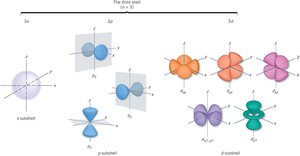
Electrons are arranged in shells and subshells around the nucleus. The Bohr model describes electrons in fixed orbits, but the quantum mechanical model uses orbitals defined by wavefunctions (ψ), with s, p, d, and f types.
Key Point: Electrons occupy energy levels (shells) and subshells (orbitals).
Key Point: Quantum mechanics replaces classical orbits with probability-based orbitals.
Orbital Energies and Electron Filling
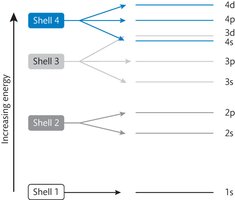
Orbital energies are determined by the principal quantum number (n) and subshell type. Electrons fill orbitals according to the Aufbau Principle (lowest energy first), Pauli Exclusion Principle (max two electrons per orbital, opposite spins), and Hund's Rule (electrons fill degenerate orbitals singly first).
Key Point: s < p < d < f in energy within a shell.
Key Point: Electron configuration explains chemical properties and periodic table structure.
Periodic Table and Group Similarities
Periodic Table Structure
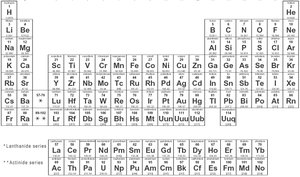
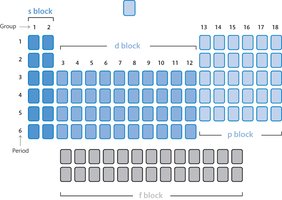
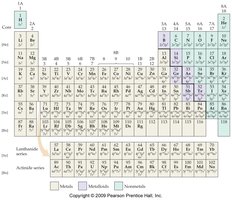
The periodic table organizes elements by increasing atomic number and groups elements with similar electronic configurations and chemical properties. The structure reflects the filling of s, p, d, and f orbitals.
Key Point: Elements in the same group have similar valence electron configurations.
Key Point: Periodic trends arise from electronic structure.
Summary Table: Key Atomic Properties
Property | Definition | Example |
|---|---|---|
Atomic Number | Number of protons in nucleus | Carbon: 6 |
Mass Number | Protons + Neutrons | Carbon-12: 12 |
Isotope | Same atomic number, different mass number | C-12, C-13 |
Relative Atomic Mass | Weighted average of isotopes | Cl: 35.5 |
Mole | 6.022×10²³ entities | 12 g C-12 = 1 mol |
Orbital | Region of space for electrons | 1s, 2p, 3d |
Key Equations
Mass of atom:
Avogadro's number:
Mole calculation:
