 Back
BackBiochemistry Exam 3 Review: Membrane Transport, Signal Transduction, Metabolic Regulation, and Key Pathways
Study Guide - Smart Notes
 Tailored notes based on your materials, expanded with key definitions, examples, and context.
Membrane Proteins and Transport
Types of Protein Channels
Membrane proteins facilitate the movement of molecules across biological membranes. There are three main types of protein channels, each with a distinct method of transport:
Uniprot: Transports a single type of molecule in one direction across the membrane.
Symport: Simultaneously transports two different molecules in the same direction.
Antiport: Transports two different molecules in opposite directions.
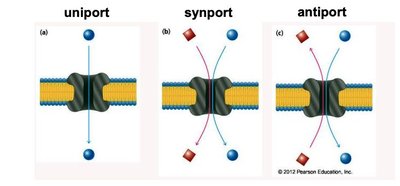
Example: The sodium-glucose symporter uses the sodium gradient to import glucose into cells.
Primary vs. Secondary Active Transport
Active transport moves molecules against their concentration gradients, requiring energy input. There are two main types:
Primary Active Transport: Directly uses ATP to transport molecules against their gradient (e.g., Na+/K+ ATPase).
Secondary Active Transport: Does not use ATP directly. Instead, it relies on the gradient established by primary active transport to drive the movement of other molecules (e.g., sodium-glucose symporter).
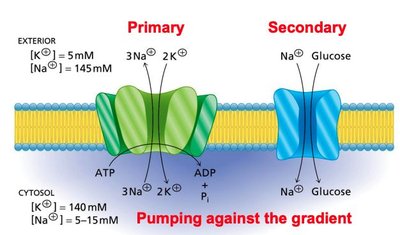
Example: The Na+/K+ pump creates a sodium gradient, which is then used by the sodium-glucose symporter to import glucose into the cell.
Signal Transduction Pathways
Overview of Signal Transduction
Signal transduction pathways allow cells to respond to external signals through a series of molecular events. Key components include:
First Messenger: The extracellular signaling molecule (e.g., hormone).
Receptor: Protein on the cell surface or inside the cell that binds the first messenger.
Transducer: Molecule that relays the signal from the receptor to downstream effectors (often G proteins).
Effector Enzyme: Enzyme activated by the transducer that generates second messengers.
Second Messenger: Small intracellular molecules that propagate the signal (e.g., cAMP, Ca2+).
Example: In the classic G protein-coupled receptor (GPCR) pathway, a hormone (first messenger) binds the receptor, activating a G protein (transducer), which then activates adenylyl cyclase (effector enzyme) to produce cAMP (second messenger).
Receptor Tyrosine Kinase Pathway
Receptor tyrosine kinases (RTKs) are another major class of signal transduction receptors. Upon ligand binding, RTKs dimerize and autophosphorylate, initiating downstream signaling cascades such as the MAP kinase pathway.
Example: The insulin receptor is an RTK that triggers glucose uptake and metabolism in response to insulin.
Insulin and Glucagon: Regulation of Glycogen Metabolism
Hormonal Regulation
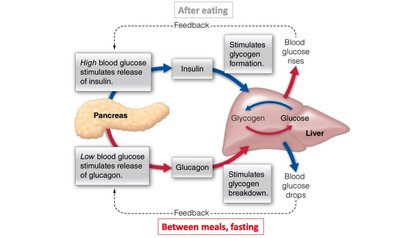
Insulin and glucagon are peptide hormones that regulate blood glucose levels by controlling glycogen metabolism:
Insulin: Secreted after eating; promotes glycogen synthesis (glycogenesis) to store excess glucose.
Glucagon: Secreted during fasting; promotes glycogen breakdown (glycogenolysis) to release glucose.
Enzyme Regulation by Phosphorylation
Glycogen Synthase: Activated by insulin (dephosphorylation); synthesizes glycogen.
Glycogen Phosphorylase: Activated by glucagon (phosphorylation); breaks down glycogen.
Phosphorylation generally activates glycogen phosphorylase and inactivates glycogen synthase. Insulin promotes dephosphorylation, while glucagon promotes phosphorylation of these enzymes.
Responsive Cell Types: Liver, adipocytes, and kidney cells respond to glucagon.
Memorization Trick
"Hungry → Need Glucose → Glucagon → Kinases → Add Phosphates → Turns on Glycogen Phosphorylase, turns off Glycogen Synthase → Glycogen breakdown."
"Full → Abundance of glucose → Insulin → Phosphatases → Remove Phosphates → Turns on Glycogen Synthase, turns off Glycogen Phosphorylase → Glycogen synthesis."
This logic also applies to the regulation of glycolysis and gluconeogenesis.
Pentose Phosphate Pathway (Shunt)
Main Role and Products
The pentose phosphate pathway (PPP) is an alternative glucose oxidation pathway with two primary functions:
Generates NADPH for anabolic reactions (e.g., fatty acid synthesis, antioxidant defense).
Produces pentose phosphates for nucleotide synthesis.
Fates of PPP Sugars:
Used to make ribose for nucleotides.
Regenerated to glucose-6-phosphate for more NADPH production.
Broken down through glycolysis for energy.
Lactic Acid Fermentation and the Cori Cycle
Lactic Acid Fermentation
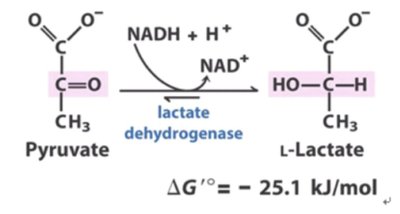
Under anaerobic conditions, pyruvate is reduced to lactate by the enzyme lactate dehydrogenase, regenerating NAD+ for glycolysis:

This is a reduction reaction (pyruvate is reduced to lactate).
The Cori Cycle
The Cori cycle describes the metabolic pathway where lactate produced by anaerobic glycolysis in muscles is transported to the liver, converted back to glucose via gluconeogenesis, and returned to the muscles for energy use.
Fatty Acids and Glycerophospholipids
Fatty Acid Structure
Fatty acids are long hydrocarbon chains with a terminal carboxyl group. Important features include:
Alpha (α) carbon: The first carbon after the carboxyl group.
Beta (β) carbon: The second carbon after the carboxyl group.
Omega (ω) carbon: The last carbon in the chain; omega-3 refers to a double bond three carbons from the end.
Example: Docosapentaenoic acid (DPA, 22:5, Δ7,10,13,16,19) is a polyunsaturated fatty acid with 22 carbons and five double bonds.
Glycerophospholipids
Glycerophospholipids are major components of cell membranes. They consist of:
A glycerol backbone
A phosphate-containing polar head group on C3
A saturated acyl chain on C1
A usually monounsaturated (cis) acyl chain on C2
They form bilayers, unlike fatty acids, which form micelles. Glycerophospholipids are major constituents of plant and animal membranes.

Hexokinase Isozymes
Hexokinase 1 vs. Hexokinase 4 (Glucokinase)
Hexokinases catalyze the phosphorylation of glucose to glucose-6-phosphate, the first step in glycolysis. There are several isozymes with distinct properties:
Feature | Hexokinase 1 | Hexokinase 4 (Glucokinase) |
|---|---|---|
Location | All tissues | Liver and Pancreas |
Active at | Low glucose concentration | High glucose concentration |
Example: Hexokinase 1 ensures glucose phosphorylation even at low concentrations, while Hexokinase 4 allows the liver to respond to high blood glucose after meals.
