 Back
BackBiochemistry Foundations: Chemistry, Water, Carbon, Macromolecules, and Statistical Analysis
Study Guide - Smart Notes
 Tailored notes based on your materials, expanded with key definitions, examples, and context.
Introduction to Biochemistry
Chemistry Basics
Biochemistry is the study of the chemical processes and substances that occur within living organisms. Understanding the basic chemistry underlying biological molecules is essential for grasping more advanced biochemistry concepts.
Atom: The smallest unit of an element, maintaining its chemical properties.
Subatomic Particles: Protons (positive, nucleus), neutrons (neutral, nucleus), electrons (negative, electron cloud).
Molecule: Two or more atoms covalently bonded together.
Valence Electrons: Electrons in the outermost shell, crucial for chemical bonding.
Chemical Bonds: Covalent (sharing electrons), ionic (transfer of electrons), hydrogen bonds (weak attractions between polar molecules), van der Waals interactions (temporary attractions).
Example: Water (H2O) is a molecule formed by covalent bonds between hydrogen and oxygen.
Water
Biochemistry of Water
Water is fundamental to life, making up over 70% of most organisms. Its unique properties arise from its molecular structure and polarity.
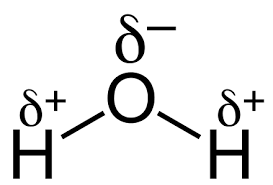
Polar Molecule: Water has a bent shape, with oxygen being more electronegative, resulting in partial charges.
Hydrogen Bonds: Water molecules form hydrogen bonds, leading to high specific heat, cohesion, adhesion, and expansion upon freezing.
High Specific Heat: Water resists temperature changes, helping organisms maintain homeostasis.
Universal Solvent: Water dissolves many substances, facilitating transport of nutrients and waste.
Heat of Vaporization: High energy required for evaporation, enabling cooling mechanisms like sweating.
Cohesion and Adhesion: Water molecules stick to each other and to other surfaces, important for processes like transpiration in plants.
Expansion Upon Freezing: Ice is less dense than liquid water, allowing it to float and insulate aquatic life.
Example: Water's polarity enables it to dissolve salts and polar molecules, crucial for biological functions.
Carbon
Biochemistry: Carbon Properties
Carbon is the backbone of organic molecules, forming the basis of life. Its versatility allows for the creation of diverse macromolecules.
Organic Chemistry: Study of carbon-containing compounds.
Four Valence Electrons: Carbon can form four covalent bonds, enabling complex structures.
Small Size: Strong covalent bonds due to proximity of valence electrons to the nucleus.
Abundance: Carbon is plentiful on Earth, making it ideal for life's building blocks.
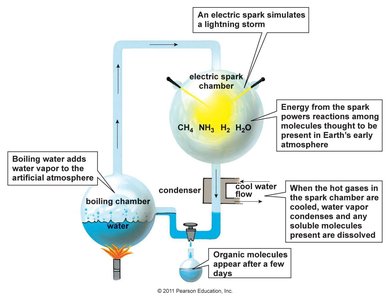
Miller-Urey Experiment: Demonstrated that organic molecules can be synthesized from inorganic precursors under early Earth conditions.
Example: Carbon forms the backbone of carbohydrates, lipids, proteins, and nucleic acids.
Macromolecules
Carbohydrates
Carbohydrates are essential for energy storage and structural support in living organisms.
Monosaccharides: Simple sugars (e.g., glucose, fructose).
Polysaccharides: Complex carbohydrates formed by linking monosaccharides (e.g., starch, glycogen, cellulose, chitin).
Functions: Energy storage (starch, glycogen), structural support (cellulose, chitin).
Example: Cellulose is a structural polysaccharide in plant cell walls, difficult to digest due to extensive hydrogen bonding.
Lipids
Lipids are hydrophobic molecules, including fats, oils, waxes, and steroids, important for energy storage, membrane structure, and signaling.
Fatty Acids and Glycerol: Basic building blocks of triglycerides.
Saturated vs. Unsaturated Fats: Saturated fats have no double bonds, are solid at room temperature; unsaturated fats have double bonds, are liquid at room temperature.
Phospholipids: Amphipathic molecules forming cell membranes.
Steroids: Lipids with four carbon rings, functioning as hormones and membrane components.
Example: Cholesterol is a steroid that maintains cell membrane flexibility.
Proteins
Proteins are polymers of amino acids, performing a wide range of functions including catalysis, structure, transport, and regulation.
Amino Acids: Monomers with a central carbon, carboxyl group, amine group, and variable R group.
Peptide Bonds: Covalent bonds linking amino acids.
Levels of Structure:
Primary: Sequence of amino acids.
Secondary: Local folding (alpha helix, beta sheet) via hydrogen bonds.
Tertiary: Overall 3D shape stabilized by disulfide bridges, ionic, and hydrophobic interactions.
Quaternary: Assembly of multiple polypeptide chains (e.g., hemoglobin).
Denaturation: Loss of structure and function due to environmental changes (pH, temperature, salt).
Example: Enzymes are proteins that catalyze biochemical reactions.
Nucleic Acids
Nucleic acids store and transmit genetic information and energy. DNA and RNA are polymers of nucleotides, while ATP is a nucleotide used for energy transfer.
Nucleotide: Composed of a pentose sugar, phosphate group, and nitrogenous base.
DNA: Double-stranded, stores genetic information.
RNA: Single-stranded, involved in protein synthesis.
ATP: Energy currency of the cell.
Example: DNA codes for proteins, RNA transmits instructions, ATP powers cellular activities.
Data Analysis and Statistics in Biochemistry
Descriptive Statistics
Statistical analysis is essential for interpreting experimental data in biochemistry. Descriptive statistics summarize data sets and provide measures of central tendency and variability.
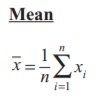
Mean (x̄): Average value of a sample.
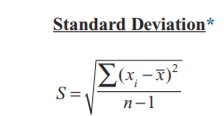
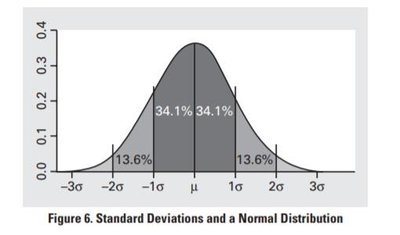
Standard Deviation (S): Measures spread of data around the mean.
Standard Error (SEx): Estimates how well the sample mean represents the population mean.
Formulas:
Mean:
Standard Deviation:
Standard Error:

Inferential Statistics
Inferential statistics allow researchers to draw conclusions about populations based on sample data. Common tests include the chi-square test and t-test.
Chi-Square Test: Compares observed and expected frequencies to determine if differences are due to chance.
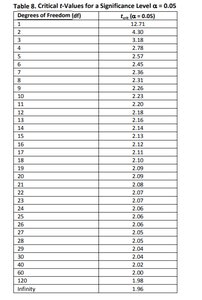
t-Test: Compares means of two groups to assess statistical significance.
p-Value: Probability that observed differences are due to random chance. A p-value less than 0.05 indicates statistical significance.
Formulas:
Chi-Square:
t-Test:

Graphing and Error Bars
Graphs visually represent data, showing relationships and trends. Error bars indicate variability and confidence intervals, helping to assess statistical significance.
Bar Graphs: Compare means of groups.
Error Bars: Show 95% confidence intervals (±2 SEx).
Interpretation: Overlapping error bars suggest no significant difference; non-overlapping bars indicate significance.

Biogeochemical Cycles
Water Cycle
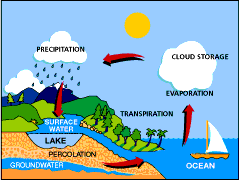
The water cycle describes the movement of water through evaporation, condensation, precipitation, and transpiration, supporting life and regulating climate.

Nitrogen and Phosphorus Cycles
Nitrogen and phosphorus are essential elements cycled through ecosystems, supporting the synthesis of proteins, nucleic acids, and other biomolecules.
Nitrogen Cycle: Involves nitrogen fixation, nitrification, denitrification, and ammonification.
Phosphorus Cycle: Phosphorus moves from rocks to soil and water, then into organisms and back to the environment.
Example: Nitrogen is required for amino acids and nucleic acids; phosphorus is needed for ATP and DNA.
Summary Table: Macromolecules
Macromolecule | Monomer | Function | Example |
|---|---|---|---|
Carbohydrate | Monosaccharide | Energy, Structure | Glucose, Cellulose |
Lipid | Fatty Acid & Glycerol | Energy, Membranes, Signaling | Triglyceride, Cholesterol |
Protein | Amino Acid | Catalysis, Structure, Transport | Enzyme, Hemoglobin |
Nucleic Acid | Nucleotide | Genetic Information, Energy | DNA, ATP |
Additional info: This guide expands brief notes into full academic explanations, includes relevant formulas, and provides context for biochemistry students preparing for exams.
