 Back
Lecture 1: Introduction to Protein Structure & Metabolism
Study Guide - Smart Notes
 Tailored notes based on your materials, expanded with key definitions, examples, and context.
Introduction to Biochemistry
Biology and the Laws of Thermodynamics
Biochemistry is the study of the chemical processes that occur within living organisms. Biological systems follow the laws of thermodynamics, which govern energy transformations and the direction of chemical reactions.
Order vs. Entropy: Living systems are highly ordered and require energy input to oppose entropy (disorder).
Work and Energy: Maintaining biological order requires continuous work and energy expenditure.
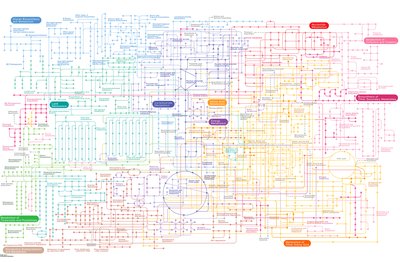
Biochemical Pathways: Reactions are organized into complex, interconnected pathways to efficiently manage energy and resources.
Application: Understanding biochemistry is foundational for fields such as cell biology, medicine, and pharmacology.
Water and Aqueous Environments
Biochemical Reactions in Water
Most biochemical reactions occur in aqueous environments, making water's properties essential for life.
Solvent Properties: Water dissolves ions and polar molecules, facilitating biochemical reactions.
Hydrogen Bonding: Water's ability to form hydrogen bonds influences protein folding, enzyme activity, and membrane structure.
pH Dependence: The protonation state of biomolecules is sensitive to pH, affecting their structure and function.
Thermodynamics in Biochemistry
Free Energy and Spontaneity
Biochemical reactions are governed by changes in free energy (G), which determines whether a reaction is spontaneous.
Free Energy (G): The energy available to do work in a system.
Spontaneous Reactions: Occur when ΔG is negative; not all spontaneous reactions are fast.
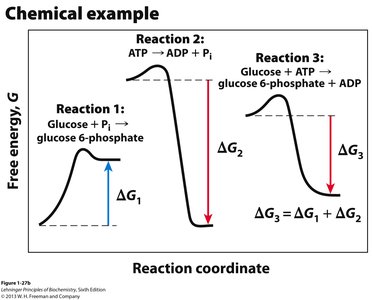
Coupled Reactions: Non-spontaneous reactions can be driven by coupling to spontaneous reactions, such as ATP hydrolysis.
Example: Glucose phosphorylation is coupled to ATP hydrolysis to make the reaction energetically favorable.
Enzymes and Enzyme Kinetics
Role of Enzymes in Biochemical Reactions
Enzymes are biological catalysts that accelerate reactions by lowering activation energy without altering the free energy change.
Specificity: Enzymes are highly specific for their substrates.
Regulation: Enzyme activity is tightly regulated to meet cellular needs.
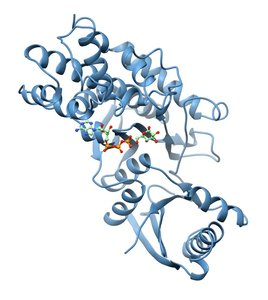
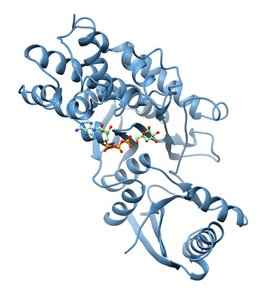
Example: Glucokinase catalyzes the phosphorylation of glucose in glycolysis.
pH and Buffering in Biochemistry
Importance of pH in Biological Systems
Biochemical processes are highly pH-dependent. The protonation state of biomolecules affects their structure and function, and cells must maintain optimal pH for proper activity.
pH Sensitivity: Protein structure and enzyme activity can be altered by changes in pH.
Examples: Different cellular compartments have distinct pH values (e.g., cytoplasm pH 7, lysosomes pH 4.8).
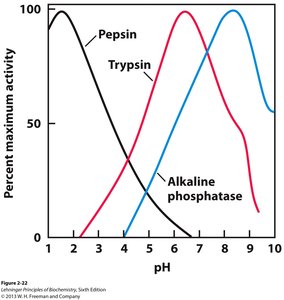
Enzyme Activity: Enzymes have optimal pH ranges for activity.
Buffers in Biochemistry
How Buffers Work
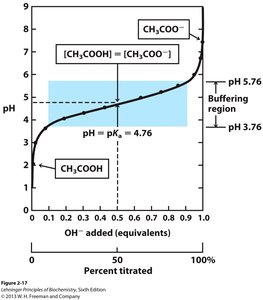
Buffers are solutions that resist changes in pH upon addition of acid or base. They are essential for maintaining stable pH in biological systems.
Weak Acid/Conjugate Base Pairs: Buffers consist of a weak acid and its conjugate base.
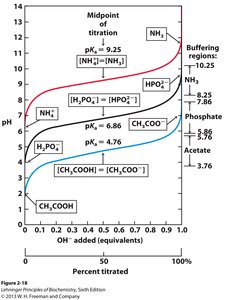
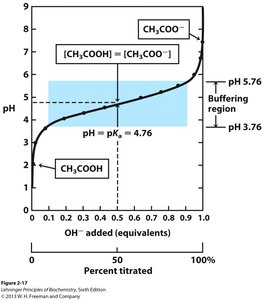
Buffering Range: Maximum buffering occurs within ±1 pH unit of the buffer's pKa.
Henderson-Hasselbalch Equation: Describes the relationship between pH, pKa, and the ratio of conjugate base to acid.
Henderson-Hasselbalch Equation:
Buffering Capacity and Equivalents
The buffering capacity depends on the concentration of the buffer components and the proximity to the pKa.
Equivalents: The mole fraction of species indicates how many equivalents of strong base or acid have been added.
Buffering Capacity: Defined by the sum of acid and conjugate base concentrations.
Biological Buffers: Blood Buffering System
Blood pH is tightly regulated by dynamic buffering systems, primarily the carbonic acid-bicarbonate system.
Carbonic Acid-Bicarbonate System: Involves three equilibria: acid/base, hydration/dehydration, and solution/gas.
Physiological pH: Blood pH is maintained around 7.4; large deviations are dangerous.
Modified Henderson-Hasselbalch Equation: Used for blood buffering:
Summary Table: Buffer Systems and Properties
The following table summarizes key buffer systems, their pKa values, and buffering regions:
Buffer System | pKa | Buffering Region (pH) |
|---|---|---|
Acetate | 4.76 | 3.76 - 5.76 |
Phosphate | 6.86 | 5.86 - 7.86 |
Ammonium | 9.25 | 8.25 - 10.25 |
Key Equations and Concepts
Henderson-Hasselbalch Equation:
Blood Buffer Equation:
Buffering Capacity: Maximum within ±1 pH unit of pKa.
Biochemical Reactions: Often linked and catalyzed by enzymes; occur in aqueous, pH-dependent environments.
Conclusion
Understanding thermodynamics, pH, and buffering is essential for mastering biochemistry. These concepts underpin the structure, function, and regulation of biomolecules and metabolic pathways, forming the foundation for advanced study in biological and medical sciences.
