 Back
BackLEC 16 Bioenergetics and Carbohydrate Chemistry: Metabolism, Monosaccharides, and Isomerism
Study Guide - Smart Notes
 Tailored notes based on your materials, expanded with key definitions, examples, and context.
Bioenergetics and Metabolism
Introduction to Metabolism
Metabolism encompasses the sum of all chemical reactions that occur within living organisms to maintain life. These reactions are organized into metabolic pathways, which allow cells to capture and utilize energy from nutrients or light, primarily in the form of ATP and proton motive force.
Catabolism: Degradative pathways that break down molecules to release energy.
Anabolism: Biosynthetic pathways that consume energy to build complex molecules.
Metabolic Diversity: Organisms are classified as phototrophs (using light energy) or heterotrophs (using organic molecules for energy).
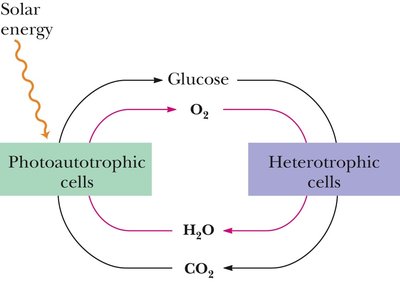
Metabolic Maps and Pathways
Metabolic maps visually represent the complex network of biochemical reactions and intermediates in cells. Each dot typically represents a metabolite, and each line an enzyme-catalyzed reaction.
Central pathways such as glycolysis and the citric acid cycle are highly interconnected and serve as metabolic hubs.
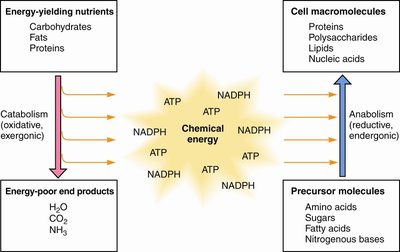
Catabolic pathways converge to a few end products (e.g., CO2, H2O, NH3), while anabolic pathways diverge to synthesize a variety of biomolecules.
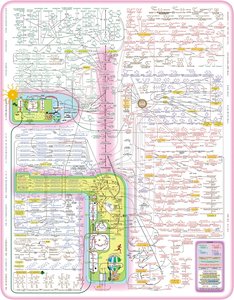
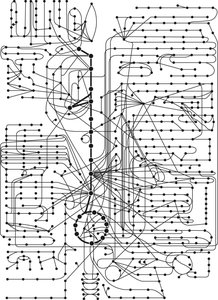
Analysis of Metabolic Maps
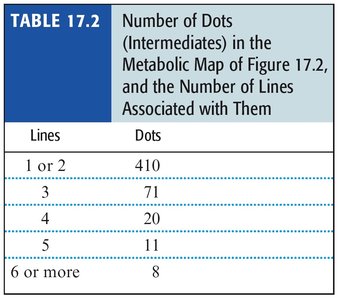
Metabolic maps can be analyzed by counting the number of connections (lines) each intermediate (dot) has, which reflects its role in metabolism.
Lines | Dots |
|---|---|
1 or 2 | 410 |
3 | 71 |
4 | 20 |
5 | 11 |
6 or more | 8 |
Catabolism and Anabolism: Core Processes
Catabolic and anabolic pathways are interrelated but distinct. Catabolic pathways break down macromolecules into smaller units, releasing energy, while anabolic pathways use energy to synthesize complex molecules from simpler precursors.
Catabolic pathways converge to a few end products through three main stages: breakdown of macromolecules, conversion to acetyl-CoA, and oxidation to CO2, H2O, and NH3.
Anabolic pathways diverge to produce a wide variety of biomolecules.
Some pathways are amphibolic, serving both catabolic and anabolic functions (e.g., the TCA cycle).
Regulation and Compartmentalization of Metabolic Pathways
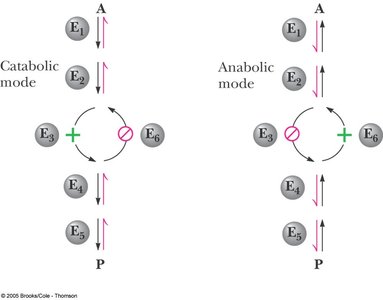
Metabolic pathways are regulated to ensure efficiency and prevent futile cycles. Regulation is achieved by:
Using different enzymes for irreversible steps in catabolic and anabolic pathways.
Compartmentalizing pathways within different cellular organelles.
Reciprocal regulation: activation of one pathway is accompanied by inhibition of the opposing pathway.
Carbohydrates: Structure and Classification
Overview of Carbohydrates
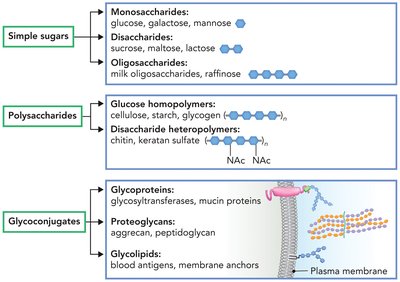
Carbohydrates, also known as glycans, are the most abundant organic molecules in nature. Their general formula is (CH2O)n, where n = 3 or more. They are classified based on their structure and complexity:
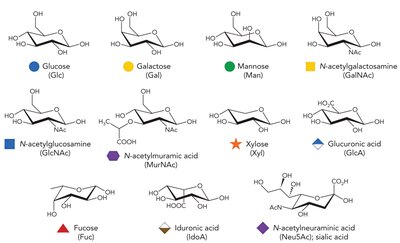
Monosaccharides: Simple sugars (e.g., glucose, galactose, mannose).
Disaccharides: Two monosaccharides linked by a glycosidic bond (e.g., sucrose, lactose).
Oligosaccharides: 2–10 monosaccharide units.
Polysaccharides: Long chains of monosaccharide units (e.g., starch, glycogen, cellulose).
Glycoconjugates: Carbohydrates covalently linked to proteins or lipids.
Chemical Features of Monosaccharides
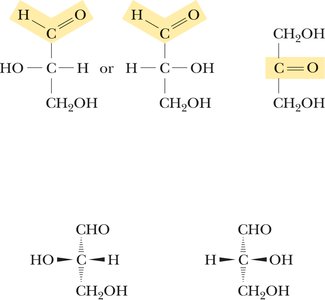
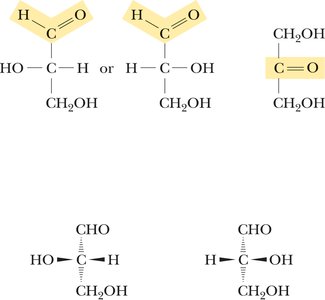
Monosaccharides are the simplest carbohydrates and cannot be hydrolyzed into simpler sugars under mild conditions. They typically contain 3 to 7 carbon atoms and can exist in linear or ring forms. Most have one or more chiral centers, making them optically active.
Aldoses: Monosaccharides with an aldehyde group (e.g., glyceraldehyde).
Ketoses: Monosaccharides with a ketone group (e.g., dihydroxyacetone).
Stereochemistry and Isomerism in Carbohydrates
Carbohydrates exhibit various forms of isomerism due to the presence of multiple chiral centers:
Stereoisomers: Same chemical formula and connectivity, different spatial arrangement.
Enantiomers: Non-superimposable mirror images (differ at all chiral centers).
Diastereomers: Stereoisomers that are not mirror images (differ at one or more, but not all, chiral centers).
Epimers: Diastereomers that differ at only one chiral center.
Anomers: Isomers that differ at the anomeric carbon formed during cyclization (α and β forms).
Cyclization of Monosaccharides: Hemiacetals and Hemiketals
Monosaccharides can cyclize to form ring structures via the reaction of an alcohol group with the carbonyl group, producing a hemiacetal (from an aldehyde) or hemiketal (from a ketone). This process introduces a new chiral center at the anomeric carbon, resulting in α and β anomers.
Pyranose: Six-membered ring form.
Furanose: Five-membered ring form.
Mutarotation: Interconversion between α and β anomers in solution via the open-chain form.
Oligosaccharides and Glycosidic Bonds
Oligosaccharides are composed of 2 to 10 monosaccharide units linked by glycosidic bonds. Disaccharides are the simplest oligosaccharides. The glycosidic bond forms between the anomeric carbon of one sugar and a hydroxyl group of another, with the elimination of water.
Reducing sugar: Has a free anomeric carbon (e.g., lactose).
Non-reducing sugar: Both anomeric carbons are involved in the glycosidic bond (e.g., sucrose).
Summary Table: Types of Isomers in Carbohydrates
Type | Definition | Example |
|---|---|---|
Enantiomers | Mirror images, differ at all chiral centers | D- and L-glucose |
Diastereomers | Not mirror images, differ at one or more (but not all) chiral centers | D-glucose and D-mannose |
Epimers | Diastereomers differing at only one chiral center | D-glucose and D-galactose (C4 epimers) |
Anomers | Isomers differing at the anomeric carbon | α- and β-glucose |
Practice Questions (with Answers)
Monosaccharides that differ in configuration about the hemiacetal carbon atom are called anomers.
Cyclization of monosaccharides is the reaction of hemiketal or hemiacetal formation and creates α and β epimers (anomers).
