 Back
Bioenergetics and Metabolic Pathway Regulation: Study Notes
Study Guide - Smart Notes
 Tailored notes based on your materials, expanded with key definitions, examples, and context.
Bioenergetics Primer
Introduction to Bioenergetics
Bioenergetics is the study of the transformation of energy in living organisms, focusing on how cells use "high-energy" biomolecules to drive thermodynamically unfavorable processes. Understanding bioenergetics is crucial for grasping metabolic pathway regulation and the role of ATP as the cell's energy currency.
High-energy biomolecules: Compounds like ATP and phosphoenolpyruvate (PEP) are used to drive cellular reactions.
Free energy change (ΔG): Indicates whether a reaction is spontaneous (exergonic) or nonspontaneous (endergonic).
Spontaneous aggregation: Driven by entropy, such as protein folding and drug solubility.
Key Thermodynamic Terms
Thermodynamics provides the framework for understanding energy changes in biochemical reactions.
Spontaneous process: Proceeds without outside intervention.
Entropy (S): Measure of randomness or disorder in a system.
Enthalpy (H): Heat flow in a process at constant pressure.
Free energy (G): Relates entropy, enthalpy, and spontaneity.
Key equation:
Where:
= change in free energy
= change in enthalpy
= temperature (in Kelvin)
= change in entropy
Interpreting Thermodynamic Parameters
Understanding the signs of thermodynamic parameters helps predict reaction behavior:
: Heat is released (exothermic).
: Heat is absorbed (endothermic).
: Disorder decreases.
: Disorder increases.
: Reaction is exergonic (spontaneous).
: Reaction is endergonic (nonspontaneous).
ATP: The Energy Currency of the Cell
Why ATP?
ATP is positioned as the cell's energy currency because its hydrolysis releases a moderate amount of free energy, making it ideal for coupling with both high- and low-energy phosphate compounds.
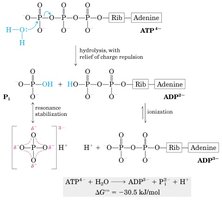
ATP hydrolysis: = -30.5 kJ/mol
Coupling reactions: ATP can drive endergonic reactions by coupling its hydrolysis to them.
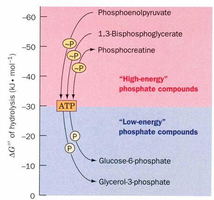
Example: ATP sits between high-energy compounds (like PEP and 1,3-BPG) and low-energy compounds (like glucose-6-phosphate), facilitating phosphate transfer reactions.
ATP Hydrolysis Mechanism
ATP hydrolysis involves breaking the terminal phosphate bond, relieving charge repulsion, and stabilizing the products through resonance and ionization.
Hydrolysis reaction:
Standard free energy change: kJ/mol
Free Energy and Equilibrium Constant
Relationship Between Free Energy and Equilibrium
There is a direct relationship between the net free energy change and the equilibrium constant for a reaction under standard conditions.
Standard free energy change: refers to pH 7, 1 M concentrations, 25°C, and 1 atm.
Equation:
Where: = gas constant, = temperature, = equilibrium constant
For the reaction :
Coupling Reactions and Metabolic Regulation
Coupling Endergonic and Exergonic Reactions
Cells couple endergonic reactions (requiring energy) with exergonic reactions (releasing energy) to drive metabolic processes. The free energy changes are additive, allowing unfavorable reactions to proceed.
Bond cleavage of high-energy compounds: Used in group transfers to drive coupled reactions.
Under cellular conditions: Actual energy available may differ from standard values.
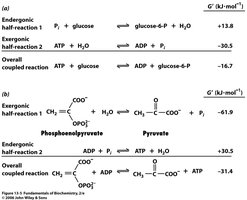
Example: Coupling ATP hydrolysis to glucose phosphorylation or PEP hydrolysis to ATP synthesis.
Regulation of Metabolic Pathways
Steps with large changes in free energy are key regulatory points in metabolic pathways. These steps control the direction and flux of metabolites through the network.
Flux maintenance: Reactions proceed if products are removed by subsequent reactions, compartmentalization, excretion, or conversion.
Regulatory control points: Large negative values indicate steps where pathway regulation occurs.
End of Section Questions and Applications
Application: Coupling ATP Hydrolysis to Phosphorylation
Two mechanisms for coupling ATP hydrolysis to the phosphorylation of fructose-6-phosphate (F6P):
Sequential hydrolysis: ATP is hydrolyzed as F6P is transformed to F16BP.
Direct transfer: ATP transfers its γ phosphate directly to F6P in one step.
Biochemical rationale: The direct transfer mechanism is more feasible, as it allows for efficient phosphate transfer and minimizes energy loss.
Application: Glycolytic Pathway Reactions
Glyceraldehyde-3-phosphate (GAP) conversion to 3-phosphoglycerate (3PG) can occur via two scenarios:
GAP is oxidized to 1,3-BPG ( kJ/mol), then hydrolyzed to 3PG ( kJ/mol).
GAP is oxidized to 1,3-BPG, which transfers its phosphate to ADP, yielding ATP ( kJ/mol).
Overall equations:
Scenario I: GAP + Pi + NAD+ → 1,3-BPG + NADH + H+ → 3PG + Pi
Scenario II: GAP + Pi + NAD+ + ADP → 3PG + NADH + H+ + ATP
Cellular preference: Scenario II is more likely, as it couples phosphate transfer to ATP synthesis, conserving energy for cellular use.
Additional info: These notes expand on brief points by providing definitions, equations, and examples to ensure completeness and academic quality for biochemistry students.
