 Back
BackCellular Respiration and Metabolic Pathways: Biochemistry Study Notes
Study Guide - Smart Notes
 Tailored notes based on your materials, expanded with key definitions, examples, and context.
Cellular Respiration
Overview of Cellular Respiration
Cellular respiration is the process by which cells break down organic compounds to produce ATP, the primary energy currency of the cell. This process is essential for maintaining cellular functions and is a central topic in biochemistry.
Definition: Cellular respiration is the set of metabolic reactions used by cells to convert biochemical energy from nutrients into ATP.
Importance: Provides energy for cellular activities.
Types: Aerobic (requires oxygen) and anaerobic (does not require oxygen).
Major Steps: Glycolysis, Pyruvate Decarboxylation, Citric Acid Cycle, Electron Transport Chain.
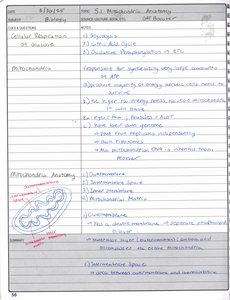
Mitochondrial Anatomy
Structure and Function
The mitochondrion is the organelle where most of cellular respiration occurs. Its structure is specialized to maximize ATP production.
Outer Membrane: Smooth, contains transport proteins.
Inner Membrane: Highly folded (cristae), contains proteins for the electron transport chain and ATP synthesis.
Intermembrane Space: Space between outer and inner membranes, important for proton gradient.
Mitochondrial Matrix: Contains enzymes for the citric acid cycle and pyruvate decarboxylation.
Glycolysis
Pathway and Key Steps
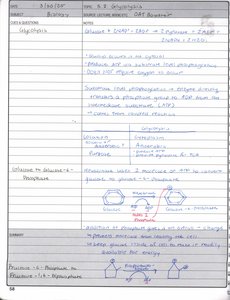
Glycolysis is the first step in cellular respiration, occurring in the cytoplasm. It breaks down glucose into pyruvate, generating ATP and NADH.
Equation:
Key Steps: Energy investment phase, cleavage phase, energy payoff phase.
Regulation: Phosphofructokinase is a major regulatory enzyme.
Pyruvate Decarboxylation
Conversion to Acetyl-CoA
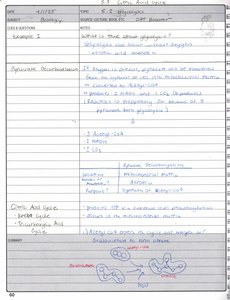
Pyruvate produced from glycolysis is transported into the mitochondria and converted to acetyl-CoA, releasing CO2 and producing NADH.
Equation:
Location: Mitochondrial matrix.
Citric Acid Cycle (Krebs Cycle)
Cycle Steps and Products
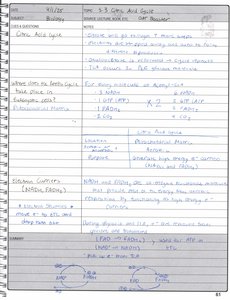
The citric acid cycle is a series of reactions in the mitochondrial matrix that oxidizes acetyl-CoA to CO2, generating NADH, FADH2, and ATP (or GTP).
Equation:
Key Steps: Citrate formation, isomerization, oxidative decarboxylation, regeneration of oxaloacetate.
Regulation: Controlled by substrate availability and feedback inhibition.
Electron Transport Chain (ETC)
Mechanism and ATP Production
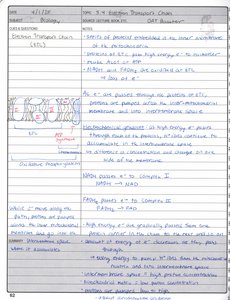
The electron transport chain is a series of protein complexes in the inner mitochondrial membrane that transfer electrons from NADH and FADH2 to oxygen, generating a proton gradient used to produce ATP.
Key Complexes: Complex I (NADH dehydrogenase), Complex II (succinate dehydrogenase), Complex III (cytochrome bc1), Complex IV (cytochrome c oxidase).
Proton Gradient: Electrons flow through complexes, pumping protons into the intermembrane space.
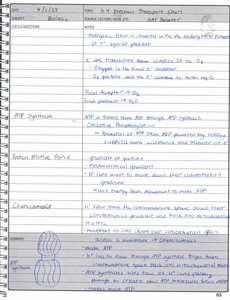
ATP Synthesis: ATP synthase uses the proton gradient to synthesize ATP from ADP and Pi.
Oxidative Phosphorylation
ATP Generation
Oxidative phosphorylation is the process by which ATP is formed as electrons are transferred to oxygen in the ETC. The proton motive force drives ATP synthase.
Equation: (driven by proton flow)
Yield: Approximately 34 ATP per glucose molecule (including glycolysis and citric acid cycle).
Anaerobic Respiration and Fermentation
Alternative Pathways
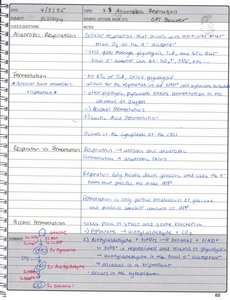
When oxygen is unavailable, cells use anaerobic respiration or fermentation to produce ATP. These pathways are less efficient than aerobic respiration.
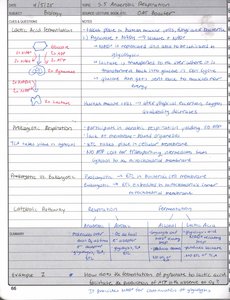
Lactic Acid Fermentation: Pyruvate is reduced to lactate, regenerating NAD+.
Alcohol Fermentation: Pyruvate is converted to ethanol and CO2 in yeast.
Yield: Only 2 ATP per glucose (from glycolysis).
Regulation of Carbohydrate Metabolism
Hormonal and Enzymatic Control
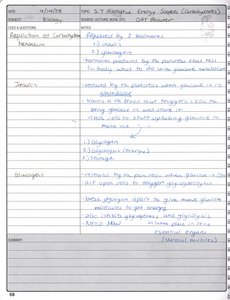
Carbohydrate metabolism is tightly regulated by hormones and enzymes to maintain energy balance.
Insulin: Promotes glucose uptake and storage (glycogenesis).
Glucagon: Stimulates glucose release (glycogenolysis, gluconeogenesis).
Enzymatic Regulation: Key enzymes include hexokinase, phosphofructokinase, and pyruvate kinase.
Alternative Energy Sources: Lipids
Triglycerides and Beta-Oxidation
Lipids are important energy sources, especially during fasting. Triglycerides are broken down into fatty acids, which undergo beta-oxidation to produce acetyl-CoA.
Beta-Oxidation: Sequential removal of two-carbon units from fatty acids, producing acetyl-CoA, NADH, and FADH2.
Energy Yield: Fatty acids yield more ATP per molecule than carbohydrates.
Alternative Energy Sources: Proteins
Protein Catabolism and Amino Acid Oxidation
Proteins are used as energy sources when carbohydrates and lipids are insufficient. Amino acids are deaminated and their carbon skeletons enter metabolic pathways.
Oxidative Deamination: Removal of amino group, producing ammonia and keto acids.
Urea Cycle: Ammonia is converted to urea for excretion.
Summary Table: ATP Yield from Glucose
Comparison of Aerobic and Anaerobic Pathways
The following table summarizes the ATP yield from glucose metabolism under aerobic and anaerobic conditions.
Pathway | ATP Yield per Glucose | Key Products |
|---|---|---|
Aerobic Respiration | ~36-38 ATP | CO2, H2O |
Anaerobic Respiration | 2 ATP | Lactate or Ethanol, CO2 |
Additional info:
Some diagrams and pathway details were inferred for completeness and clarity. The notes cover core biochemistry topics: glycolysis, citric acid cycle, electron transport chain, fermentation, and regulation of metabolism, all directly relevant to college biochemistry.
