 Back
BackChapter 15 – Photosynthesis: Mechanisms and Structures
Study Guide - Smart Notes
 Tailored notes based on your materials, expanded with key definitions, examples, and context.
Photosynthesis
The Basic Processes of Photosynthesis
Photosynthesis is a fundamental biological process that converts light energy into chemical energy, enabling the synthesis of carbohydrates from carbon dioxide and water. This process is central to the carbon cycle and is essential for life on Earth.
Carbon Cycle: The carbon cycle describes the continuous movement of carbon among the atmosphere, living organisms, and the Earth. It is driven by two opposing biological processes: photosynthesis (which fixes CO2 into organic molecules) and cellular respiration (which releases CO2 back into the atmosphere).
Key Players in the Carbon Cycle: Autotrophs (organisms that produce their own food), heterotrophs (organisms that consume others for food), chloroplasts, mitochondria, CO2, and carbohydrates.
Oxidative vs. Reductive Processes: Oxidative processes break down carbohydrates to release energy (catabolism), while reductive processes build carbohydrates from CO2 (anabolism). Both are essential for life: water is oxidized to provide electrons and produce O2, while CO2 is reduced to form carbohydrates.
Definition of Photosynthesis: Photosynthesis is the process by which light energy is converted into chemical energy, allowing cells to oxidize H2O to produce O2 and reduce CO2 to form carbohydrates through a series of reactions.
General Photosynthetic Reaction:
Where H2A is a general reductant and A* is the oxidized product.
Alternative Reductants: In addition to water, other reductants include H2S (used by green sulfur bacteria), SO32− (purple bacteria), and H2 (non-sulfur photosynthetic bacteria).
Light Reactions: These reactions require light and involve the synthesis of ATP (by photophosphorylation) and the reduction of NADP+ to NADPH via the oxidation of water. Reactants: H2O, NADP+, ADP, Pi. Products: O2, NADPH, ATP.
Dark Reactions (Calvin Cycle): These reactions do not require direct light but depend on the products of the light reactions. They use ATP and NADPH to convert CO2 and water into carbohydrates. Reactants: CO2, ATP, NADPH. Products: Carbohydrates, ADP, NADP+.
The Chloroplast
Structure and Function of the Chloroplast
The chloroplast is the organelle where photosynthesis occurs in plants and algae. It shares several similarities with mitochondria but also has distinct differences related to its function in photosynthesis.
Similarities with Mitochondria:
Both are double-membrane-bound organelles (outer and inner membranes).
Both use a proton gradient across a membrane to drive ATP synthesis via ATP synthase.
Both contain their own DNA and ribosomes, supporting the endosymbiotic theory.
Both have an electron transport chain embedded in their inner membrane system.
Both are involved in energy transduction (conversion of energy into ATP).
Both have an inner compartment (matrix in mitochondria, stroma in chloroplasts) where key metabolic reactions occur.
Differences:
Mitochondria perform catabolism (break down fuel molecules to produce ATP), while chloroplasts perform anabolism (use light energy to synthesize glucose).
Mitochondria use chemical energy (glucose, fats, amino acids); chloroplasts use light energy.
Mitochondria consume O2 and release CO2; chloroplasts consume CO2 and release O2.
Mitochondria have cristae (infoldings of the inner membrane); chloroplasts have thylakoid membranes organized into stacks called grana.
Mitochondria use NADH and FADH2; chloroplasts use NADPH and plastoquinone.
ATP is produced on the inner mitochondrial membrane in mitochondria and on the thylakoid membrane in chloroplasts.
Mitochondria are found in nearly all eukaryotic cells; chloroplasts are only found in photosynthetic eukaryotes (plants and algae).
Chloroplast Structure: Key Components
Outer Membrane: The external boundary of the chloroplast.
Inner Membrane: Lies just inside the outer membrane, enclosing the stroma.
Thylakoid Membrane: Internal membrane system where light reactions occur; forms flattened sacs called thylakoids.
Thylakoid: Individual membrane-bound compartment within the chloroplast; site of the light-dependent reactions.
Granum (plural: Grana): Stack of thylakoids; increases surface area for light absorption.
Stroma: Fluid-filled space surrounding the grana; site of the Calvin cycle (dark reactions) and starch storage.
Stroma Lamellae: Membranous structures connecting grana stacks, facilitating the distribution of energy and metabolites.
Thylakoid Lumen: Internal space within a thylakoid, involved in the generation of the proton gradient for ATP synthesis.
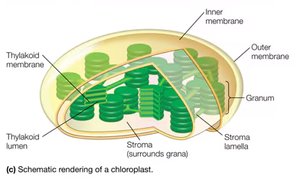
Localization of Photosynthetic Reactions
Light Reactions: Occur within or on the thylakoid membranes.
Dark Reactions (Calvin Cycle): Occur within the stroma of the chloroplast.
Starch Storage: Starch is stored within the stroma.
