 Back
BackChapter 22 Review: DNA Replication – Key Concepts and Mechanisms
Study Guide - Smart Notes
 Tailored notes based on your materials, expanded with key definitions, examples, and context.
Q1. Define these terms: DNA replication, transcription, reverse transcription, translation.
Background
Topic: Central Dogma of Molecular Biology
This question tests your understanding of the fundamental processes by which genetic information is stored, transferred, and expressed in cells.
Key Terms:
DNA Replication: The process of copying the DNA molecule to produce two identical DNA molecules before cell division.
Transcription: The synthesis of RNA from a DNA template.
Reverse Transcription: The synthesis of DNA from an RNA template (e.g., in retroviruses).
Translation: The synthesis of proteins using mRNA as a template.
Step-by-Step Guidance
Start by recalling the flow of genetic information: DNA → RNA → Protein.
For each term, identify the template and the product (e.g., DNA as template for replication and transcription).
Think about the enzymes involved in each process (e.g., DNA polymerase for replication, RNA polymerase for transcription).
Try solving on your own before revealing the answer!
Q2. What is semiconservative DNA replication?
Background
Topic: Mechanisms of DNA Replication
This question is about how genetic information is preserved and passed on during cell division.
Key Terms:
Semiconservative Replication: Each new DNA molecule consists of one parental (old) strand and one newly synthesized (daughter) strand.
Step-by-Step Guidance
Recall the Meselson-Stahl experiment, which demonstrated the semiconservative nature of DNA replication.
Think about what happens to the parental DNA strands during replication.
Describe how the new DNA duplexes are composed after one round of replication.
Try solving on your own before revealing the answer!
Q3. What are “forks” in DNA replication?
Background
Topic: DNA Replication Structures
This question focuses on the physical structures formed during DNA replication.
Key Terms:
Replication Fork: The Y-shaped region where the DNA double helix is unwound to allow replication of each strand.
Step-by-Step Guidance
Visualize the DNA double helix being separated into two single strands.
Consider how enzymes like helicase create and move the replication fork.
Think about the direction in which the fork moves as replication proceeds.
Try solving on your own before revealing the answer!
Q4. Understand the terms parental vs daughter strands or duplexes.
Background
Topic: DNA Replication Terminology
This question tests your understanding of the nomenclature used to describe DNA strands during replication.
Key Terms:
Parental Strand: The original DNA strand used as a template.
Daughter Strand: The newly synthesized strand complementary to the parental strand.
Step-by-Step Guidance
Identify which strand serves as the template in replication.
Describe how the daughter strand is synthesized using the parental strand as a guide.
Try solving on your own before revealing the answer!
Q5. What is the difference between unidirectional and bidirectional replication? Know the locations of the origin and terminus for each type of replication.
Background
Topic: DNA Replication Mechanisms
This question examines your understanding of the directionality of DNA synthesis and the organization of replication origins and termini.
Key Terms:
Unidirectional Replication: Replication proceeds in one direction from the origin.
Bidirectional Replication: Replication proceeds in two directions from the origin.
Origin: The starting point of DNA replication.
Terminus: The ending point of DNA replication.
Step-by-Step Guidance
Draw or visualize a circular or linear DNA molecule and mark the origin and terminus.
For unidirectional replication, trace the path of synthesis from the origin to the terminus in one direction.
For bidirectional replication, trace the paths in both directions from the origin, meeting at the terminus.
Try solving on your own before revealing the answer!
Q6. Understand that there are several origins of replication in eukaryotic DNA.
Background
Topic: Eukaryotic DNA Replication
This question is about the complexity of replication in eukaryotic cells due to their large, linear chromosomes.
Key Terms:
Origin of Replication: Specific sequence where replication begins.
Replication Forks: Structures that move outward from each origin.
Step-by-Step Guidance
Recall that eukaryotic chromosomes are much larger than prokaryotic ones.
Think about why multiple origins are necessary for timely replication.
Describe how replication forks move and eventually meet.
Try solving on your own before revealing the answer!
Q7. Describe the mechanism of action of DNA elongation (3’OH nucleophilic attack on alpha-phosphate, pyrophosphate leaves, formation of phosphodiester bond, etc.).
Background
Topic: DNA Polymerase Catalysis
This question tests your understanding of the chemical mechanism by which DNA polymerases add nucleotides to a growing DNA strand.
Key Terms and Formulas:
3’OH Group: The hydroxyl group at the 3’ end of the primer strand.
Alpha-Phosphate: The innermost phosphate of the incoming dNTP.
Phosphodiester Bond: The linkage formed between nucleotides.
Key Reaction:
Step-by-Step Guidance
Identify the 3’OH group on the primer strand as the nucleophile.
Describe how this group attacks the alpha-phosphate of the incoming dNTP.
Explain that this forms a new phosphodiester bond and releases pyrophosphate (PPi).
Try solving on your own before revealing the answer!
Q8. What is a primer? What is a template strand?
Background
Topic: DNA Replication Requirements
This question focuses on the essential components needed for DNA synthesis.
Key Terms:
Primer: A short nucleic acid sequence that provides a starting point for DNA synthesis.
Template Strand: The DNA strand that is copied during replication.
Step-by-Step Guidance
Recall why DNA polymerases cannot start synthesis de novo and require a primer.
Describe how the primer binds to the template strand to initiate synthesis.
Try solving on your own before revealing the answer!
Q9. Study figure 22.5 and know the five scenarios that purified DNA polymerase can act on.
Background
Topic: Substrates for DNA Polymerase
This question is about the different DNA structures that DNA polymerase can use as substrates.
Key Terms:
Primed circular single strand
Primed linear strand
Single stranded hairpin
Gapped duplex
Nicked duplex (strand displacement synthesis)
Step-by-Step Guidance
For each scenario, visualize or sketch the DNA structure described.
Think about how a primer is positioned relative to the template in each case.
Consider how DNA polymerase would extend the primer in each scenario.
Try solving on your own before revealing the answer!
Q10. What are the three catalytic activities of DNA polymerase?
Background
Topic: DNA Polymerase Functions
This question tests your knowledge of the enzymatic activities that DNA polymerases possess.
Key Terms:
3’→5’ exonuclease activity (proofreading)
5’→3’ exonuclease activity (removal of primers or damaged DNA)
Polymerase activity (5’→3’ synthesis)
Step-by-Step Guidance
List each activity and briefly describe its function in DNA replication or repair.
Think about why each activity is important for maintaining genetic fidelity.
Try solving on your own before revealing the answer!
Q11. There are two Klenow fragments. What catalytic activity are found on each?
Background
Topic: DNA Polymerase I Structure
This question is about the functional domains of DNA Polymerase I (Klenow fragment) in bacteria.
Key Terms:
Klenow Fragment: Large fragment with polymerase and 3’→5’ exonuclease activity.
Small Fragment: Contains 5’→3’ exonuclease activity.
Step-by-Step Guidance
Recall the process of proteolytic cleavage that separates the two fragments.
Assign the catalytic activities to the correct fragment.
Try solving on your own before revealing the answer!
Q12. What type of DNA polymerase is found in bacteria?
Background
Topic: Prokaryotic DNA Replication
This question tests your knowledge of the main DNA polymerase responsible for genome replication in bacteria.
Key Terms:
DNA Polymerase III: Main replicative polymerase in bacteria.
Step-by-Step Guidance
Recall the different DNA polymerases in prokaryotes and their functions.
Identify which polymerase is responsible for leading and lagging strand synthesis.
Try solving on your own before revealing the answer!
Q13. Understand the role of the Mg ions in the two-metal mechanism.
Background
Topic: DNA Polymerase Catalysis
This question is about the role of metal ions in the catalytic mechanism of DNA polymerases.
Key Terms:
Mg2+ ions: Essential cofactors for catalysis.
Two-metal mechanism: One Mg2+ activates the 3’OH, the other stabilizes the leaving pyrophosphate.
Step-by-Step Guidance
Describe how each Mg2+ ion contributes to the reaction mechanism.
Think about how the ions stabilize the transition state and facilitate bond formation/breakage.
Try solving on your own before revealing the answer!
Q14. What residues hold the Mg ions in position?
Background
Topic: Enzyme Structure and Function
This question focuses on the amino acid residues that coordinate metal ions in the active site of DNA polymerases.
Key Terms:
Aspartate and glutamate residues: Commonly coordinate Mg2+ in the active site.
Step-by-Step Guidance
Recall the types of amino acid side chains that can bind metal ions.
Identify which residues are typically involved in DNA polymerase active sites.
Try solving on your own before revealing the answer!
Q15. What is a replisome?
Background
Topic: DNA Replication Complexes
This question is about the multi-protein machinery responsible for DNA replication.
Key Terms:
Replisome: The complex of enzymes and proteins that carry out DNA replication.
Step-by-Step Guidance
List the main components of the replisome (e.g., helicase, primase, polymerases, clamp loader, SSB).
Describe the overall function of the replisome during replication.
Try solving on your own before revealing the answer!
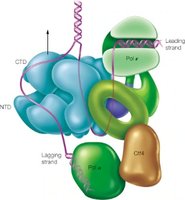
Q16. Know the function of each of the labeled protein in figure 22.27.
Background
Topic: Eukaryotic DNA Replication Machinery
This question tests your ability to identify and describe the roles of key proteins in the eukaryotic replisome.
Key Terms:
Helicase: Unwinds the DNA double helix.
Polymerase ε (epsilon): Synthesizes the leading strand.
Polymerase α (alpha): Initiates lagging strand synthesis.
Ctf4: Connects and stabilizes the replisome complex.
Step-by-Step Guidance
Identify each labeled protein in the figure and match it to its function.
Describe how these proteins interact to coordinate leading and lagging strand synthesis.
Try solving on your own before revealing the answer!
Q17. Describe the model for chromatin replication.
Background
Topic: Chromatin Structure and DNA Replication
This question is about how nucleosomes and histones are managed during DNA replication in eukaryotes.
Key Terms:
Nucleosome: DNA wrapped around histone proteins.
Chromatin: The complex of DNA and proteins in the nucleus.
Step-by-Step Guidance
Describe what happens to nucleosomes as the replication fork approaches.
Explain how histones are redistributed or newly synthesized to package the new DNA.
Try solving on your own before revealing the answer!
Q18. What are the roles of oriC and the three 13bp repeats next to it?
Background
Topic: Initiation of DNA Replication in Prokaryotes
This question focuses on the DNA sequences that define the origin of replication in E. coli.
Key Terms:
oriC: The origin of replication in E. coli.
13bp repeats: AT-rich sequences that facilitate DNA unwinding.
Step-by-Step Guidance
Identify the function of the 9bp and 13bp repeats at oriC.
Describe how these sequences contribute to the initiation of replication.
Try solving on your own before revealing the answer!
Q19. Know the roles of DnaA proteins, DnaB helicase, DnaG primase, and SSB, and the order that they bind to DNA.
Background
Topic: Initiation of DNA Replication
This question is about the sequence of protein binding events that initiate DNA replication in prokaryotes.
Key Terms:
DnaA: Binds to oriC and initiates unwinding.
DnaB (with DnaC): Helicase that unwinds DNA.
DnaG: Primase that synthesizes RNA primers.
SSB: Stabilizes single-stranded DNA.
Step-by-Step Guidance
List the order in which these proteins bind to the origin of replication.
Describe the role of each protein in preparing the DNA for replication.
Try solving on your own before revealing the answer!
