 Back
Chapter 8: Enzymes – Biological Catalysis and Kinetics
Study Guide - Smart Notes
 Tailored notes based on your materials, expanded with key definitions, examples, and context.
Enzyme Catalysis: Fundamental Concepts
Definition and Role of Enzymes
Enzymes are biological catalysts that accelerate thermodynamically favorable reactions in living cells, enabling kinetic control over metabolic processes. Most enzymes are proteins, though some are RNA molecules. They are essential for cellular function, mediating nearly all biochemical reactions.
Catalytic Power: Enzymes increase reaction rates by factors ranging from 105 to 1015 compared to uncatalyzed reactions.
Specificity: Enzymes exhibit high substrate specificity, often catalyzing stereoselective reactions.
Regulation: Enzyme activity is tightly regulated to meet cellular needs, and is sensitive to temperature and pH.
Major Classes of Enzymes
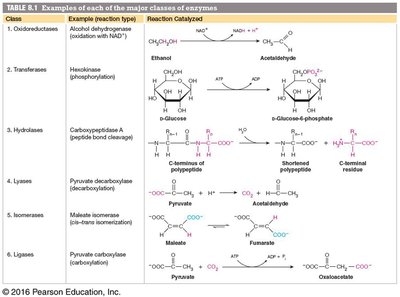
Enzymes are classified into six major groups based on the type of reaction they catalyze. Each class is assigned an E.C. number for precise identification.
Oxidoreductases: Catalyze oxidation-reduction reactions.
Transferases: Transfer functional groups between molecules.
Hydrolases: Catalyze hydrolytic cleavage of bonds.
Lyases: Add or remove groups to form double bonds.
Isomerases: Catalyze isomerization changes within a molecule.
Ligases: Join two molecules together using ATP.
Enzyme Kinetics and Reaction Rates
Reaction Order and Rate Constants
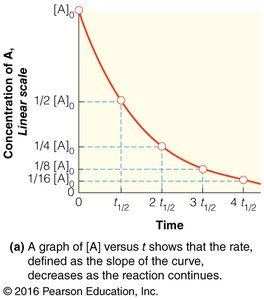
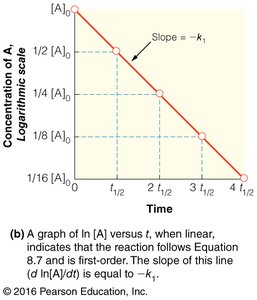
Chemical kinetics provides a foundation for understanding enzyme-catalyzed reactions. The rate of a reaction depends on the concentration of reactants and the order of the reaction.
First-order reactions: Rate is proportional to the concentration of one reactant.
Second-order reactions: Rate depends on two reactants.
Activation Energy and Transition State
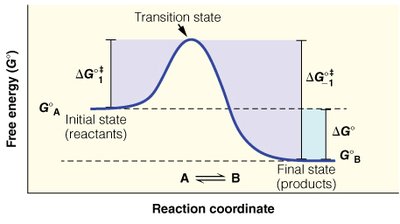
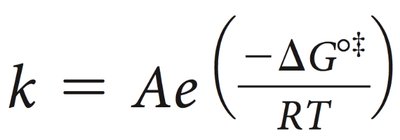
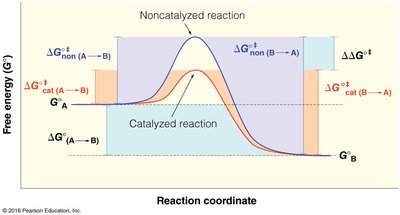
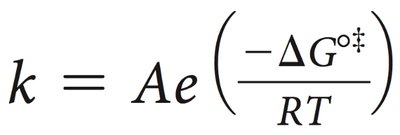
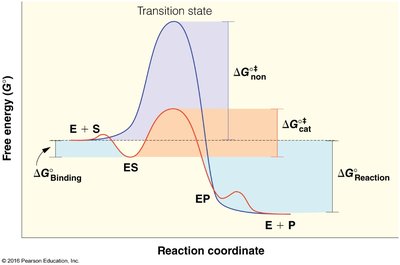
Enzymes lower the activation energy (ΔG‡) required for a reaction, stabilizing the transition state and increasing the rate constant (k). The standard free energy change (ΔG°) determines reaction spontaneity, but enzymes do not alter ΔG° or equilibrium constant (Keq).
Transition State: The highest energy point along the reaction coordinate.
Arrhenius Equation: Describes the relationship between rate constant and activation energy:
Effect of Temperature and Catalysis
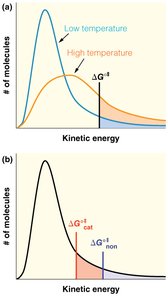
Increasing temperature raises the kinetic energy of molecules, increasing the fraction able to overcome the activation barrier. Enzymes achieve rate enhancement by lowering ΔG‡.
Mechanisms of Enzyme Catalysis
Transition State Stabilization
Enzymes preferentially stabilize the transition state, reducing the activation energy and enhancing reaction rates. The difference in activation energies between catalyzed and uncatalyzed reactions determines the rate enhancement.
Binding and Entropy Effects
Enzyme-substrate binding involves both enthalpic and entropic changes. Favorable binding enthalpy (ΔH) dominates, as formation of bonds between enzyme and transition state provides stabilization.
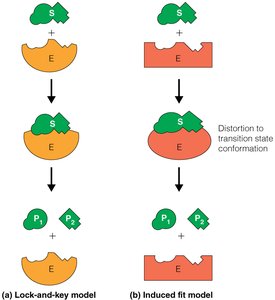
Lock-and-Key vs. Induced Fit Models
Two models describe enzyme-substrate recognition:
Lock-and-Key Model: Substrate fits precisely into the enzyme's active site.
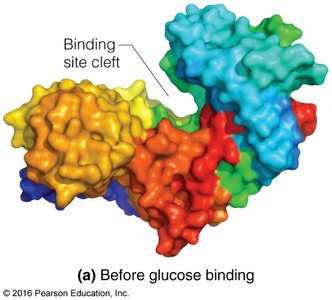
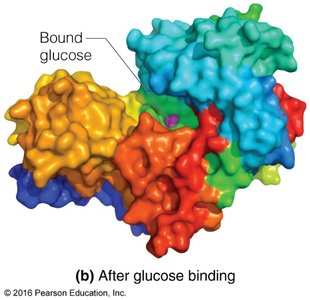
Induced Fit Model: Enzyme undergoes conformational change upon substrate binding, optimizing transition state stabilization.
General Catalytic Mechanisms
Enzymatic catalysis may involve:
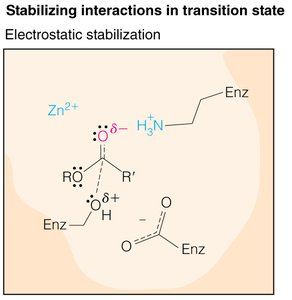
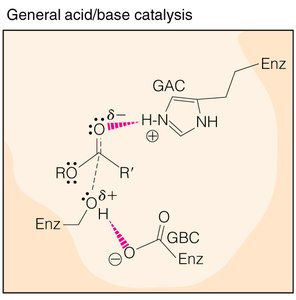
General acid/base catalysis
Covalent catalysis
Electrostatic stabilization
Proximity effects
Preferential stabilization of the transition state
Protein conformational changes
Specific Enzyme Mechanisms: Lysozyme and Chymotrypsin
Lysozyme Catalytic Mechanism
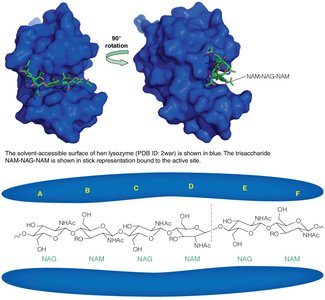
Lysozyme cleaves polysaccharides by binding the substrate in its active site and facilitating electron transfer. Key residues include E35 (acid catalyst) and D52 (base catalyst), which stabilize the transition state and return to their original states after catalysis.
Lysozyme Activity vs. pH
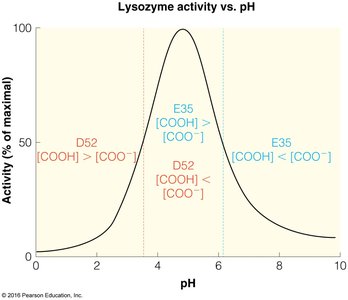
Lysozyme activity is pH-dependent, requiring E35 to be protonated and D52 to be deprotonated for optimal catalysis. The activity peaks at a pH where these conditions are met.
Serine Protease Mechanism: Chymotrypsin
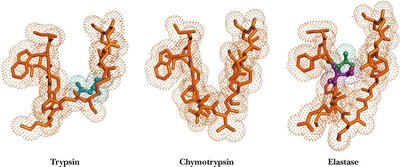
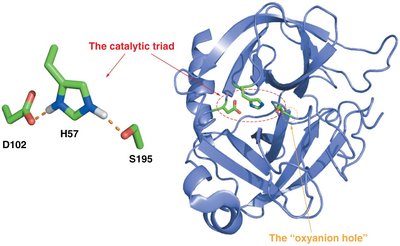
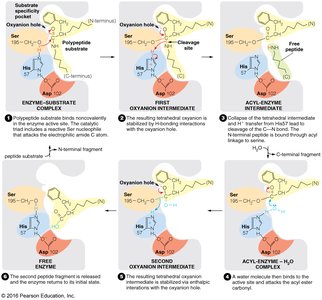
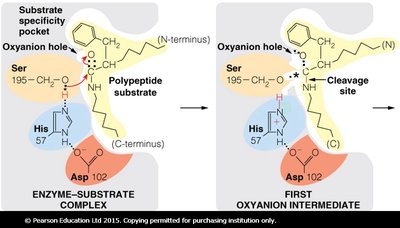
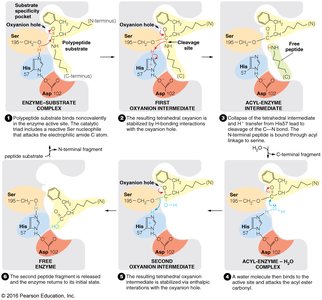
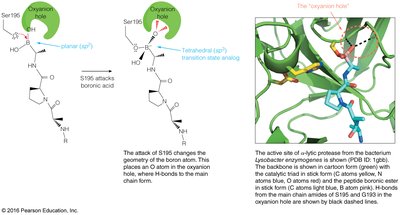
Chymotrypsin is a serine protease with a substrate-binding pocket adapted for hydrophobic residues. The catalytic triad (S195, H57, D102) facilitates nucleophilic attack, proton transfer, and stabilization of the transition state. The oxyanion hole stabilizes the tetrahedral intermediate.
Enzyme Kinetics: Michaelis-Menten and Lineweaver-Burk
Michaelis-Menten Equation
The Michaelis-Menten equation describes the rate of enzyme-catalyzed reactions:
Vmax: Maximum rate achieved when enzyme is saturated with substrate.
kcat: Turnover number, the number of substrate molecules converted per enzyme per second.
KM: Michaelis constant, an estimate of substrate binding affinity.
Lineweaver-Burk Plot
The Lineweaver-Burk plot is a double reciprocal plot used to determine Vmax and KM:
Interpreting kcat, KM, and kcat/KM
kcat: Measures catalytic speed.
KM: Indicates substrate binding efficiency.
kcat/KM: Second-order rate constant, a measure of enzyme efficiency and substrate specificity.
Enzyme Inhibition Mechanisms
Competitive Inhibition
Competitive inhibitors resemble the substrate and bind to the active site, increasing apparent KM but leaving Vmax unchanged. Inhibition can be overcome by increasing substrate concentration.
Uncompetitive Inhibition
Uncompetitive inhibitors bind only to the enzyme-substrate complex, decreasing both apparent KM and Vmax.
Mixed and Noncompetitive Inhibition
Mixed inhibitors bind to both free enzyme and ES complex, typically increasing KM and decreasing Vmax. Noncompetitive inhibitors bind elsewhere, reducing Vmax without affecting KM.
Regulation of Enzyme Activity
Regulatory Mechanisms
Substrate level control
Product inhibition
Feedback inhibition/activation
Covalent modification (e.g., phosphorylation)
Allosteric regulation
Allosteric Regulation
Allosteric enzymes are often multisubunit proteins with multiple active sites. They display cooperative substrate binding and are regulated by effectors, resulting in sigmoid v vs. [S] plots rather than hyperbolic Michaelis-Menten kinetics.
Cofactors and Coenzymes
Role of Cofactors
Some enzymes require cofactors (metal ions or organic molecules) for activity. Coenzymes are often derived from vitamins and participate in catalysis. Metalloenzymes contain metal ions essential for function.
Summary Table: Major Classes of Enzymes
Class | Example (Reaction Type) | Reaction Catalyzed |
|---|---|---|
Oxidoreductases | Alcohol dehydrogenase (oxidation with NAD+) | Ethanol → Acetaldehyde |
Transferases | Hexokinase (phosphorylation) | Glucose → Glucose-6-phosphate |
Hydrolases | Carboxypeptidase A (peptide bond cleavage) | Polypeptide → C-terminal residue |
Lyases | Pyruvate decarboxylase (decarboxylation) | Pyruvate → Acetaldehyde |
Isomerases | Maleate isomerase (cis-trans isomerization) | Maleate → Fumarate |
Ligases | Pyruvate carboxylase (carboxylation) | Pyruvate → Oxaloacetate |
