 Back
Chemistry 107 Exam 2 Study Guidance – Molecular Structure, Bonding, and Intermolecular Forces
Study Guide - Smart Notes
 Tailored notes based on your materials, expanded with key definitions, examples, and context.
Q1. Write the name of each compound whose formula is given below
Background
Topic: Nomenclature of inorganic compounds
This question tests your ability to apply rules for naming ionic compounds, including transition metals and polyatomic ions.
Key Terms and Formulas:
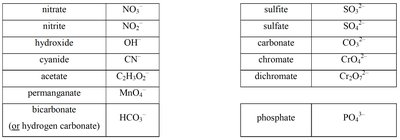
Polyatomic ions: Refer to the table of common polyatomic ions for correct names.
Transition metals: Use Roman numerals to indicate oxidation state if needed.
Step-by-Step Guidance
For Au2S, identify the cation (Au) and anion (S). Determine the charge of each ion and use the rules for naming transition metal compounds.
For Ba3(PO4)2, identify the cation (Ba) and the polyatomic anion (PO43−). Name the compound using the cation and the polyatomic ion name.
Check if any Roman numerals are needed for the metal ions based on their possible oxidation states.
Try solving on your own before revealing the answer!
Final Answer:
a. Au2S: Gold(I) sulfide
b. Ba3(PO4)2: Barium phosphate
Gold is a transition metal and can have multiple oxidation states, so Roman numerals are used. Barium is a group 2 metal and does not require Roman numerals.
Q2. Write the chemical formula for each compound whose name is given below
Background
Topic: Writing chemical formulas from compound names
This question tests your ability to translate compound names into their correct chemical formulas, including molecular and ionic compounds.
Key Terms and Formulas:
Prefixes (tetra-, penta-, etc.) indicate the number of atoms.
Roman numerals indicate the oxidation state of transition metals.
Polyatomic ions: Use the table for correct formulas.
Step-by-Step Guidance
For tetraphosphorous pentaoxide, use the prefixes to determine the number of P and O atoms.
For vanadium (VIII) sulfide, determine the charge of vanadium (VIII) and sulfide, then balance the formula accordingly.
Write the formula using correct subscripts for each element.
Try solving on your own before revealing the answer!
Final Answer:
a. Tetraphosphorous pentaoxide: P4O10
b. Vanadium (VIII) sulfide: V2S8
The prefixes indicate the number of atoms. Vanadium (VIII) means V8+, so the formula balances charges with sulfide (S2−).
Q3. Consider the molecule shown. Identify each of its bonds as nonpolar, slightly polar, or polar
Background
Topic: Bond polarity and molecular polarity
This question tests your understanding of electronegativity differences and how they affect bond polarity and overall molecular polarity.
Key Terms and Formulas:
Electronegativity: The tendency of an atom to attract electrons in a bond.
Bond polarity: Determined by the difference in electronegativity between two atoms.
Step-by-Step Guidance
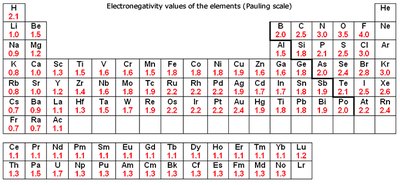
Look up the electronegativity values for C, H, and N using the provided table.
Calculate the difference in electronegativity for each bond (C–H, C–C, C–N).
Classify each bond as nonpolar, slightly polar, or polar based on the difference.
Redraw the molecule and add bond dipoles to indicate direction of electron pull.
Try solving on your own before revealing the answer!
Final Answer:
C–H bond: Slightly polar (C is slightly more electronegative than H)
C–C bond: Nonpolar (same electronegativity)
C–N bond: Polar (N is significantly more electronegative than C)
The molecule is polar because the bond dipoles do not cancel out, resulting in a net dipole moment.
Q4. For each bond, decide if it is polar or nonpolar. If polar, label the 𝛅+ and 𝛅− ends of the bond.
Background
Topic: Bond polarity and partial charges
This question tests your ability to determine bond polarity and assign partial charges based on electronegativity differences.
Key Terms and Formulas:
Electronegativity difference: Determines bond polarity.
𝛅+ and 𝛅−: Indicate partial positive and negative charges.
Step-by-Step Guidance
For N—F, compare electronegativity values of N and F.
For O—H, compare electronegativity values of O and H.
For S—C, compare electronegativity values of S and C.
Label the 𝛅+ and 𝛅− ends for each polar bond.
Try solving on your own before revealing the answer!
Final Answer:
N—F: Polar, N is 𝛅+, F is 𝛅−
O—H: Polar, H is 𝛅+, O is 𝛅−
S—C: Slightly polar, C is 𝛅+, S is 𝛅−
Electronegativity differences determine the direction of partial charges.
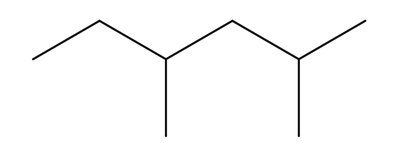
Q5. Every carbon in the molecule below follows the octet rule. How many hydrogen atoms are bonded to each carbon with an arrow pointing to it?
Background
Topic: Octet rule and bonding in organic molecules
This question tests your understanding of the octet rule and how to count hydrogen atoms bonded to carbon atoms in a structural formula.
Key Terms and Formulas:
Octet rule: Atoms tend to form bonds to have eight electrons in their valence shell.
Bond line structure: Each line represents a bond; hydrogens are often omitted but must be counted.
Step-by-Step Guidance
Identify the number of bonds each carbon forms in the structure.
Subtract the number of bonds to other atoms from four (the typical number for carbon) to determine the number of hydrogens.
Repeat for each carbon labeled A, B, and C.
Try solving on your own before revealing the answer!
Final Answer:
Carbon A: 2 hydrogens
Carbon B: 1 hydrogen
Carbon C: 3 hydrogens
Each carbon forms enough bonds to satisfy the octet rule, and the remaining bonds are to hydrogen.
Q6. Write the correct name of the organic compounds below.
Background
Topic: Organic nomenclature
This question tests your ability to name organic compounds based on their structure, following IUPAC rules.
Key Terms and Formulas:
IUPAC nomenclature: Systematic naming of organic compounds.
Functional groups: Identify and name based on structure.
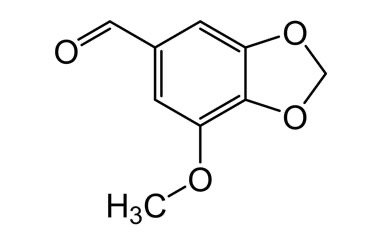
Step-by-Step Guidance
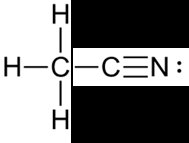
Identify the longest carbon chain in each structure.
Identify and name any substituents or functional groups present.
Apply IUPAC rules to assign the correct name.
Try solving on your own before revealing the answer!
Final Answer:
First compound: 2,3-dimethylpentane
Second compound: Acetonitrile (or methyl cyanide)
Third compound: 3,4-methylenedioxy-5-methoxybenzaldehyde
Names are based on the longest chain and functional groups present.
