 Back
BackClinical Biochemistry: Foundations, Biomolecules, and Bioenergetics
Study Guide - Smart Notes
 Tailored notes based on your materials, expanded with key definitions, examples, and context.
Biochemistry and the Language of Chemistry
Hierarchical Organization of Life
The complexity of living systems is organized in a hierarchy, where each level exhibits emergent properties not predictable from the previous level. The main levels, in increasing order, are: atoms, molecules, macromolecules, organelles, cells, tissues, organs, and whole organisms. Single-celled organisms lack tissues and organs, highlighting the diversity of biological organization.
Are Viruses Alive?
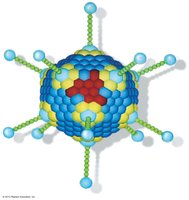
Viruses, such as adenovirus, are composed of a nucleic acid molecule surrounded by a protein coat. There is ongoing debate about whether viruses are considered alive, as they lack many characteristics of living organisms, such as independent metabolism and cellular structure.
History of Biochemistry
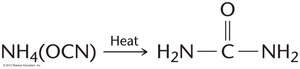
Biochemistry has ancient roots, with evidence of biochemical processes such as wine production by the Egyptians around 1500 BCE. The field advanced significantly in the 19th century, with figures like Friedrich Wöhler, who demonstrated that organic compounds could be synthesized from inorganic precursors, challenging the concept of vitalism.


Chemicals of Life
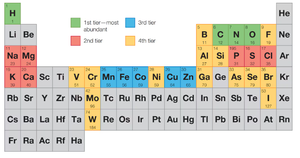
Over 97% of the mass of most organisms is composed of six elements: carbon (C), hydrogen (H), nitrogen (N), oxygen (O), phosphorus (P), and sulfur (S)—collectively known as CHNOPS. These elements form stable covalent bonds and are essential for life. Other elements, present in smaller amounts, are also vital as trace elements.
Chemical Reactions in Biochemistry
Biochemical reactions often involve the transformation of inorganic compounds into organic molecules. For example, urea can be synthesized by heating ammonium cyanate, demonstrating that organic molecules can arise from inorganic substances.
Why Study Biochemistry?
Explains biology at the molecular level
Elucidates the roles of enzymes and nucleic acids
Informs drug action, nutrition, and disease mechanisms
Enables advances in cloning and genetic engineering
Provides a foundation for liberal arts education
What is Biochemistry?
Biochemistry is the study of biomolecules, their properties, interactions, chemical reactions, regulation, and energetics. It overlaps with molecular biology, which focuses on the flow of genetic information.
Molecular Biology and the Central Dogma
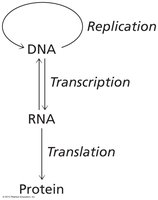
The central dogma of molecular biology describes the flow of genetic information: DNA is transcribed into RNA, which is then translated into protein. The transfer of information from nucleic acid to protein is considered irreversible.
The Chemical Foundation of Life
Functional Groups and Linkages
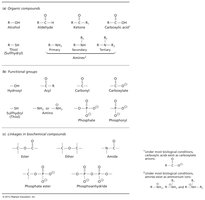
Functional groups are specific groups of atoms within molecules that have characteristic properties and reactivities. Common functional groups in biochemistry include hydroxyl, carbonyl, carboxyl, amino, phosphate, and sulfhydryl groups. Linkages such as esters, amides, and phosphoesters are crucial in forming macromolecules.
Main Classes of Biomolecules
Carbohydrates: Composed of carbon, hydrogen, and oxygen (CH2O). Monosaccharides are the building blocks. Functions include energy storage and structural support.
Proteins: Polymers of amino acids. Serve as enzymes, structural components, and signaling molecules.
Nucleic Acids: DNA and RNA, polymers of nucleotides. Store and transmit genetic information.
Lipids: Derived from acetyl-CoA. Function in energy storage and as components of membranes.
Polymers and Monomers
Many macromolecules are polymers, composed of repeating monomer units. The properties of macromolecules differ significantly from their monomers. For example, starch (a polymer) has different properties than glucose (its monomer).
Introduction to Proteins
Amino Acids: Structure and Properties
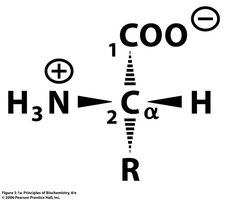
Proteins are composed of 20 common amino acids, each containing an amino group, a carboxylate group, and a unique side chain (R group). The central carbon (alpha carbon) is chiral, and at physiological pH, amino acids exist as zwitterions.
Peptide Bond Formation
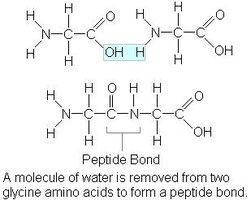
Amino acids are linked by peptide bonds, formed through a condensation reaction that releases water. The resulting polypeptide has directionality, with an N-terminus (amino end) and a C-terminus (carboxyl end).
Protein Structure and Function
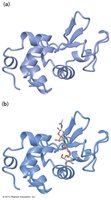
Proteins fold into specific three-dimensional shapes determined by their amino acid sequence.
The function of a protein depends on its conformation.
Enzymes are proteins that catalyze biochemical reactions, often containing an active site where substrates bind and reactions occur.
Carbohydrates
Monosaccharides and Polysaccharides
Carbohydrates (saccharides) are composed of carbon, hydrogen, and oxygen. Monosaccharides are simple sugars, while polysaccharides are polymers of monosaccharide residues. Common monosaccharides include glucose, fructose, galactose, and ribose.
Nomenclature and Structure
Hexose: Six-carbon sugar (e.g., glucose)
Pentose: Five-carbon sugar (e.g., ribose)
Furanose: Five-membered ring form
Pyranose: Six-membered ring form
Aldose: Sugar with an aldehyde group
Ketose: Sugar with a ketone group
Cyclization of Saccharides
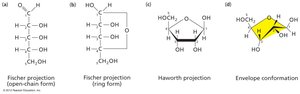
Monosaccharides can cyclize to form hemiacetals (from aldehydes) or hemiketals (from ketones), resulting in ring structures such as furanose and pyranose forms.
Representations of Sugar Structures
Different projections (Fischer, Haworth, envelope) are used to represent sugar structures, aiding in understanding their three-dimensional conformation.
Disaccharides and Polysaccharides
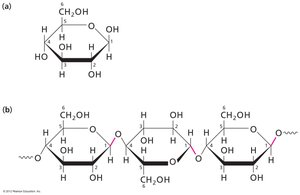
Disaccharides are formed by linking two monosaccharides via a glycosidic (ether) bond. Polysaccharides, such as cellulose, are linear or branched polymers of monosaccharide residues.
Nucleic Acids
Structure and Function
Nucleic acids are polymers of nucleotides, each consisting of a five-carbon sugar, a nitrogenous base (purine or pyrimidine), and one or more phosphate groups. DNA and RNA differ in their sugar component and function in genetic information storage and transfer.
Structure of ATP
Adenosine triphosphate (ATP) is a nucleotide with three phosphate groups, serving as the primary energy currency of the cell.
Phosphodiester Linkage
Nucleotides are joined by phosphodiester bonds to form the backbone of nucleic acids.
DNA Double Helix
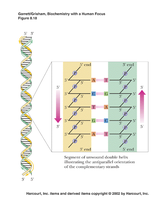
DNA consists of two complementary polynucleotide strands forming a double helix. The sequence of base pairs encodes genetic information.
Lipids, Membranes, and Cellular Transport
Lipid Structure and Properties
Lipids are hydrophobic molecules rich in carbon and hydrogen, with few oxygen atoms. They are insoluble in water but soluble in organic solvents. Lipids often have a polar head and a non-polar tail, allowing them to form bilayers in aqueous environments.
Biological Membranes
Lipid bilayers form the structural basis of biological membranes, which act as barriers and are stabilized by noncovalent forces. Membranes are flexible and selectively permeable, allowing for compartmentalization within cells.
Fatty Acids and Glycerophospholipids
Fatty acids are long-chain hydrocarbons with a carboxylate group. Glycerophospholipids, composed of glycerol-3-phosphate and two fatty acyl groups, are major components of membranes.
Membrane Proteins
Proteins embedded in membranes serve as channels, transporters, and enzymes, facilitating the movement of molecules and catalyzing reactions at the membrane surface.
The Energetics of Life
Bioenergetics and Thermodynamics
Bioenergetics is the study of energy changes during metabolic reactions, governed by the principles of thermodynamics. The same thermodynamic laws that apply to nonliving systems also govern biological processes.
Energy Flow in Living Systems
Photosynthetic organisms capture solar energy to synthesize organic compounds. The breakdown of these compounds releases energy for cellular processes in all organisms.
Reaction Rates and Equilibria
The rate of a chemical reaction depends on the concentration of reactants and the rate constant. Most biochemical reactions are reversible and reach equilibrium, where the rate of the forward reaction equals the rate of the reverse reaction.
The equilibrium constant () is defined as:
where [A], [B], [C], and [D] are the concentrations of reactants and products at equilibrium.
Gibbs Free Energy
The Gibbs free energy change () for a reaction determines whether a process is spontaneous. It is calculated as:
where is the enthalpy change, is the temperature in Kelvin, and is the entropy change.
: Reaction is spontaneous (exergonic)
: Reaction is non-spontaneous (endergonic)
: Reaction is at equilibrium
Standard Free Energy Change
Standard free energy change () is measured under standard conditions (25°C, 1 atm, 1 M concentrations). For biochemical reactions, the standard free energy change at pH 7 is denoted .
The relationship between actual and standard free energy change is:
At equilibrium, and , so:
where is the gas constant and is the temperature in Kelvin.
Gibbs Free Energy and Reaction Rates
The progress of a reaction depends on both the overall free energy change and the activation energy barrier. Even if is negative, a reaction may require an input of energy to overcome the activation barrier.
Cell Structure and Organization
Prokaryotes, Viruses, and Eukaryotes
Cells are the basic units of life. Prokaryotes lack a nucleus and membrane-bound organelles, while eukaryotes possess these structures. Viruses are acellular entities that rely on host cells for replication.
Key Eukaryotic Organelles
Nucleus: Contains most of the cell's DNA, organized with histones into chromatin. Site of DNA replication and transcription.
Nucleolus: Site of ribosomal RNA synthesis and ribosome assembly.
Endoplasmic Reticulum (ER): Involved in protein and lipid synthesis.
Golgi Apparatus: Modifies, sorts, and packages proteins for transport.
Mitochondria: Main site of energy production via metabolism of carbohydrates, fatty acids, and amino acids.
Chloroplasts: Sites of photosynthesis in plants and algae.
Appendix: SI Units and Prefixes
Scientific measurements in biochemistry use SI units and standard prefixes to denote magnitude (e.g., milli-, micro-, nano-).
