 Back
BackComprehensive Study Guidance for BIOC-2010/2015: Organic Chemistry of Biomolecules
Study Guide - Smart Notes
 Tailored notes based on your materials, expanded with key definitions, examples, and context.
Q1. Which of the following statements is the most correct?
Background
Topic: Enzyme Kinetics
This question tests your understanding of the units and meaning of kinetic parameters in enzyme catalysis, including , , and .
Key Terms and Formulas:
: Turnover number, typically in units of (per second).
: Michaelis constant, typically in units of concentration (e.g., mM).
: Catalytic efficiency, typically in units of .
Step-by-Step Guidance
Recall the definitions and typical units for , , and .
Check each statement for correctness based on these definitions and units.
Eliminate any statement that does not match the standard units or definitions.
Try solving on your own before revealing the answer!
Q2. An UNCOMPETITIVE inhibitor binds to:
Background
Topic: Enzyme Inhibition
This question tests your knowledge of different types of enzyme inhibitors and their binding sites.
Key Terms:
Uncompetitive inhibitor: Binds only to the enzyme-substrate (ES) complex, not to the free enzyme.
Competitive inhibitor: Binds only to the free enzyme.
Noncompetitive inhibitor: Binds to both the free enzyme and the ES complex.
Step-by-Step Guidance
Recall the definition of uncompetitive inhibition and how it differs from competitive and noncompetitive inhibition.
Identify which form (E or ES) the uncompetitive inhibitor binds to.
Eliminate options that do not match the definition.
Try solving on your own before revealing the answer!
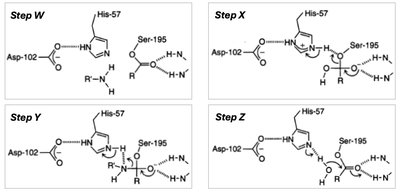
Q3. In Step Z, the His-57 side chain is acting as a ____________ to activate a molecule of water for _______ attack on the carbonyl carbon ________ of the acyl-enzyme intermediate.
Background
Topic: Enzyme Catalysis (Chymotrypsin Mechanism)
This question tests your understanding of the catalytic triad and the role of histidine in peptide bond hydrolysis.
Key Terms:
General acid/base catalysis: Refers to amino acid side chains acting as proton donors or acceptors.
Nucleophilic attack: When a nucleophile attacks an electrophilic center (e.g., carbonyl carbon).
Acyl-enzyme intermediate: A covalent enzyme-substrate complex formed during catalysis.
Step-by-Step Guidance
Identify the role of His-57 in Step Z (is it donating or accepting a proton?).
Determine whether water is acting as a nucleophile or electrophile in this step.
Decide which atom is being attacked (the carbonyl carbon of the acyl-enzyme intermediate).
Try solving on your own before revealing the answer!
Q4. In Step Y, the His-57 side chain is acting as a ____________ to stabilize and promote the formation of the _______ formed after the cleavage of the scissile bond of the peptide substrate.
Background
Topic: Enzyme Catalysis (Chymotrypsin Mechanism)
This question focuses on the stabilization of reaction intermediates and the role of His-57 after peptide bond cleavage.
Key Terms:
General acid/base catalysis
Leaving group: The part of the substrate that departs during bond cleavage.
Step-by-Step Guidance
Recall what happens immediately after the peptide bond is cleaved in chymotrypsin catalysis.
Determine whether His-57 is acting as an acid or base in this step.
Identify what is being stabilized (leaving group or nucleophile).
Try solving on your own before revealing the answer!
Q5. In Step X, the oxyanion pocket is stabilizing the high-energy ________ to _______ the activation free energy barrier.
Background
Topic: Transition State Stabilization in Enzyme Catalysis
This question tests your understanding of how enzymes lower activation energy by stabilizing transition states.
Key Terms:
Oxyanion pocket: A region in the enzyme that stabilizes negatively charged oxygen atoms in the transition state.
Transition state: The high-energy state during a reaction.
Activation free energy barrier: The energy required to reach the transition state.
Step-by-Step Guidance
Identify what the oxyanion pocket stabilizes during catalysis.
Determine the effect of this stabilization on the activation energy barrier.
Try solving on your own before revealing the answer!
Q6. The order of steps in the catalytic mechanism leading to the hydrolysis of peptide substrates by chymotrypsin is:
Background
Topic: Enzyme Mechanisms (Chymotrypsin)
This question tests your ability to sequence the steps in the catalytic mechanism of chymotrypsin.
Key Terms:
Chymotrypsin mechanism: Involves acylation and deacylation steps, with specific roles for Ser-195, His-57, and Asp-102.
Step-by-Step Guidance
Review the four steps (W, X, Y, Z) and what occurs in each.
Determine the logical sequence from substrate binding to product release.
Try solving on your own before revealing the answer!
