 Back
BackComprehensive Study Notes: Carbohydrates and Their Metabolic Pathways
Study Guide - Smart Notes
 Tailored notes based on your materials, expanded with key definitions, examples, and context.
Carbohydrates
Introduction to Carbohydrates
Carbohydrates are the most abundant biomolecules on earth and play essential roles in energy production, cellular recognition, and structural integrity. They are classified into three major groups based on their complexity:
Monosaccharides: Simple sugars consisting of a single polyhydroxyl aldehyde or ketone unit (e.g., glucose, fructose, galactose).
Oligosaccharides: Short chains of monosaccharide units joined by glycosidic bonds (e.g., sucrose, lactose).
Polysaccharides: Polymers with more than 20 monosaccharide units, also joined by glycosidic bonds (e.g., glycogen, cellulose).
Glycans are carbohydrates serving structural and protective functions, while glycoconjugates are complex carbohydrate polymers attached to proteins or lipids, influencing the fate and function of the hybrid molecules.
Monosaccharides
Key Structural Features
Monosaccharides have the empirical formula (CH2O)n and are classified based on their carbonyl group:
Aldoses: Contain an aldehyde group.
Ketoses: Contain a ketone group.
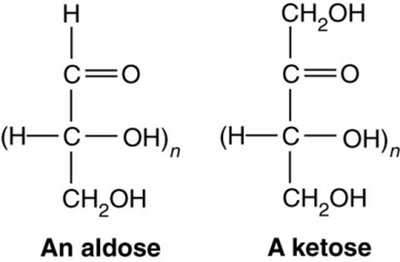
Chirality is a key feature, with the number of enantiomers determined by the formula 2n (where n is the number of chiral centers). Enantiomers are classified as D or L sugars based on the configuration of the asymmetric carbon furthest from the carbonyl group.
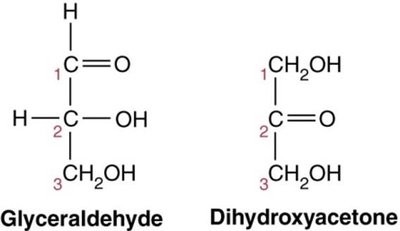
Examples of Simple Monosaccharides
Glyceraldehyde: The simplest aldose.
Dihydroxyacetone: The simplest ketose.
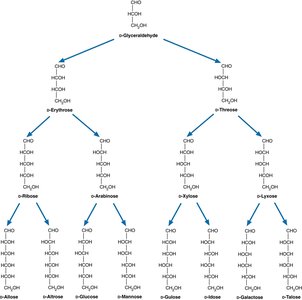
Monosaccharide Families and Isomerism
Monosaccharides are grouped into families based on their carbon number and configuration. The addition of chiral centers increases the number of possible isomers.
Cyclic Structures of Monosaccharides
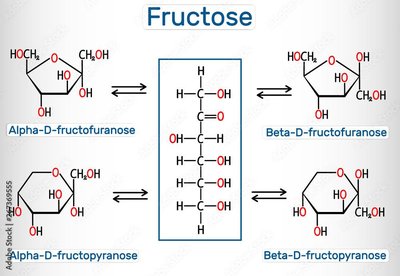
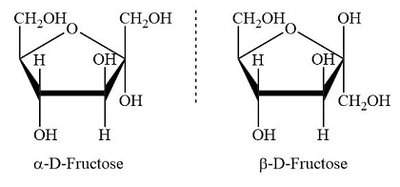
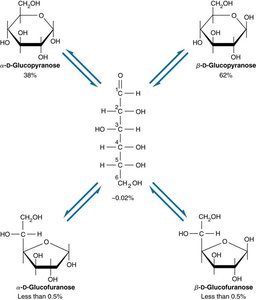
Monosaccharides interconvert between linear and cyclic forms, with cyclic forms being more stable and prevalent in biological systems. The two main types of rings are:
Furanoses: 5-membered rings
Pyranoses: 6-membered rings
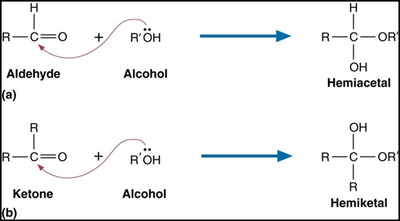
Formation of Hemiacetals and Hemiketals
Cyclic forms arise from the reaction of the carbonyl group with a hydroxyl group, forming hemiacetals (from aldehydes) or hemiketals (from ketones).
Fischer and Haworth Representations
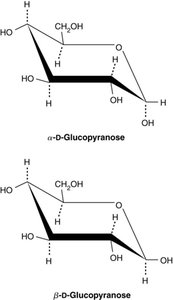
Monosaccharides can be represented in linear (Fischer) or cyclic (Haworth) forms. The carbonyl carbon becomes a new chiral center in the ring, leading to α and β isomers (anomers).
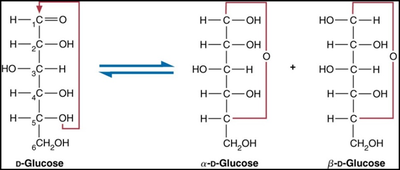
α and β Anomers of Glucose
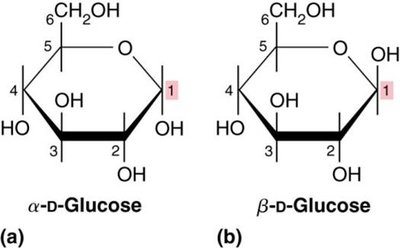
The α and β forms differ in the position of the hydroxyl group on the anomeric carbon:
α-D-Glucose: Hydroxyl group below the plane of the ring.
β-D-Glucose: Hydroxyl group above the plane of the ring.
Equilibrium Distribution of Glucose Structures
Glucose exists in equilibrium between its linear and cyclic forms, with the β-D-glucopyranose form being the most prevalent in solution.
Monosaccharides as Reducing Agents
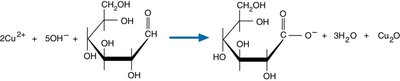
Monosaccharides, especially aldoses, act as reducing agents due to their free aldehyde groups. The Benedict's test is used to identify reducing sugars by the reduction of copper(II) ions to copper(I) oxide, resulting in a color change.
Disaccharides
Structure and Examples
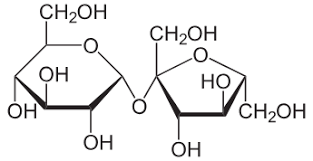
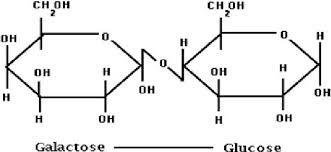
Disaccharides are formed by the glycosidic linkage of two monosaccharides and play crucial roles in nutrition and metabolism.
Sucrose: Composed of glucose and fructose, linked by an α(1→2) or β(2→1) glycosidic bond.
Lactose: Composed of galactose and glucose, linked by a β(1→4) glycosidic bond.
Metabolism
Central Position of Glucose in Metabolism
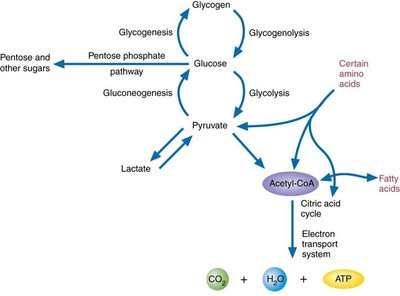
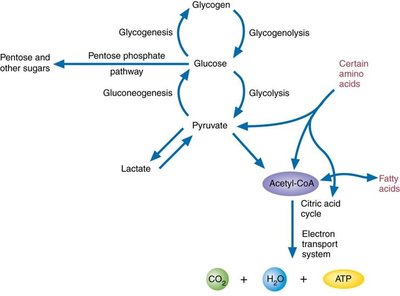
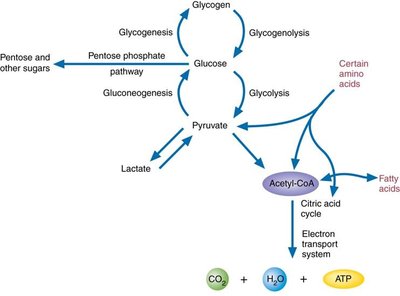
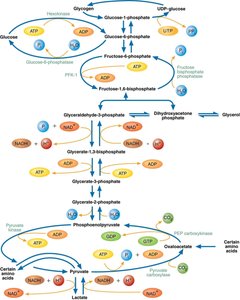
Glucose is a central metabolic hub, linking glycolysis, glycogenesis, glycogenolysis, gluconeogenesis, the pentose phosphate pathway, and the citric acid cycle.
Glycolysis
Overview and Stages
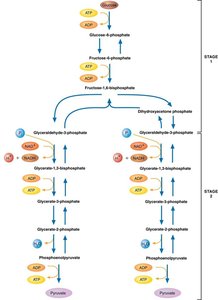
Glycolysis is a series of anaerobic enzymatic reactions occurring in the cytoplasm, converting glucose to pyruvate and generating ATP and NADH. It consists of two main stages:
Stage 1 (Investment): ATP is consumed to prime glucose and split it into two three-carbon molecules.
Stage 2 (Pay-Off): ATP and NADH are produced, and pyruvate is formed.
Investment Stage
Key enzymes include hexokinase (most tissues) and glucokinase (liver), which phosphorylate glucose. Glucokinase has a higher Km for glucose and is not inhibited by glucose-6-phosphate.
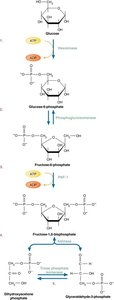
Phosphoglucoisomerase catalyzes a reversible reaction, also important in the pentose phosphate pathway and gluconeogenesis.
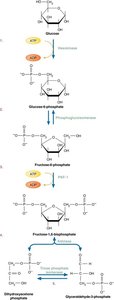
Phosphofructokinase-1 (PFK1) is the rate-limiting enzyme, regulated allosterically by AMP, fructose-2,6-bisphosphate (activators), and ATP, citrate (inhibitors). Aldolase catalyzes a reversible reaction, affected by substrate and product concentrations.
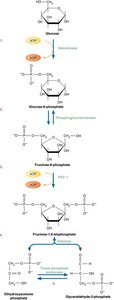
Pay-Off Stage
ATP is synthesized via substrate-level phosphorylation, and NADH is produced. Key enzymes include:
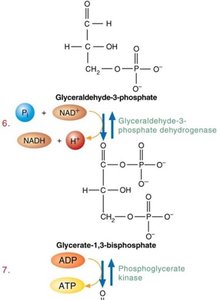
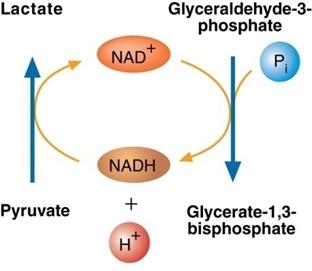
Glyceraldehyde-3-Phosphate Dehydrogenase (GAPDH): Oxidizes G3P, adds inorganic phosphate, and reduces NAD+ to NADH.
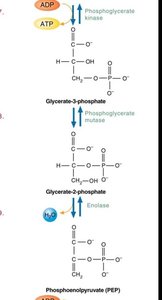
Phosphoglycerate Kinase (PGK): Transfers phosphate from 1,3-BPG to ADP, generating ATP.
Phosphoglycerate Mutase: Transfers phosphate within the molecule.
Enolase: Catalyzes dehydration, forming phosphoenolpyruvate (PEP).
Pyruvate Kinase: Transfers phosphate from PEP to ADP, forming pyruvate and ATP.
Fate of Pyruvate
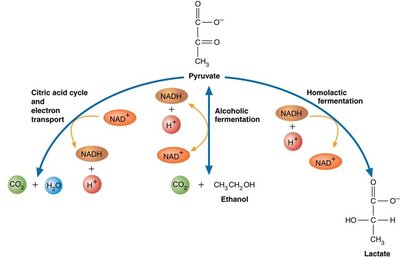
Pyruvate is a metabolic hub, linking glycolysis to the citric acid cycle, fermentation, gluconeogenesis, amino acid, and fatty acid synthesis. Its fate depends on oxygen availability and cellular energy needs.
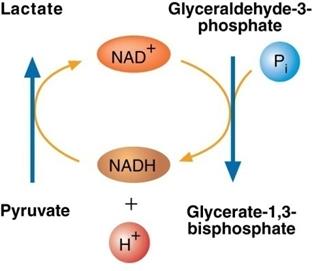
Lactic Acid Fermentation
Occurs under anaerobic conditions, regenerating NAD+ to maintain glycolysis, especially in muscle cells during strenuous activity.
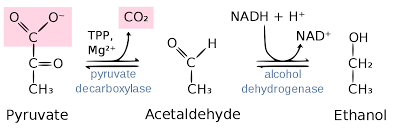
Alcoholic Fermentation
Occurs in yeast and some bacteria under anaerobic conditions, regenerating NAD+ to maintain glycolysis.
Regulation of Glycolysis
Phosphofructokinase-1 (PFK-1) Structure and Regulation
PFK-1 is a tetrameric enzyme with muscle (M) and liver (L) isoforms. It catalyzes the rate-limiting step in glycolysis and is regulated by allosteric activators (AMP, fructose-2,6-bisphosphate) and inhibitors (ATP, citrate).
Muscle vs. Liver Isozymes
Muscle PFK: Rapid response to energy demand, sensitive to AMP and ATP.
Liver PFK: Regulates blood glucose, sensitive to fructose-2,6-bisphosphate, less sensitive to ATP.
Pentose Phosphate Pathway (PPP)
Overview and Functions
The PPP occurs in the cytosol and serves two main functions:
Production of NADPH (for fatty acid, cholesterol, and antioxidant biosynthesis).
Synthesis of ribose-5-phosphate (for nucleic acid biosynthesis).
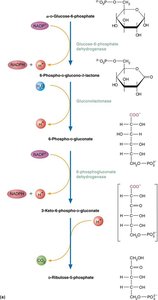
Phases of PPP
Oxidative Phase: Irreversible reactions, conversion of glucose-6-phosphate to ribulose-5-phosphate, generation of NADPH.
Non-oxidative Phase: Reversible reactions, production of ribose-5-phosphate and integration of other sugars into metabolism.
Polysaccharides
Overview and Functions
Polysaccharides are long chains of monosaccharides linked by glycosidic bonds. They serve as energy storage (starch, glycogen) and structural support (cellulose).
Starch
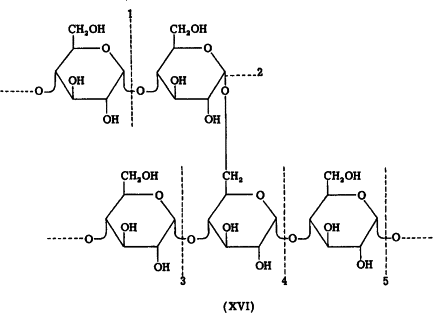
Amylose: Linear, α(1→4) linkage, 20-30% of starch.
Amylopectin: Branched, α(1→6) linkage, 70-80% of starch.
Cellulose
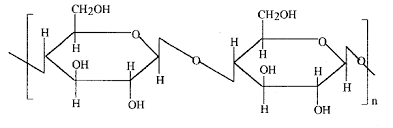
Linear polysaccharide of β-D-glucopyranose units, β(1→4) linkage.
Forms strong fibers via hydrogen bonds, not digestible by humans but important as dietary fiber.
Glycogen
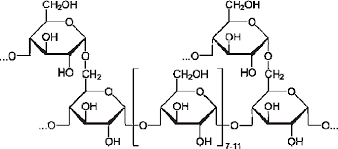
Branched polysaccharide of α-D-glucopyranose units.
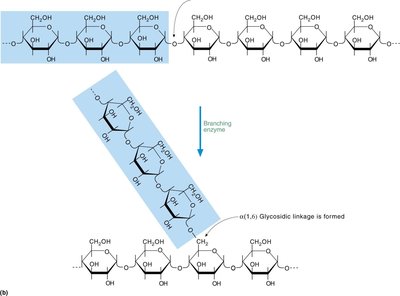
Linear chains: α(1→4); branches: α(1→6) after every 8-12 units.
Major energy storage in muscle and liver.
Glycogen Metabolism
Glycogenesis
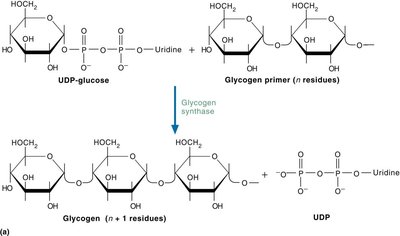
Glycogenesis converts glucose into glycogen for storage, primarily in liver and muscle. Key steps include phosphorylation, conversion to glucose-1-phosphate, activation to UDP-glucose, chain elongation, and branch formation. Regulation is hormonal (insulin) and allosteric (G6P).
Glycogenolysis
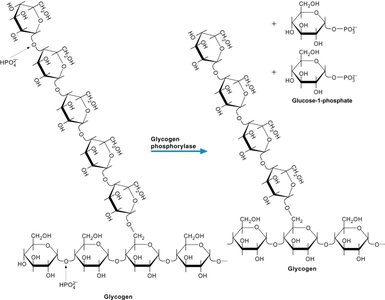
Glycogenolysis breaks down glycogen to release glucose. Key steps include phosphorylation (glycogen phosphorylase), debranching (debranching enzyme), and conversion to glucose-6-phosphate. Regulation is hormonal (glucagon, epinephrine) and allosteric (AMP, G6P).
Regulation of Glycogen Metabolism
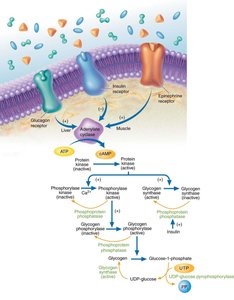
Insulin: Promotes glycogenesis, inhibits glycogenolysis.
Glucagon: Activates glycogen phosphorylase, inhibits glycogen synthase.
Epinephrine: Activates glycogen phosphorylase in muscle during stress.
Gluconeogenesis
Overview
Gluconeogenesis synthesizes glucose from non-carbohydrate precursors (lactate, glycerol, amino acids), primarily in the liver. It maintains blood glucose during fasting or prolonged exercise.
Key Enzymes and Regulation
Pyruvate Carboxylase: Pyruvate to oxaloacetate.
Phosphoenolpyruvate Carboxykinase (PEPCK): Oxaloacetate to phosphoenolpyruvate.
Fructose-1,6-Bisphosphatase: Fructose-1,6-bisphosphate to fructose-6-phosphate.
Glucose-6-Phosphatase: Glucose-6-phosphate to glucose.
Regulation
Hormonal: Stimulated by glucagon and cortisol during fasting; inhibited by insulin in fed states.
Allosteric: Key enzymes regulated by metabolites; fructose-1,6-bisphosphate is central.
Tcells
Summary Table: Major Carbohydrate Types
Type | Structure | Function | Example |
|---|---|---|---|
Monosaccharide | Single unit | Energy, building block | Glucose |
Disaccharide | Two units | Nutrition, metabolism | Sucrose |
Polysaccharide | Many units | Storage, structure | Glycogen |
Key Equations
Glycolysis overall reaction:
Investment stage:
Pay-off stage:
Additional info:
Some context and regulatory mechanisms were expanded for clarity and completeness.
Tables and pathways were logically grouped and explained for self-contained study utility.
