 Back
BackComprehensive Study Notes: Central Metabolic Pathways and Regulation in Biochemistry
Study Guide - Smart Notes
 Tailored notes based on your materials, expanded with key definitions, examples, and context.
The Citric Acid Cycle (TCA Cycle)
Overview and Steps of the TCA Cycle
The tricarboxylic acid (TCA) cycle, also known as the Krebs cycle or citric acid cycle, is a central metabolic pathway that oxidizes acetyl-CoA to CO2 and generates high-energy electron carriers (NADH, FADH2) and GTP/ATP. It is essential for energy production in aerobic organisms.
Location: Mitochondrial matrix in eukaryotes.
Main function: Complete oxidation of acetyl groups, generation of reducing equivalents for the electron transport chain (ETC).
Key products per turn: 3 NADH, 1 FADH2, 1 GTP (or ATP), 2 CO2.
Key Steps and Enzymes
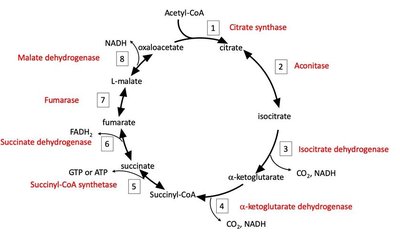
Step 1: Citrate synthase catalyzes condensation of acetyl-CoA and oxaloacetate to form citrate.
Step 2: Aconitase converts citrate to isocitrate via cis-aconitate.
Step 3: Isocitrate dehydrogenase oxidizes isocitrate to α-ketoglutarate, producing NADH and CO2.
Step 4: α-Ketoglutarate dehydrogenase converts α-ketoglutarate to succinyl-CoA, producing NADH and CO2.
Step 5: Succinyl-CoA synthetase converts succinyl-CoA to succinate, generating GTP (or ATP).
Step 6: Succinate dehydrogenase oxidizes succinate to fumarate, producing FADH2.
Step 7: Fumarase hydrates fumarate to L-malate.
Step 8: Malate dehydrogenase oxidizes L-malate to oxaloacetate, producing NADH.
Energetics of the TCA Cycle
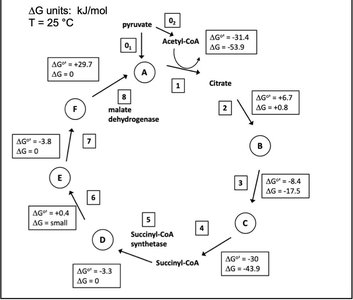
Each step has a characteristic standard free energy change (ΔG°').
Key regulatory steps are those with large negative ΔG°' values (irreversible steps).
Detailed Mechanism: Hydration of Fumarate to Malate (Step 7)
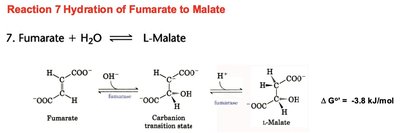
This reaction is catalyzed by fumarase and involves the addition of water to fumarate, forming L-malate. The reaction proceeds via a carbanion transition state.
Equation:
ΔG°': -3.8 kJ/mol
Regulation of the TCA Cycle
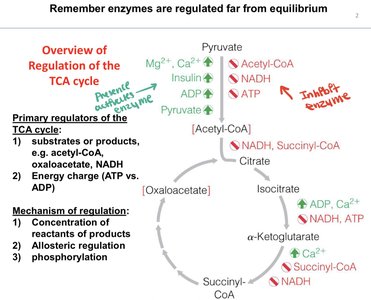
The TCA cycle is tightly regulated to meet cellular energy demands. Regulation occurs primarily at steps catalyzed by citrate synthase, isocitrate dehydrogenase, and α-ketoglutarate dehydrogenase.
Activators: ADP, Ca2+, pyruvate, insulin (stimulates pyruvate dehydrogenase complex)
Inhibitors: ATP, NADH, succinyl-CoA, citrate, acetyl-CoA
Mechanisms: Allosteric regulation, substrate/product concentration, covalent modification (phosphorylation)
Pyruvate Dehydrogenase Complex (PDC)
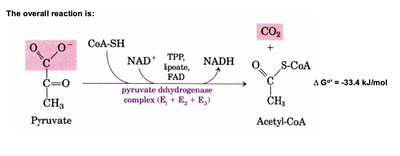
The PDC links glycolysis and the TCA cycle by converting pyruvate to acetyl-CoA. It is a multienzyme complex requiring several cofactors (TPP, lipoate, FAD, NAD+, CoA-SH).
Reaction:
ΔG°': -33.4 kJ/mol
Regulation: Activated by insulin, inhibited by NADH and acetyl-CoA
Fatty Acid Metabolism
β-Oxidation of Fatty Acids
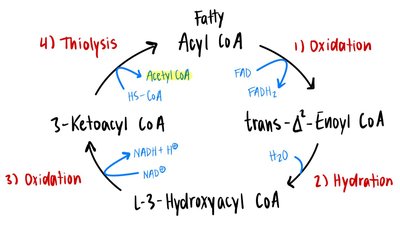
β-oxidation is the catabolic process by which fatty acids are broken down in the mitochondrial matrix to generate acetyl-CoA, NADH, and FADH2.
Location: Mitochondrial matrix
Steps:
Oxidation (FAD-dependent)
Hydration
Oxidation (NAD+-dependent)
Thiolysis (cleavage by CoA)
Products: Acetyl-CoA (enters TCA cycle), NADH and FADH2 (enter ETC), shortened fatty acyl-CoA
Fatty Acid Synthesis
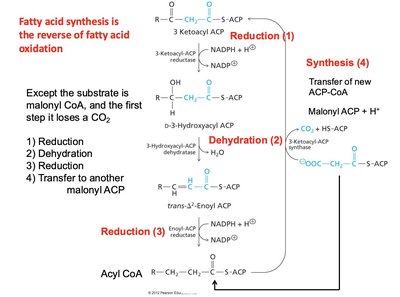
Fatty acid synthesis is the anabolic process of creating fatty acids from acetyl-CoA and malonyl-CoA, occurring in the cytosol. It is essentially the reverse of β-oxidation, but with distinct enzymes and intermediates.
Location: Cytosol
Steps:
Reduction
Dehydration
Reduction
Transfer to another malonyl-ACP
Nature: Anabolic (requires energy input, NADPH)
Electron Transport Chain (ETC) and Oxidative Phosphorylation
Overview of the ETC
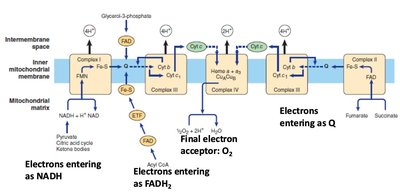
The ETC is a series of protein complexes in the inner mitochondrial membrane that transfer electrons from NADH and FADH2 to oxygen, generating a proton gradient used to synthesize ATP.
Complexes: I (NADH dehydrogenase), II (succinate dehydrogenase), III (cytochrome bc1), IV (cytochrome c oxidase)
Mobile carriers: Ubiquinone (Q), cytochrome c
Final electron acceptor: O2
Q cycle: Mechanism in Complex III that transfers electrons from QH2 to cytochrome c and pumps protons across the membrane
Photosynthesis: Light Reactions and CO2 Assimilation
Light Reactions
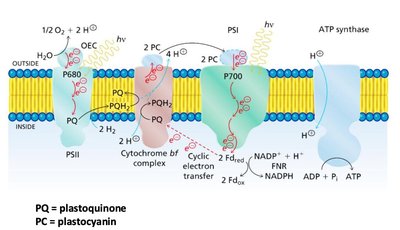
Photosynthetic light reactions occur in the thylakoid membranes and involve the transfer of electrons from water to NADP+, forming NADPH and generating ATP via a proton gradient.
Non-cyclic pathway: H2O → PSII → Cyt bf complex → Plastocyanin → PSI → Fd → NADPH
Cyclic pathway: PSI → Fd → PQ → Cyt bf → PC → PSI (generates ATP only)
Key products: ATP, NADPH, O2
CO2 Assimilation (Calvin Cycle)
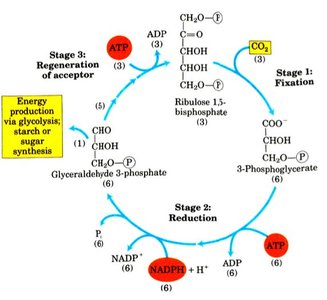
The Calvin cycle is the set of biochemical reactions that assimilate CO2 into organic molecules in the chloroplast stroma. It consists of three main stages:
Stage 1: Fixation – CO2 is fixed to ribulose 1,5-bisphosphate, forming 3-phosphoglycerate.
Stage 2: Reduction – 3-phosphoglycerate is reduced to glyceraldehyde 3-phosphate using ATP and NADPH.
Stage 3: Regeneration – Ribulose 1,5-bisphosphate is regenerated for continued CO2 fixation.
Summary Table: Key Regulatory Points in Central Metabolism
Pathway | Key Regulatory Enzyme(s) | Activators | Inhibitors |
|---|---|---|---|
TCA Cycle | Citrate synthase, Isocitrate dehydrogenase, α-Ketoglutarate dehydrogenase | ADP, Ca2+, Insulin | ATP, NADH, Succinyl-CoA, Citrate |
Pyruvate Dehydrogenase | Pyruvate dehydrogenase complex | Insulin, ADP, Ca2+ | NADH, Acetyl-CoA, ATP |
β-Oxidation | Carnitine acyltransferase I (entry step) | AMP | Malonyl-CoA |
Fatty Acid Synthesis | Acetyl-CoA carboxylase | Citrate, Insulin | Palmitoyl-CoA, Glucagon |
Additional info: These notes integrate diagrams and mechanisms from the provided images, expanding on regulatory mechanisms, energetics, and the integration of metabolic pathways. The content is structured to facilitate exam preparation and conceptual understanding for biochemistry students.
