Back
BackComprehensive Study Notes: Enzyme Kinetics and Enzyme Inhibition
Study Guide - Smart Notes
 Tailored notes based on your materials, expanded with key definitions, examples, and context.
Enzymes: Biological Catalysts
Definition and General Properties
Enzymes are biological catalysts that accelerate biochemical reactions without being consumed. Most enzymes are proteins, though some RNA molecules (ribozymes) also possess catalytic activity. Enzymes exhibit remarkable specificity for their substrates and function efficiently under mild physiological conditions, making them essential for all metabolic processes.
Specificity: Enzymes selectively recognize proper substrates, producing products in high yields (often >95%).
Structure: The unique fit of substrate with enzyme controls selectivity and product yield.
Industrial Significance: Engineered enzymes are increasingly important in biotechnology, pharmaceuticals, and synthetic biology.
Enzyme Cofactors: Metal Ions and Coenzymes
Types and Functions
Many enzymes require non-protein components called cofactors for activity. These include metal ions and organic molecules (coenzymes), which may be loosely or tightly bound to the enzyme.
Cofactors: Non-protein chemical components required for enzyme activity. The protein alone (apoenzyme) is inactive without them.
Coenzymes: Organic cofactors, often derived from vitamins, that act as transient carriers of functional groups (e.g., NAD+, FAD).
Metal Ions: Inorganic cofactors (e.g., Fe2+, Mg2+, Zn2+) that help orient substrates, stabilize charges, or participate in redox reactions.
Prosthetic Groups: Tightly or covalently bound cofactors.
Holoenzyme: The catalytically active complex of apoenzyme and cofactor.
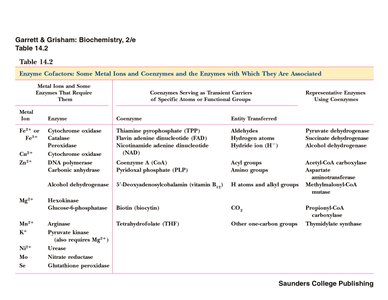
Metal Ion | Enzyme | Coenzyme | Entity Transferred | Representative Enzyme |
|---|---|---|---|---|
Fe2+ | Cytochrome oxidase | Thiamine pyrophosphate (TPP) | Aldehyde group | Pyruvate dehydrogenase |
Cu2+ | Cytochrome oxidase | Flavin adenine dinucleotide (FAD) | Hydride ion | Succinate dehydrogenase |
Zn2+ | Alcohol dehydrogenase | Nicotinamide adenine dinucleotide (NAD+) | Hydride ion | Lactate dehydrogenase |
Mg2+ | Hexokinase | Biotin | CO2 | Propionyl-CoA carboxylase |
Mn2+ | Arginase | Tetrahydrofolate (THF) | Other one-carbon groups | Thymidylate synthase |
Enzyme Structure: The Active Site
Active Site Characteristics
The active site is a specific three-dimensional region where the substrate binds and catalysis occurs. It is formed by a small number of amino acid residues brought together by the protein's 3D folding. The active site's shape and chemical environment dictate substrate specificity and catalytic mechanism.
Active site residues are crucial for both substrate binding and catalysis.
Modern research highlights the importance of active site dynamics and flexibility in catalysis and drug design.
Introduction to Enzyme Kinetics
Understanding Reaction Rates
Enzyme kinetics is the study of the rates of enzyme-catalyzed reactions. It provides quantitative insights into enzyme mechanisms, efficiency, and regulation. By analyzing reaction rates, important parameters such as Vmax and KM can be determined.
Factors Affecting Enzyme Activity
Substrate Concentration ([S]): Primary focus of kinetics experiments.
Enzyme Concentration ([E]): Rate is proportional to [E] if substrate is not limiting.
Temperature: Each enzyme has an optimal temperature; high temperatures can cause denaturation.
pH: Each enzyme has an optimal pH; extremes can denature the enzyme.
Inhibitors/Activators: Molecules that decrease or increase enzyme activity.
Measuring Enzyme Activity: Initial Velocity (v0)
Definition and Importance
The initial velocity (v0) is the rate of product formation measured at the very beginning of the reaction. It is used because substrate concentration is effectively constant, product inhibition is minimal, and enzyme activity is maximal.
Effect of Substrate Concentration on Reaction Rate
Hyperbolic Kinetics
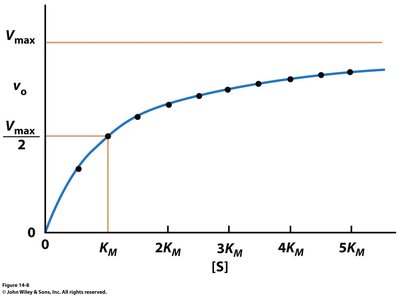
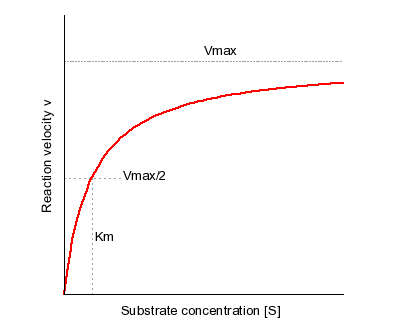
When enzyme concentration is constant, increasing substrate concentration produces a characteristic hyperbolic curve:
At low [S]: v0 is proportional to [S] (first-order kinetics).
At high [S]: The enzyme is saturated, and v0 approaches Vmax (zero-order kinetics).
The Michaelis-Menten Model
Reaction Scheme and Assumptions
The Michaelis-Menten model describes the kinetics of many enzyme-catalyzed reactions. The basic reaction scheme is:

Single substrate, single product.
Steady-state assumption: [ES] remains constant during initial velocity measurement.
Product release is rapid/irreversible.
Overall rate depends on k2 (rate-limiting step).
Michaelis-Menten Equation
The Michaelis-Menten equation mathematically describes the relationship between initial velocity (v0), substrate concentration ([S]), Vmax, and KM:
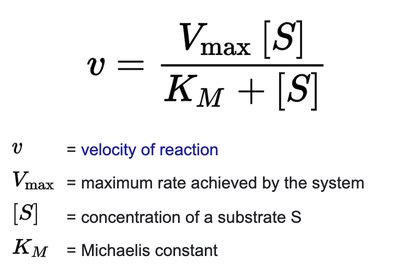
Vmax: Maximum reaction rate when enzyme is saturated with substrate.
KM: Substrate concentration at which v0 = Vmax/2; often reflects enzyme's affinity for substrate.
Interpreting KM and Vmax
KM: Lower KM indicates higher affinity; higher KM indicates lower affinity.
Vmax: Directly proportional to total enzyme concentration.
Dual Nature of the Michaelis-Menten Equation
At low [S]: First-order kinetics (rate depends on [S]).
At high [S]: Zero-order kinetics (rate independent of [S]).
The Turnover Number (kcat)
Definition and Examples
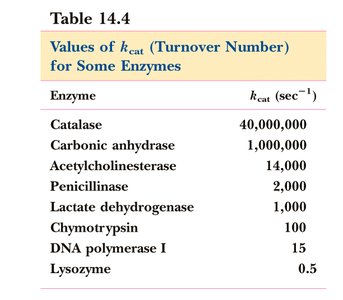
The turnover number (kcat) is the number of substrate molecules converted to product per enzyme molecule per unit time when the enzyme is saturated with substrate.
Units: s−1
Values range from less than 1/sec to millions/sec.
Enzyme | kcat (sec−1) |
|---|---|
Catalase | 40,000,000 |
Carbonic anhydrase | 1,000,000 |
Acetylcholinesterase | 14,000 |
Penicillinase | 2,000 |
Lactate dehydrogenase | 1,000 |
Chymotrypsin | 100 |
DNA polymerase I | 15 |
Lysozyme | 0.5 |
Catalytic Efficiency: The kcat/KM Ratio
Definition and Biological Significance
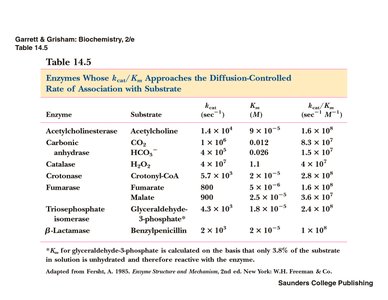
The ratio kcat/KM is a measure of an enzyme's overall catalytic efficiency, reflecting both substrate affinity and catalytic rate. It is called the specificity constant and is especially relevant at low substrate concentrations.
Upper limit is the diffusion limit (108–109 M−1s−1).
Highly efficient enzymes ("perfect enzymes") approach this limit.
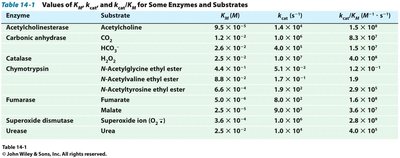
Enzyme | Substrate | KM (M) | kcat (s−1) | kcat/KM (M−1s−1) |
|---|---|---|---|---|
Acetylcholinesterase | Acetylcholine | 5.5 × 10⁻⁴ | 1.4 × 10⁴ | 1.3 × 10⁷ |
Carbonic anhydrase | CO2 | 1.2 × 10⁻³ | 1.0 × 10⁶ | 8.3 × 10⁸ |
Catalase | H2O2 | 2.5 × 10⁻² | 4.0 × 10⁷ | 1.6 × 10⁹ |
Linearizing the Michaelis-Menten Equation: Lineweaver-Burk Plot
Double Reciprocal Plot
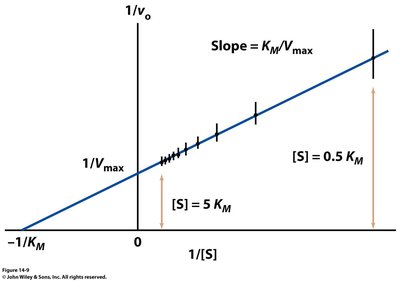
The Lineweaver-Burk plot is a double reciprocal plot used to determine KM and Vmax graphically. It is derived by taking the reciprocal of both sides of the Michaelis-Menten equation:
Y-intercept: 1/Vmax
X-intercept: −1/KM
Slope: KM/Vmax
Enzyme Inhibition and Regulation
Types of Inhibition
Enzyme inhibitors are molecules that decrease enzyme activity. Inhibition is a key regulatory mechanism in metabolism and is the basis for many drugs. Inhibitors are classified as reversible or irreversible.
Reversible Inhibitors: Bind noncovalently and can dissociate from the enzyme.
Irreversible Inhibitors: Bind covalently, permanently inactivating the enzyme.
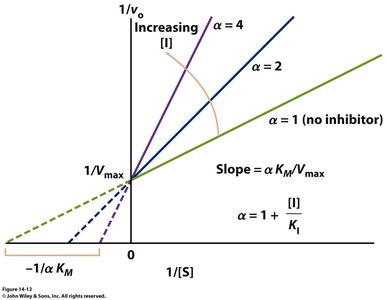
Reversible Inhibition: Competitive Inhibition
Inhibitor resembles substrate and competes for the active site.
Vmax is unchanged; KM increases.
Examples: Malonate (succinate dehydrogenase inhibitor), statins.
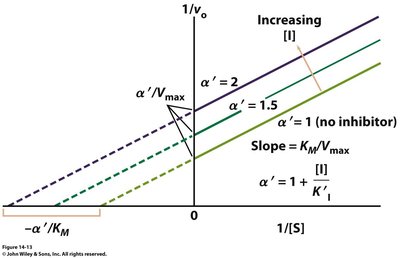
Reversible Inhibition: Uncompetitive Inhibition
Inhibitor binds only to the ES complex, forming an inactive ESI complex.
Both Vmax and KM decrease.
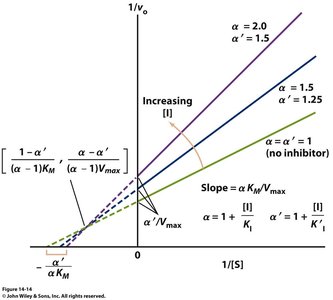
Reversible Inhibition: Noncompetitive (Mixed) Inhibition
Inhibitor binds to a site distinct from the active site, to either E or ES.
Vmax decreases; KM may increase, decrease, or remain unchanged depending on inhibitor affinities.
Examples: Many metal ions (e.g., Hg2+, Pb2+).
Irreversible Inhibition
Inhibitor forms a covalent bond with the enzyme, permanently inactivating it.
Examples: Aspirin (COX inhibitor), penicillin (transpeptidase inhibitor).
Suicide inhibitors are substrate analogs that inactivate the enzyme during catalysis.
Summary Table: Kinetic Parameters for Selected Enzymes
Enzyme | Substrate | KM (M) | kcat (s−1) | kcat/KM (M−1s−1) |
|---|---|---|---|---|
Acetylcholinesterase | Acetylcholine | 5.5 × 10⁻⁴ | 1.4 × 10⁴ | 1.3 × 10⁷ |
Carbonic anhydrase | CO2 | 1.2 × 10⁻³ | 1.0 × 10⁶ | 8.3 × 10⁸ |
Catalase | H2O2 | 2.5 × 10⁻² | 4.0 × 10⁷ | 1.6 × 10⁹ |
Chymotrypsin | N-Acetyltyrosine ethyl ester | 8.4 × 10⁻⁵ | 5.0 × 101 | 5.9 × 10⁵ |
Fumarase | Fumarate | 5.6 × 10⁻⁶ | 9.0 × 10² | 1.6 × 10⁸ |