 Back
Comprehensive Study Notes: Enzyme Structure, Function, and Kinetics
Study Guide - Smart Notes
 Tailored notes based on your materials, expanded with key definitions, examples, and context.
Enzymes: Structure, Function, and Catalysis
General Introduction to Enzymes
Enzymes are protein-based catalysts that accelerate biochemical reactions by lowering the activation energy barrier, without altering the equilibrium or the overall free energy change (ΔG) of the reaction. Their regulation is possible through post-translational modifications and allosteric ligands, making them essential for biological control.
Catalyst: A molecule that increases reaction rate by lowering activation energy and is regenerated after the reaction.
Activation Energy (ΔG‡): The energy barrier that must be overcome for a reaction to proceed.
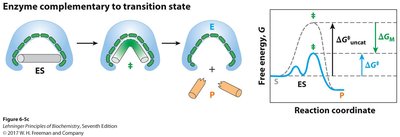
Transition State Stabilization: Enzymes bind the transition state more tightly than the substrate, releasing binding energy to lower the activation barrier.
Substrate Orientation: Enzymes orient substrates to promote reaction and stabilize the transition state.
Equilibrium Constant (K): Determines the ratio of products to reactants at equilibrium; unaffected by enzymes.
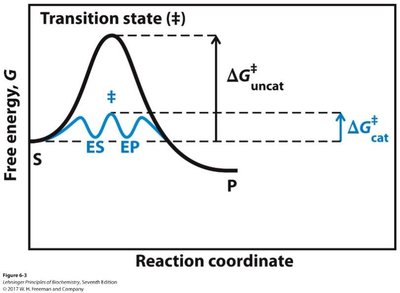
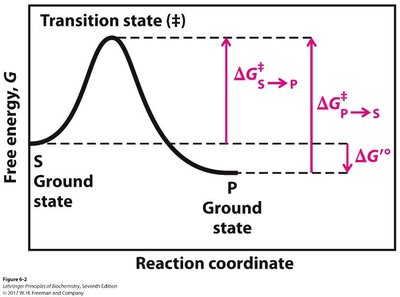
Example: ATP hydrolysis is thermodynamically favorable (large negative ΔG) but kinetically slow without enzymes, demonstrating the necessity of enzymatic control in group transfer reactions.
Rate Enhancements by Enzymes
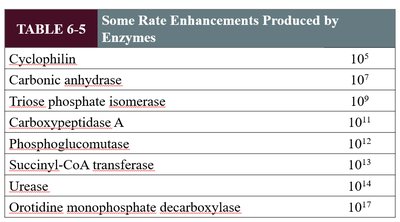
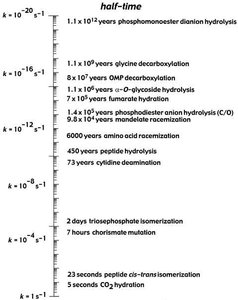
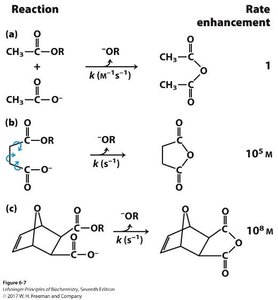
Enzymes can increase reaction rates by many orders of magnitude compared to uncatalyzed reactions. This is illustrated by the rate enhancements and half-lives of various biochemical reactions.
Rate Enhancement: The fold increase in reaction rate due to enzyme catalysis.
Half-life: The time required for half of the substrate to be converted to product; dramatically reduced by enzymes.
Enzyme | Rate Enhancement |
|---|---|
Cyclophilin | 105 |
Carbonic anhydrase | 107 |
Triose phosphate isomerase | 109 |
Carboxypeptidase A | 1011 |
Phosphoglucomutase | 1012 |
Succinyl-CoA transferase | 1013 |
Urease | 1014 |
Orotidine monophosphate decarboxylase | 1017 |
Transition State Stabilization and Substrate Orientation
Enzymes achieve catalysis by stabilizing the transition state and orienting substrates. The active site is often complementary to the transition state, not the substrate, which is exploited in the design of transition state analog inhibitors.
Transition State Analogs: Molecules designed to mimic the transition state and inhibit enzymes by tight binding.
Proximity Effect: Bringing reactive groups close together increases reaction rate.
Enzyme Kinetics
Steady-State (Michaelis-Menten) Kinetics
Enzyme kinetics is the quantitative study of enzyme activity. The most common approach is steady-state kinetics, described by the Michaelis-Menten equation. Initial rates are measured to avoid complications from product inhibition and reverse reactions.
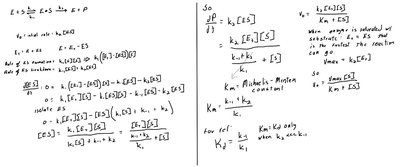
Steady-State Assumption: The rate of ES formation equals the rate of its breakdown during the initial phase of the reaction.
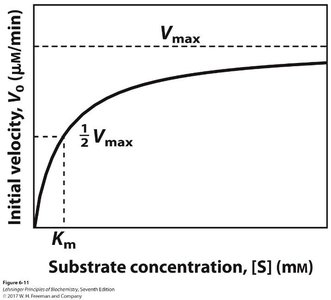
Michaelis-Menten Constant (Km): ; substrate concentration at which the reaction rate is half-maximal.
Maximum Velocity (Vmax): The rate when the enzyme is saturated with substrate.
Turnover Number (kcat): ; number of substrate molecules converted per enzyme per second.
Catalytic Efficiency (kcat/Km): A measure of enzyme specificity and efficiency; for a "perfect" enzyme, this approaches the diffusion limit (108-109 M-1s-1).
Plotting Kinetic Data
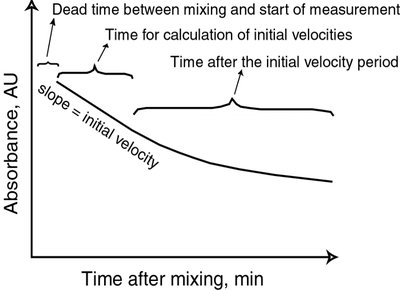
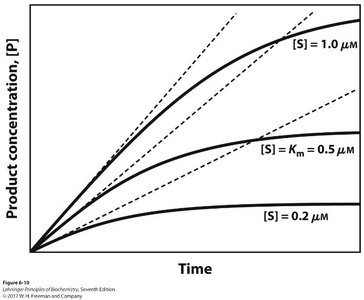
Enzyme activity is typically measured by monitoring product formation over time and plotting initial velocity versus substrate concentration.
Initial Velocity (V0): The slope of product formation at the start of the reaction.
Michaelis-Menten Plot: Shows V0 versus [S], with Vmax and Km indicated.
Lineweaver-Burk (Double Reciprocal) Plot
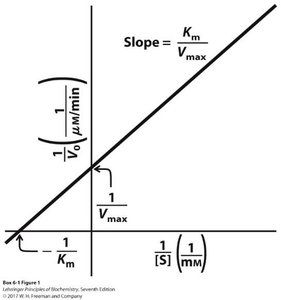
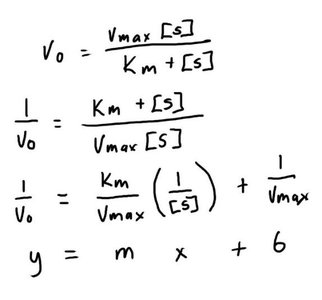
The Lineweaver-Burk plot linearizes the Michaelis-Menten equation for easier determination of kinetic parameters:
Equation:
Slope:
Y-intercept:
X-intercept:
Two Substrate Reactions
Sequential and Ping-Pong Mechanisms
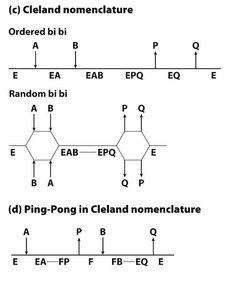
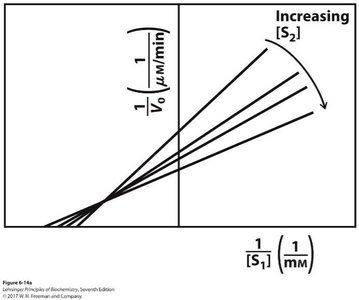
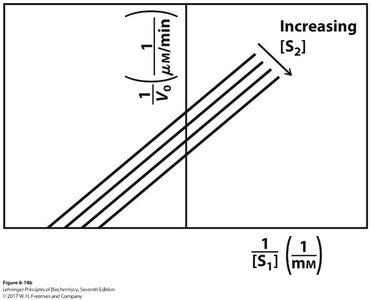
Enzymes often catalyze reactions involving two substrates. The kinetic mechanism can be sequential (ordered or random) or ping-pong (double displacement), distinguished by Lineweaver-Burk plots.
Sequential Mechanism: Both substrates bind before product is released; lines intersect on L-B plot.
Ping-Pong Mechanism: One substrate binds and modifies the enzyme, which then reacts with the second substrate; parallel lines on L-B plot.
Enzyme Inhibition
Types of Inhibition
Enzyme inhibitors are classified as irreversible or reversible. Reversible inhibitors include competitive, uncompetitive, noncompetitive, and mixed types, each with distinct effects on kinetic parameters and characteristic Lineweaver-Burk plots.
Irreversible Inhibitors: Covalently modify the enzyme, permanently inactivating it.
Activity-Based Probes: Irreversible inhibitors tagged for quantification of active enzymes.
Reversible Inhibitors: Bind non-covalently and can dissociate; include competitive, uncompetitive, noncompetitive, and mixed types.
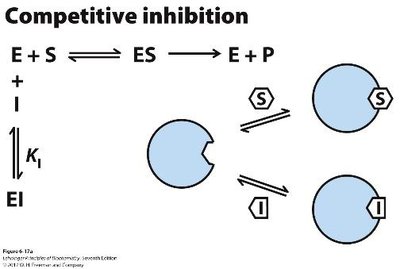
Competitive Inhibition
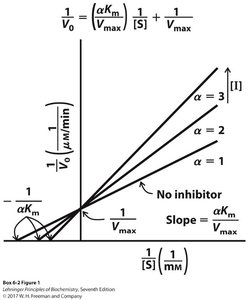
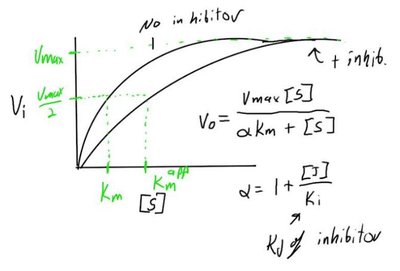
Competitive inhibitors bind to the free enzyme, blocking substrate binding. Increasing substrate concentration can overcome inhibition.
Effect: Apparent Km increases; Vmax unchanged.
Modified Equation: , where
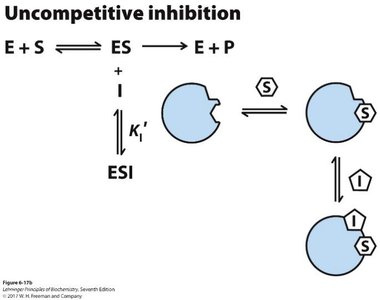
Uncompetitive Inhibition
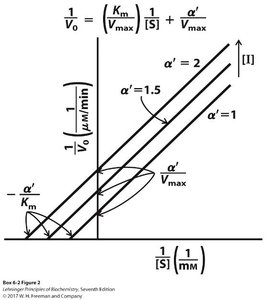
Uncompetitive inhibitors bind only to the ES complex, decreasing both apparent Km and Vmax by the same factor.
Effect: Both Km and Vmax decrease; kcat/Km unchanged.
Modified Equation: , where
Mixed and Noncompetitive Inhibition
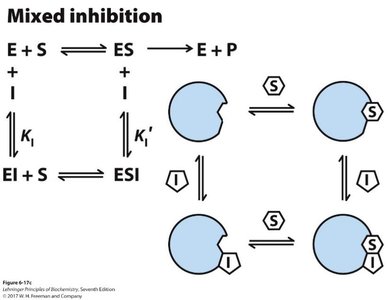
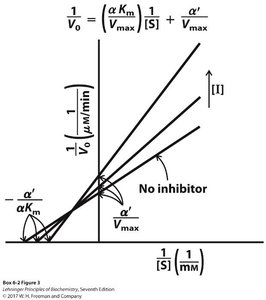
Mixed inhibitors bind to both free enzyme and ES complex, affecting both Km and Vmax. Noncompetitive inhibition is a special case where binding affinity is equal for both forms.
Effect: Mixed: Both Km and Vmax change; Noncompetitive: Km unchanged, Vmax decreases.
Modified Equation:
Applied Enzyme Kinetics: Ras and Cancer Therapy
Ras Protein Processing and Targeting
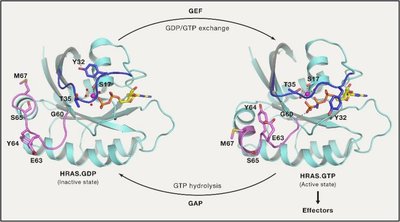
Ras is a small GTPase acting as a molecular switch for cell growth. Its activity is regulated by GTPase activating proteins (GAPs) and guanine nucleotide exchange factors (GEFs). Mutations in Ras are implicated in many cancers.
Post-translational Modification: Farnesyltransferase (FTase) attaches a farnesyl group to Ras, enabling membrane localization.
Therapeutic Target: FTase inhibitors (FTIs) were developed to block Ras localization, but alternative prenylation by GGTase-I can bypass this block.
Catalytic Efficiency: kcat/Km is used to compare substrate analogs and predict product distribution when substrates compete for the same enzyme.
Chymotrypsin: Mechanism and Evidence
Chymotrypsin Mechanism
Chymotrypsin is a serine protease that cleaves peptide bonds on the carboxyl side of aromatic amino acids. Its mechanism involves a catalytic triad (Asp102, His57, Ser195), a hydrophobic specificity pocket, an oxyanion hole, and a covalent acyl-enzyme intermediate.
Catalytic Triad: Asp102, His57, Ser195; enables activation of serine for nucleophilic attack.
Oxyanion Hole: Stabilizes the tetrahedral intermediate via backbone NH groups.
Ping-Pong Mechanism: Formation of a covalent intermediate followed by reaction with water.
Evidence: Burst kinetics and isolation of the acyl-enzyme intermediate support the mechanism.
Summary Table: Key Kinetic Parameters
Parameter | Definition | Units |
|---|---|---|
kcat | Turnover number | s-1 |
Km | Michaelis-Menten constant | M |
kcat/Km | Catalytic efficiency | M-1s-1 |
Example: For an enzyme with Vmax = 200 µM/min, Et = 0.01 µM, Km = 5 µM:
min-1
min-1µM-1
Conclusion
Enzymes are highly efficient catalysts that achieve rate enhancements through transition state stabilization and substrate orientation. Their kinetic parameters provide insight into their function, regulation, and potential as drug targets. Understanding enzyme kinetics is fundamental for biochemistry students and essential for applications in medicine and research.
