 Back
BackComprehensive Study Notes on Enzymes: Structure, Catalysis, and Kinetics
Study Guide - Smart Notes
 Tailored notes based on your materials, expanded with key definitions, examples, and context.
Enzymes: Biological Catalysts
Definition and Physiological Significance
Enzymes are biological catalysts that accelerate chemical reactions in living organisms without being consumed in the process. Most enzymes are globular proteins, though some RNA molecules (ribozymes) also possess catalytic activity. The study of enzymes is foundational in biochemistry due to their central role in metabolism and regulation.
Increase reaction rates by lowering activation energy barriers.
Highly specific for their substrates, minimizing side reactions.
Operate under mild physiological conditions (pH ~7, 37°C).
Enable regulation of metabolic pathways.
Why Biocatalysis Over Inorganic Catalysts?
Greater specificity: Enzymes avoid unwanted side products.
Milder conditions: Function under physiological temperature and pH.
Higher reaction rates: Catalyze reactions at rates compatible with life.
Regulation: Enzyme activity can be modulated by cellular signals.
Protein Structure and Enzyme Function
Levels of Protein Structure
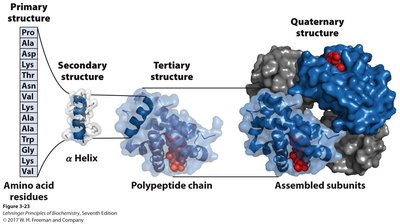
Proteins adopt specific three-dimensional conformations essential for their biological function. This native fold is stabilized by numerous noncovalent interactions.
Primary structure: Linear sequence of amino acids.
Secondary structure: Local folding (e.g., α-helix, β-sheet).
Tertiary structure: Overall 3D shape of a single polypeptide.
Quaternary structure: Assembly of multiple polypeptide subunits.
Enzyme-Substrate Interaction
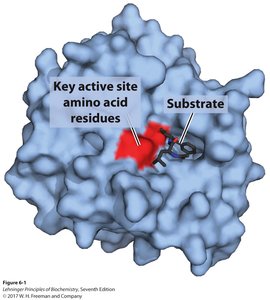
The region where a substrate binds to an enzyme is called the active site. The substrate is the molecule upon which the enzyme acts. Binding is reversible and involves noncovalent interactions such as hydrogen bonds, ionic interactions, and hydrophobic effects.
Models of Enzyme Specificity
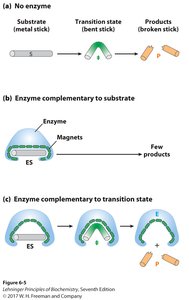
Lock-and-Key Model: The enzyme's active site is complementary in shape to the substrate, allowing specific binding.
Induced Fit Model: Binding of the substrate induces a conformational change in the enzyme, enhancing binding and catalysis.
Enzymes often bind the transition state of a reaction more tightly than the substrate, stabilizing it and lowering the activation energy.
Enzyme Catalysis: Mechanisms and Strategies
Effect on Reaction Energetics
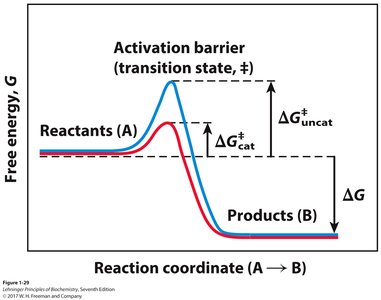
Enzymes do not alter the equilibrium constant (Keq) or the overall free energy change (ΔG) of a reaction. Instead, they lower the activation energy (ΔG‡), increasing the rate at which equilibrium is reached.
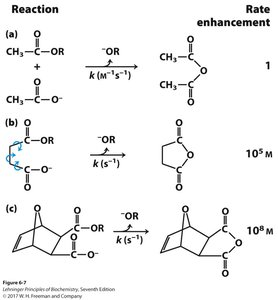
Proximity and Orientation Effects
Enzymes bring reactants into close proximity and proper orientation, greatly enhancing reaction rates compared to uncatalyzed reactions in solution.
c
Mechanisms of Chymotrypsin and Lysozyme
Lysozyme
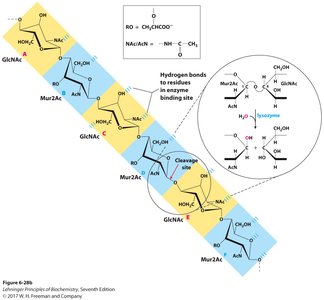
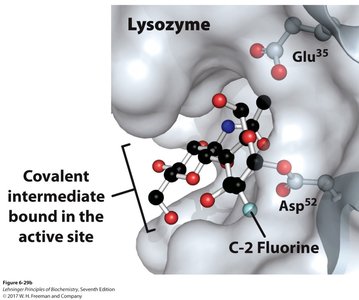
Lysozyme cleaves peptidoglycan in bacterial cell walls using both acid/base and covalent catalysis. Asp52 acts as a nucleophile, and Glu35 acts as a general acid/base.
Chymotrypsin
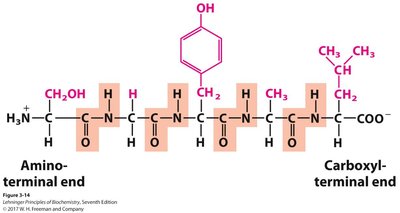
Chymotrypsin is a serine protease that cleaves peptide bonds adjacent to aromatic amino acids. Its specificity is due to a hydrophobic pocket in the active site that accommodates aromatic side c
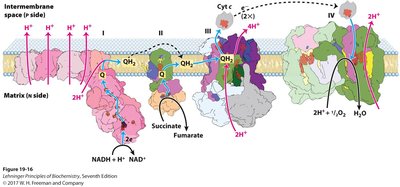
Electron Transport Chain (Metal Ion Catalysis)
The electron transport chain in mitochondria uses metal ions (e.g., iron in cytochromes) to transfer electrons and generate ATP.
Enzyme Kinetics
Basic Concepts
Enzyme kinetics studies the rates of enzyme-catalyzed reactions and how they are affected by substrate concentration, enzyme concentration, and other factors.
Activity (U): μmoles of substrate converted per minute.
Specific activity: Activity per mg of total protein (U/mg).
Michaelis-Menten Equation
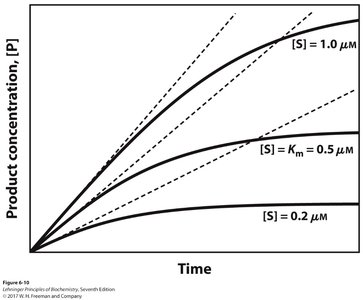
The Michaelis-Menten equation describes the relationship between reaction velocity (V), substrate concentration ([S]), maximum velocity (Vmax), and the Michaelis constant (Km):
Km: Substrate concentration at which the reaction rate is half of Vmax.
Vmax: Maximum rate achieved when the enzyme is saturated with substrate.
Lineweaver-Burk Plot
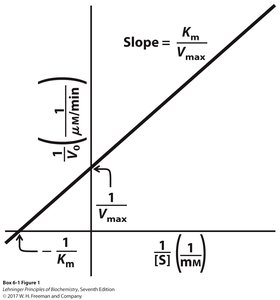
The Lineweaver-Burk equation linearizes the Michaelis-Menten equation by plotting 1/V versus 1/[S]:
Regulation of Enzyme Activity
Mechanisms of Regulation
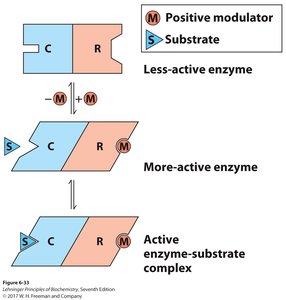
Allosteric regulation: Noncovalent binding of effectors at sites other than the active site, altering enzyme activity.
Covalent modification: Addition or removal of chemical groups (e.g., phosphorylation).
Irreversible or reversible inhibition: Binding of inhibitors that decrease enzyme activity.
Enzyme Inhibition
Types of Inhibition
Irreversible inhibition: Inhibitor covalently binds to the enzyme, permanently inactivating it.
Reversible inhibition: Inhibitor binds noncovalently and can dissociate.
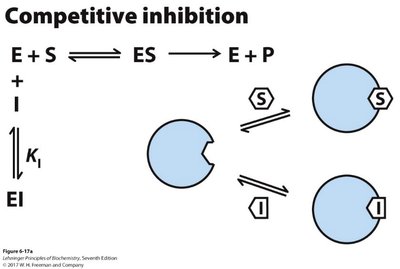
Competitive Inhibition
Inhibitor competes with substrate for the active site.
Vmax is unchanged; Km increases.
Lineweaver-Burk: lines intersect at the y-axis.
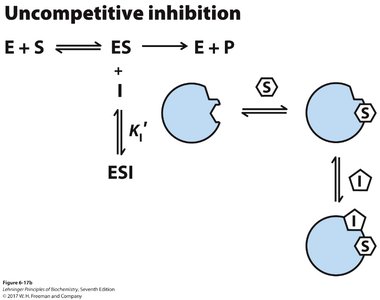
Uncompetitive (Non-competitive) Inhibition
Inhibitor binds only to the enzyme-substrate complex.
Vmax decreases; Km decreases.
Lineweaver-Burk: lines are parallel.
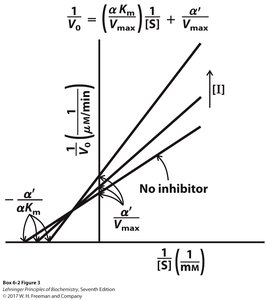
Mixed Inhibition
Inhibitor binds to both the free enzyme and the enzyme-substrate complex.
Vmax decreases; Km may increase or decrease.
Lineweaver-Burk: lines intersect left of the y-axis.
Summary
Enzymes are essential biological catalysts with high specificity and regulatory capacity.
They accelerate reactions by lowering activation energy through various catalytic mechanisms.
Enzyme kinetics, described by the Michaelis-Menten equation, provides quantitative insights into enzyme function.
Enzyme activity is regulated by allosteric effectors, covalent modifications, and inhibitors.
