 Back
BackCore Concepts in Biochemistry: Carbohydrates, Lipids, Nucleic Acids, and Proteins
Study Guide - Smart Notes
 Tailored notes based on your materials, expanded with key definitions, examples, and context.
Biological Macromolecules
Overview of Major Classes
Biological macromolecules are large, complex molecules essential for life. They include nucleic acids, carbohydrates, lipids, and proteins, each with distinct structures and functions.
Nucleic Acids: DNA and RNA, responsible for genetic information storage and transfer.
Carbohydrates: Sugars and polysaccharides, serve as energy sources and structural components.
Lipids: Fats and steroids, function in energy storage, membrane structure, and signaling.
Proteins: Polymers of amino acids, act as enzymes, hormones, and structural elements.

Carbohydrates
Classification and Structure
Carbohydrates are polyhydroxy aldehydes or ketones and their derivatives. They are classified by the number of sugar units and the nature of their carbonyl group.
Monosaccharides: Simple sugars (e.g., glucose, fructose).
Disaccharides: Two monosaccharides joined by a glycosidic bond (e.g., lactose, sucrose).
Polysaccharides: Long chains of monosaccharide units (e.g., starch, cellulose).
The aldo- and keto- prefixes indicate the presence of an aldehyde or ketone group, respectively. The number of carbons is indicated by roots such as tri-, tetra-, penta-, and hexa- (e.g., hexose for six carbons). The suffix -ose designates a carbohydrate.

D and L Families of Sugars
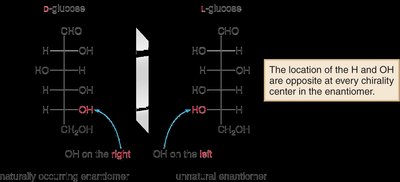
Monosaccharides exist as D- or L- isomers, determined by the orientation of the hydroxyl group on the chiral carbon farthest from the carbonyl group in Fischer projections.
D-form: –OH group on the right.
L-form: –OH group on the left.
Haworth Structures
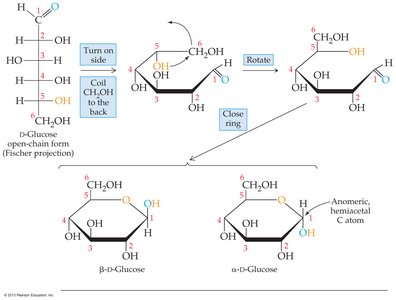
Monosaccharides can cyclize to form ring structures, represented as Haworth projections. The anomeric carbon is the new stereocenter formed during cyclization, leading to α and β anomers.
Disaccharides and Glycosidic Bonds
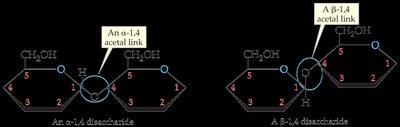
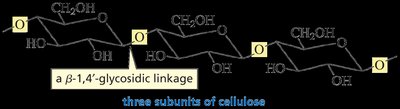
Disaccharides are formed by joining two monosaccharides via a glycosidic bond, which can be α or β depending on the configuration at the anomeric carbon. The most common linkage is between C1 of one sugar and C4 of another (α-1,4 or β-1,4 linkage).
Polysaccharides: Starch vs. Cellulose
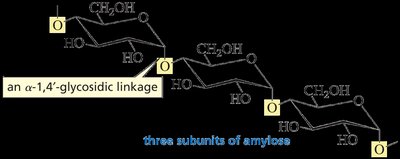
Polysaccharides are long chains of monosaccharide units. Starch (amylose and amylopectin) and cellulose are both polymers of glucose but differ in their glycosidic linkages:
Starch: α-1,4-glycosidic linkages (digestible by humans).
Cellulose: β-1,4-glycosidic linkages (not digestible by humans).
Lipids
Structure and Classification
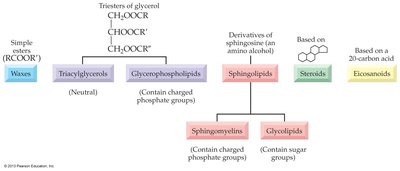
Lipids are defined by their solubility in nonpolar solvents rather than by a specific chemical structure. They include a wide variety of molecules with hydrocarbon chains or rings.
Fatty acids: Unbranched carboxylic acids with even numbers of carbons.
Triacylglycerols: Esters of glycerol and three fatty acids.
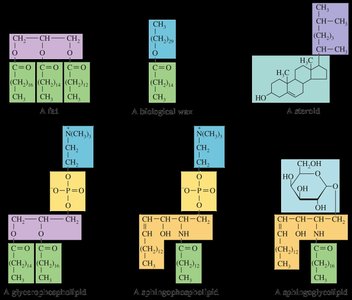
Phospholipids: Major components of cell membranes.
Steroids: Lipids with a characteristic four-ring structure.
Fatty Acids: Properties and Types
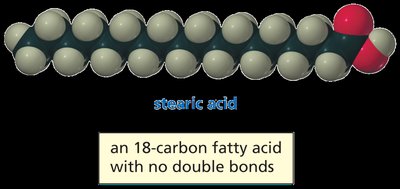
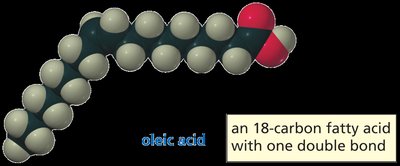
Fatty acids are classified by chain length, degree of saturation, and melting point.
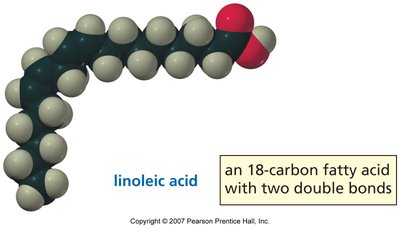
Saturated fatty acids: No double bonds; higher melting points; solid at room temperature.
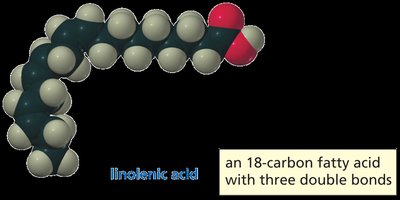
Unsaturated fatty acids: One or more double bonds (usually cis); lower melting points; liquid at room temperature.
Phospholipids and Biological Membranes
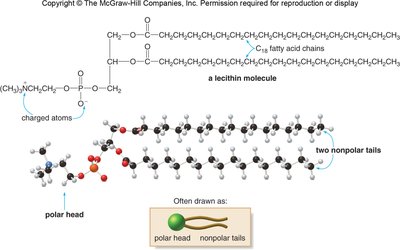
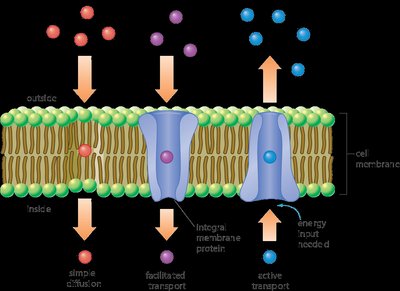
Phospholipids are amphipathic molecules that form the basic structure of cell membranes, aggregating into a bilayer with hydrophobic tails inward and hydrophilic heads outward.
Transport Across Cell Membranes
Substances cross cell membranes via:
Simple diffusion: Passive movement from high to low concentration.
Facilitated transport: Protein channels increase diffusion rate.
Active transport: Movement against a concentration gradient, requiring energy.
Nucleic Acids
Composition and Structure
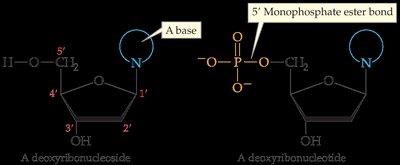
Nucleic acids are polymers of nucleotides, each consisting of a five-membered sugar, a nitrogenous base, and a phosphate group. The two main types are DNA and RNA.
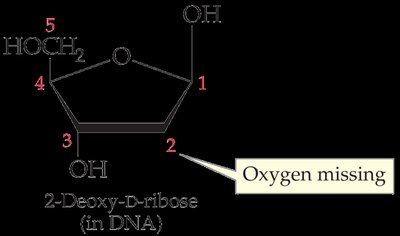
DNA: Contains deoxyribose; stores genetic information.
RNA: Contains ribose; involved in protein synthesis and gene regulation.
Nitrogenous Bases
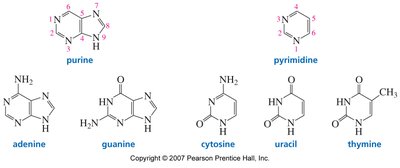
Nitrogenous bases are classified as purines (adenine, guanine) and pyrimidines (cytosine, thymine in DNA; uracil in RNA).
Differences Between DNA and RNA
Key differences include:
RNA contains ribose; DNA contains deoxyribose.
RNA uses uracil instead of thymine.
RNA is typically single-stranded; DNA is double-stranded.
Three main types of RNA: rRNA, mRNA, tRNA.
Type of RNA | Abbreviation | Function |
|---|---|---|
Ribosomal RNA | rRNA | The site of protein synthesis, found in the ribosome |
Messenger RNA | mRNA | Carries the information from DNA to the ribosome |
Transfer RNA | tRNA | Brings specific amino acids to the ribosome for protein synthesis |
Amino Acids and Proteins
Structure of Amino Acids
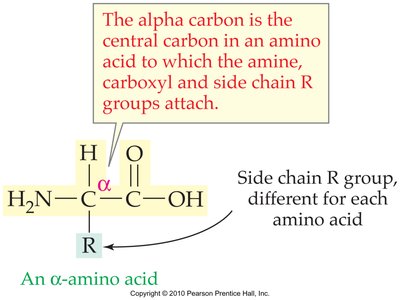
Amino acids are the building blocks of proteins. Each contains a central (alpha) carbon bonded to an amino group, a carboxyl group, a hydrogen atom, and a variable side chain (R group).
Acid-Base Properties of Amino Acids
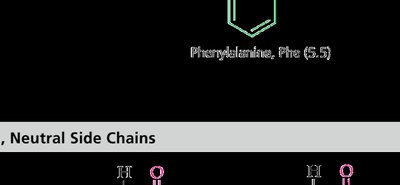
Amino acids can exist as cations, anions, or zwitterions depending on the pH. The isoelectric point (pI) is the pH at which the molecule has no net charge.
Peptide Bonds and Protein Structure
Peptide bonds are amide linkages formed between the carboxyl group of one amino acid and the amino group of another. Proteins have four levels of structure:
Primary: Sequence of amino acids.
Secondary: Local folding (α-helix, β-sheet).
Tertiary: Overall 3D shape, stabilized by R group interactions.
Quaternary: Association of multiple polypeptide chains.
Enzymes
Nature and Function
Enzymes are biological catalysts, mostly globular proteins, that accelerate chemical reactions by lowering activation energy. The substrate binds to the enzyme's active site, forming an enzyme-substrate complex.
Specificity: Enzymes are specific for their substrates and reactions.
Naming: Most enzyme names end in -ase and indicate their function or substrate.
Enzyme Mechanisms
Enzymes catalyze reactions by:
Bringing substrates together (proximity effect).
Orienting substrates correctly (orientation effect).
Providing catalytic groups (acid/base catalysis).
Inducing strain in substrates (energy effect).
Enzyme Activity: Temperature and pH
Enzyme activity is affected by temperature and pH, with optimal conditions for each enzyme. Extreme conditions can denature enzymes, reducing activity.
Enzyme Regulation
Enzyme activity is regulated by:
Allosteric control: Binding of effectors at sites other than the active site can enhance or inhibit activity.
Competitive inhibition: Inhibitors resemble the substrate and compete for the active site.
Cofactors and coenzymes: Non-protein molecules required for enzyme activity (e.g., metal ions, vitamins).
Biosignaling and Hormones
Chemical Messengers
Coordination and control of physiological functions are mediated by chemical messengers such as hormones and neurotransmitters. These molecules interact with specific receptors to elicit cellular responses.
Hormones: Delivered via the bloodstream; can be amino acid derivatives, polypeptides, or steroids.
Neurotransmitters: Released by nerve cells for rapid signaling.
Types of Hormones
Amino acid derivatives
Polypeptides: Range from a few to several hundred amino acids
Steroids: Lipids with a four-ring structure
Additional info: This guide covers the foundational concepts in biochemistry relevant to carbohydrates, lipids, nucleic acids, proteins, enzymes, and biosignaling, as outlined in a typical college-level biochemistry course.
