 Back
BackDisaccharides and Polysaccharides: Structure, Types, and Biological Roles
Study Guide - Smart Notes
 Tailored notes based on your materials, expanded with key definitions, examples, and context.
Disaccharides and Polysaccharides
Overview of Glycosides
Disaccharides and polysaccharides, collectively known as glycosides, are carbohydrates formed by the linkage of monosaccharide units through glycosidic bonds. These macromolecules play essential roles in energy storage, structural integrity, and cellular communication in living organisms.
Glycosidic linkage: An ether bond formed by enzyme-catalyzed condensation (dehydration) of two alcohol groups from monosaccharides.
Formation: The process involves the removal of a water molecule, resulting in a covalent bond between the sugar units.
Disaccharides
Structure and Types of Disaccharides
Disaccharides are carbohydrates composed of two monosaccharide units joined by a glycosidic bond. The type of monosaccharides and the nature of the linkage determine the properties and biological roles of each disaccharide.
Sucrose: Composed of α-glucose and β-fructose with an α(1→2) glycosidic linkage.
Lactose: Composed of β-galactose and α-glucose with a β(1→4) glycosidic linkage.
Maltose: Composed of two α-glucose units with an α(1→4) glycosidic linkage.
Cellobiose: Composed of two β-glucose units with a β(1→4) glycosidic linkage.
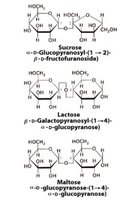
Example: Sucrose is the main transport sugar in plants, while lactose is the primary sugar in mammalian milk.
Polysaccharides
Classification of Polysaccharides
Polysaccharides are long chains of monosaccharide units. They are classified based on the types of monomers present:
Homoglycans: Polysaccharides composed of only one type of monosaccharide (e.g., starch, glycogen, cellulose, chitin).
Heteroglycans: Polysaccharides composed of more than one type of monosaccharide (e.g., proteoglycans, peptidoglycans, glycoproteins).
Homoglycans: Structure and Function
Homoglycans serve as energy storage molecules or structural components in cells. The most common homoglycans include starch, glycogen, cellulose, and chitin.
Starch
Amylose: Linear polymer of α-glucose units linked by α(1→4) bonds; forms a left-handed helix. Iodine binds inside the helix, producing a blue color.
Amylopectin: Branched polymer with linear α(1→4) linkages and branches formed by α(1→6) linkages every 24–30 glucose units.
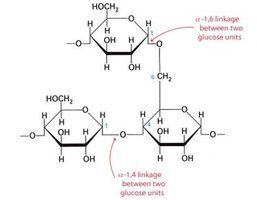
Example: Starch is the primary energy storage polysaccharide in plants.
Glycogen
Similar to amylopectin but with more frequent branching (every 8–12 glucose units).
Highly compact structure allows rapid release of glucose when needed by animals.
Example: Glycogen is the main storage form of glucose in animals, especially in liver and muscle cells.
Cellulose
Linear polymer of β-glucose units linked by β(1→4) glycosidic bonds.
Each successive glucose is rotated 180°, resulting in a straight, rigid structure.
Extensive hydrogen bonding within and between chains provides high tensile strength, forming fibers and sheets.
Humans lack the enzyme cellulase and cannot digest cellulose; it acts as dietary fiber.
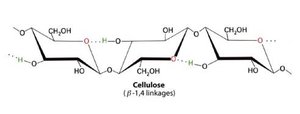
Example: Cellulose is the main structural component of plant cell walls.
Chitin
Polymer of N-acetylglucosamine (GlcNAc) units linked by β(1→4) bonds.
Structural similarities to cellulose provide strength and rigidity.
Major component of the exoskeletons of insects and crustaceans, and fungal cell walls.
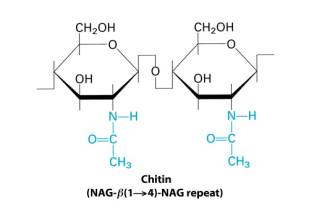
Example: Chitin forms the hard outer shells of arthropods and is used in medical and industrial applications.
Heteroglycans (Glycoconjugates)
Heteroglycans are complex carbohydrates composed of different monosaccharide units, often covalently linked to proteins or lipids. They play critical roles in cell signaling, structural support, and molecular recognition.
Proteoglycans: Found in the extracellular matrix and connective tissues of animals; consist of proteins with long chains of glycosaminoglycans.
Peptidoglycans: Major structural component of bacterial cell walls; composed of sugars and amino acids.
Glycoproteins: Proteins with covalently attached carbohydrate groups; involved in diverse functions such as enzymes, hormones, and cell surface recognition.
Example: Proteoglycans provide structural support in cartilage, while glycoproteins are essential for immune response and cell communication.
Summary Table: Major Polysaccharides
Polysaccharide | Monomer | Linkage | Structure | Function |
|---|---|---|---|---|
Amylose | α-Glucose | α(1→4) | Linear, helical | Plant energy storage |
Amylopectin | α-Glucose | α(1→4), α(1→6) | Branched | Plant energy storage |
Glycogen | α-Glucose | α(1→4), α(1→6) | Highly branched | Animal energy storage |
Cellulose | β-Glucose | β(1→4) | Linear, fibrous | Plant structural support |
Chitin | β-GlcNAc | β(1→4) | Linear, fibrous | Exoskeletons, fungal cell walls |
Additional info: The above content expands on the original notes by providing definitions, examples, and a summary table for clarity and completeness.
