 Back
BackEnzymes: Structure, Function, Mechanisms, and Kinetics
Study Guide - Smart Notes
 Tailored notes based on your materials, expanded with key definitions, examples, and context.
Enzymes: Structure, Function, Mechanisms, and Kinetics
Introduction to Enzymes
Enzymes are biological catalysts that accelerate chemical reactions in living organisms without being consumed in the process. Most enzymes are globular proteins, though some RNA molecules (ribozymes) also possess catalytic activity. The study of enzymes is foundational in biochemistry, with a rich history dating back to the 18th century.
Definition: Enzymes are catalysts that increase the rate of biochemical reactions.
Physiological Significance: Enzymes enable metabolic reactions to occur under mild cellular conditions (pH ~7, 37°C), with high specificity and regulation.
Biocatalysis vs. Inorganic Catalysts: Enzymes offer greater specificity, milder reaction conditions, higher reaction rates, and regulatory capacity compared to inorganic catalysts.
Protein Structure and Enzyme Function
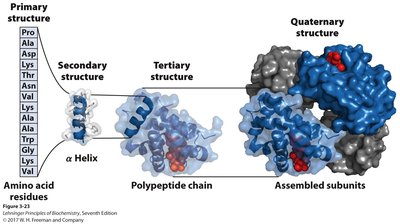
Proteins, including enzymes, adopt specific three-dimensional conformations essential for their biological function. This native fold is stabilized by numerous favorable interactions.
Four Levels of Protein Structure: Primary (amino acid sequence), secondary (α-helix, β-sheet), tertiary (3D folding), and quaternary (assembly of subunits).
Enzyme-Substrate Interaction and Specificity
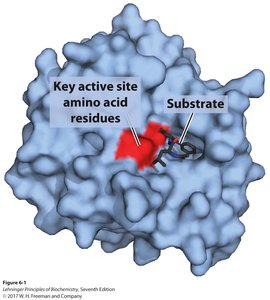
Enzymes bind substrates at their active sites, forming enzyme-substrate complexes that drive reaction specificity. The binding is reversible and involves noncovalent interactions such as hydrogen bonds, ionic interactions, and hydrophobic forces.
Active Site: The region of the enzyme where substrate binding and catalysis occur.
Substrate: The specific molecule upon which an enzyme acts.
Lock-and-Key Model
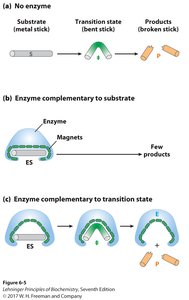
The lock-and-key model (Emil Fischer, 1894) proposes that the enzyme's active site is complementary in shape to the substrate, allowing specific binding. However, this model does not account for the flexibility observed in many enzyme-substrate interactions.
Induced Fit Model
The induced fit model (Daniel Koshland, 1958) suggests that both enzyme and substrate undergo conformational changes upon binding, enhancing specificity and catalytic efficiency. This adaptation allows enzymes to bind transition states more tightly than substrates, facilitating catalysis.
Transition State Binding
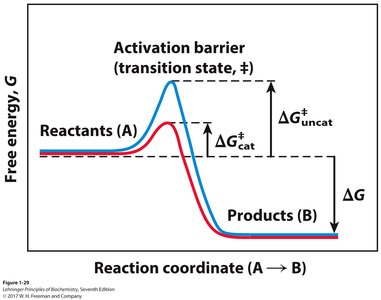
Enzymes stabilize the transition state of a reaction, lowering the activation energy required and increasing the reaction rate. This concept was proposed by Linus Pauling in 1946.
Enzyme Catalysis and Activation Energy
Enzymes do not alter the equilibrium constant (Keq) or the overall free energy change (ΔG) of a reaction. Instead, they lower the activation energy (ΔG‡), allowing reactions to proceed more rapidly.
Proximity and Orientation Effects
Enzymes increase reaction rates by bringing reactants into close proximity and proper orientation, facilitating effective collisions and transition state formation.
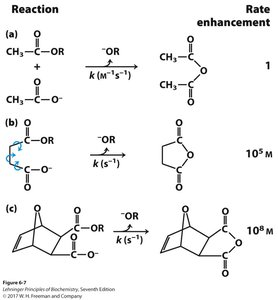
Chemical Mechanisms of Enzyme Catalysis
Enzymes employ several catalytic strategies, often in combination, to accelerate reactions:
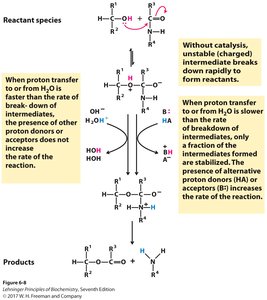
Acid-Base Catalysis: Enzyme side chains donate or accept protons to stabilize intermediates.
Covalent Catalysis: A transient covalent bond forms between the enzyme and substrate, altering the reaction pathway.
Metal Ion Catalysis: Metal ions stabilize charges, participate in redox reactions, or orient substrates.
General Acid/Base Catalysis
Proton transfer is facilitated by amino acid side chains, increasing the rate of intermediate breakdown or formation.
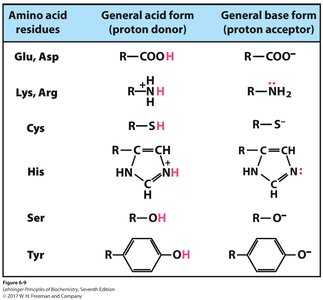
Key Amino Acids in Acid/Base Catalysis
Amino acid residues | General acid form (proton donor) | General base form (proton acceptor) |
|---|---|---|
Glu, Asp | R–COOH | R–COO− |
Lys, Arg | R–NH3+ | R–NH2 |
Cys | R–SH | R–S− |
His | R–CH+ | R–N |
Ser | R–OH | R–O− |
Tyr | R–OH | R–O− |
Covalent Catalysis
In covalent catalysis, the enzyme forms a temporary covalent bond with the substrate, creating a reactive intermediate. This mechanism requires a nucleophilic side chain (e.g., Ser, Cys, Lys, His, Asp, Glu).
Metal Ion Catalysis
Metal ions (e.g., Mg2+, Fe2+/3+) can stabilize negative charges, participate in redox reactions, and orient substrates for catalysis.
Mechanisms of Chymotrypsin and Lysozyme
Lysozyme
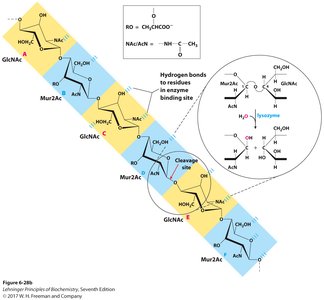
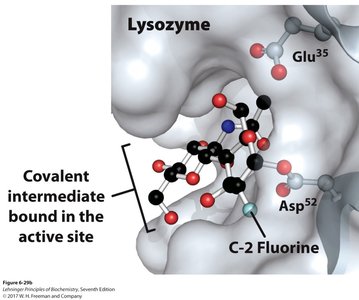
Lysozyme is an antibacterial enzyme that cleaves peptidoglycan in bacterial cell walls using both acid/base and covalent catalysis. Asp52 acts as a nucleophile, while Glu35 acts as a general acid/base.
Chymotrypsin
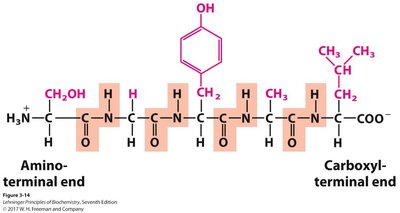
Chymotrypsin is a digestive protease that cleaves peptide bonds adjacent to aromatic amino acids. Its specificity is due to a hydrophobic pocket in the active site that accommodates aromatic side chains, aligning the peptide bond for catalysis by key residues (Ser195, His57, Asp102).
Enzyme Kinetics
Enzyme kinetics is the study of the rates of enzyme-catalyzed reactions and the factors affecting them. Key parameters include substrate concentration, enzyme concentration, temperature, and the presence of inhibitors or activators.
Michaelis-Menten Equation
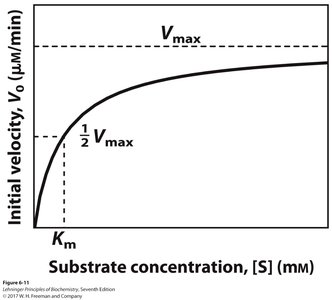
The Michaelis-Menten equation describes the relationship between reaction velocity (V), substrate concentration ([S]), maximum velocity (Vmax), and the Michaelis constant (Km):
Km: Substrate concentration at which the reaction rate is half of Vmax; reflects enzyme-substrate affinity.
Vmax: Maximum reaction rate when the enzyme is saturated with substrate.
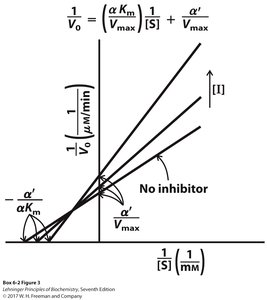
Lineweaver-Burk Plot
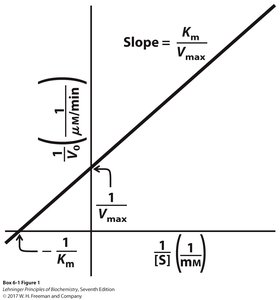
The Lineweaver-Burk equation is a double reciprocal transformation of the Michaelis-Menten equation, useful for determining kinetic parameters graphically:
Measuring Enzyme Activity
Enzyme activity is measured in Units (U), defined as μmoles of substrate converted per minute. Specific activity is the activity per mg of total protein, reflecting enzyme purity.
Enzyme Regulation
Enzyme activity can be regulated by various mechanisms:
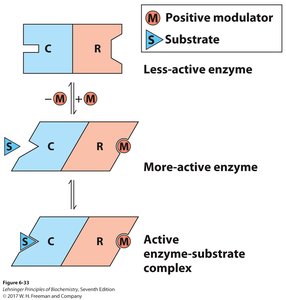
Allosteric Regulation: Noncovalent binding of effectors at sites other than the active site, altering enzyme activity.
Covalent Modification: Addition or removal of chemical groups (e.g., phosphorylation) to modulate activity.
Irreversible and Reversible Inhibition: Inhibitors can permanently inactivate (irreversible) or reversibly bind to enzymes, affecting their function.
Enzyme Inhibition
Enzyme inhibitors are molecules that decrease enzyme activity. They are classified as irreversible or reversible (competitive, uncompetitive, non-competitive, mixed):
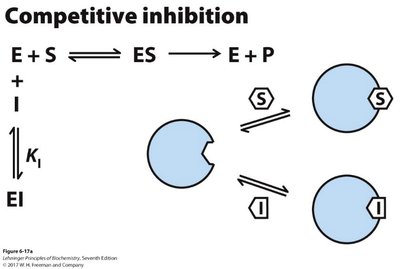
Competitive Inhibition: Inhibitor competes with substrate for the active site; increases apparent Km, Vmax unchanged.
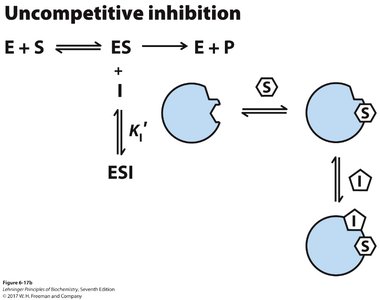
Uncompetitive Inhibition: Inhibitor binds only to the enzyme-substrate complex; decreases both Km and Vmax.
Non-competitive Inhibition: Inhibitor binds to enzyme or ES complex at a regulatory site; decreases Vmax, Km unchanged.
Mixed Inhibition: Inhibitor binds to enzyme with or without substrate; affects both Km and Vmax.
Summary
Enzymes are essential biological catalysts with remarkable specificity and regulatory capacity.
They accelerate reactions by lowering activation energy through various catalytic mechanisms.
Enzyme kinetics provides quantitative insights into enzyme function and regulation.
Enzyme activity can be modulated by allosteric effectors, covalent modifications, and inhibitors.
