 Back
BackLEC 18 Glycolysis: Pathway, Regulation, and Metabolic Fate
Study Guide - Smart Notes
 Tailored notes based on your materials, expanded with key definitions, examples, and context.
Glycolysis: Central Pathway of Metabolism
Overview of Glycolysis
Glycolysis is a fundamental metabolic pathway that converts glucose into pyruvate, generating ATP and NADH in the process. It is the primary pathway for energy production in most cells and operates under both aerobic and anaerobic conditions.
Location: Cytosol of the cell
Phases: Glycolysis consists of two main phases: the energy investment phase and the energy payoff phase.
Net Yield: From one molecule of glucose, glycolysis produces two molecules of pyruvate, two ATP (net), and two NADH.
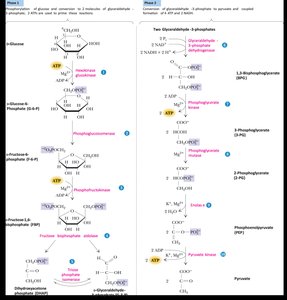
Phase 1: Energy Investment Phase
Hexokinase/Glucokinase Reaction
The first step of glycolysis involves the phosphorylation of glucose to glucose-6-phosphate (G6P) by hexokinase (or glucokinase in the liver). This reaction consumes one ATP and traps glucose inside the cell.
Enzyme: Hexokinase/Glucokinase
Reaction:
Regulation: Inhibited by its product, G6P (feedback inhibition).

Phosphofructokinase-1 (PFK-1): The Committed Step
PFK-1 catalyzes the phosphorylation of fructose-6-phosphate to fructose-1,6-bisphosphate. This is the committed and highly regulated step of glycolysis, serving as a key control point.
Enzyme: Phosphofructokinase-1 (PFK-1)
Reaction:
Regulation: Allosterically activated by AMP, ADP, and fructose-2,6-bisphosphate; inhibited by ATP and citrate.
Significance: This step commits the cell to metabolize glucose via glycolysis.
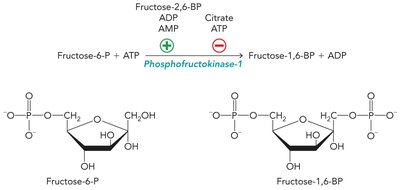
Allosteric Regulation of PFK-1
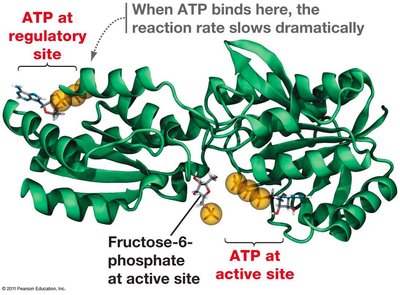
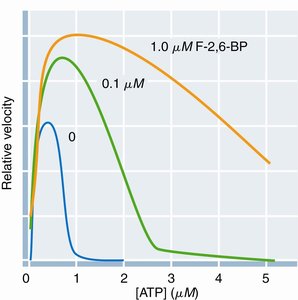
PFK-1 has two ATP binding sites: a high-affinity substrate site and a low-affinity regulatory site. High ATP levels inhibit PFK-1 by binding to the regulatory site, while AMP and fructose-2,6-bisphosphate relieve this inhibition.
Allosteric Activators: AMP, ADP, fructose-2,6-bisphosphate
Allosteric Inhibitors: ATP, citrate
Mechanism: AMP reverses ATP inhibition, linking glycolytic flux to cellular energy status.
Formation of Triose Phosphates
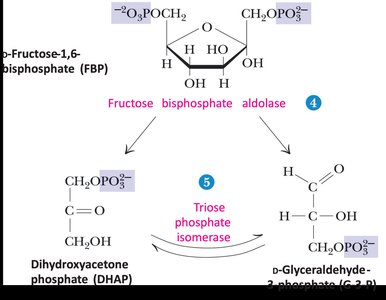
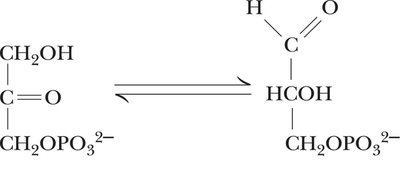
Fructose-1,6-bisphosphate is cleaved by aldolase into two three-carbon sugars: dihydroxyacetone phosphate (DHAP) and glyceraldehyde-3-phosphate (G-3-P). Triose phosphate isomerase rapidly interconverts these two molecules, ensuring both can continue through glycolysis.
Enzyme: Aldolase (cleavage), Triose phosphate isomerase (isomerization)
Reaction:
Mechanism: Class I aldolases form a Schiff base intermediate; Class II use a metal ion.
Phase 2: Energy Payoff Phase
Glyceraldehyde-3-Phosphate Dehydrogenase
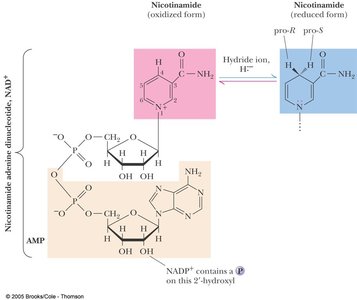
This enzyme catalyzes the oxidation and phosphorylation of G-3-P to 1,3-bisphosphoglycerate (1,3-BPG), reducing NAD+ to NADH in the process. This is the first energy-yielding step of glycolysis.
Enzyme: Glyceraldehyde-3-phosphate dehydrogenase
Reaction:
Mechanism: Involves a thiohemiacetal intermediate and covalent catalysis.
Substrate-Level Phosphorylation: Phosphoglycerate Kinase
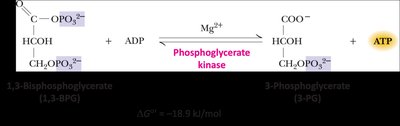
Phosphoglycerate kinase transfers a phosphate from 1,3-BPG to ADP, forming ATP and 3-phosphoglycerate. This is an example of substrate-level phosphorylation.
Enzyme: Phosphoglycerate kinase
Reaction:
Significance: This step repays the ATP invested in the early phase of glycolysis.
Formation of 2,3-Bisphosphoglycerate (2,3-BPG)
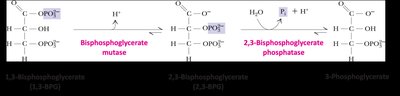
In erythrocytes, a detour from glycolysis forms 2,3-BPG, an important regulator of hemoglobin's oxygen affinity. 2,3-BPG is produced from 1,3-BPG by bisphosphoglycerate mutase and can be converted to 3-phosphoglycerate by 2,3-BPG phosphatase.
Function: 2,3-BPG decreases hemoglobin's affinity for oxygen, facilitating oxygen release in tissues.
Phosphoglycerate Mutase and Enolase
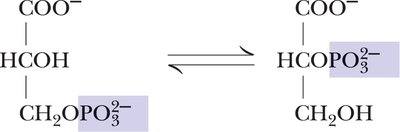
Phosphoglycerate mutase shifts the phosphate group from the 3-position to the 2-position, forming 2-phosphoglycerate. Enolase then converts 2-phosphoglycerate to phosphoenolpyruvate (PEP), a high-energy compound.
Phosphoglycerate Mutase: Requires 2,3-BPG for activation; forms a phosphohistidine intermediate.
Enolase: Dehydrates 2-phosphoglycerate to form PEP.

Pyruvate Kinase: Final Step of Glycolysis
Pyruvate kinase catalyzes the transfer of a phosphate from PEP to ADP, yielding ATP and pyruvate. This reaction is highly exergonic and regulated allosterically.
Enzyme: Pyruvate kinase
Reaction:
Regulation: Activated by AMP and fructose-1,6-bisphosphate; inhibited by ATP, acetyl-CoA, and alanine.

Thermodynamics and Regulation of Glycolysis
Key Regulatory Steps
Glycolysis is regulated at three irreversible steps: hexokinase, phosphofructokinase-1, and pyruvate kinase. These steps have large negative ΔG values and are the main control points for the pathway.
Hexokinase: Inhibited by glucose-6-phosphate
PFK-1: Allosterically regulated by ATP, AMP, citrate, and fructose-2,6-bisphosphate
Pyruvate kinase: Allosterically regulated and subject to covalent modification in the liver
Metabolic Fate of Pyruvate and NADH
Aerobic and Anaerobic Conditions
The fate of pyruvate and NADH depends on oxygen availability:
Aerobic: Pyruvate is converted to acetyl-CoA and enters the citric acid cycle; NADH is oxidized in the electron transport chain, producing ATP.
Anaerobic (e.g., muscle, yeast): Pyruvate is reduced to lactate (in animals) or ethanol and CO2 (in yeast), regenerating NAD+ for continued glycolysis.
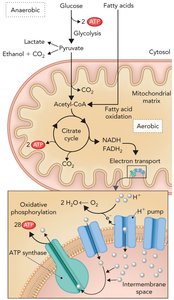
Table: Reactions and Thermodynamics of Glycolysis
The following table summarizes the main reactions, enzymes, and thermodynamic data for glycolysis:
Reaction | Enzyme | ΔG°' (kJ/mol) | ΔG (kJ/mol) |
|---|---|---|---|
Glucose + ATP → Glucose-6-phosphate + ADP | Hexokinase/Glucokinase | -16.7 | -33.9 |
Glucose-6-phosphate ⇌ Fructose-6-phosphate | Phosphoglucoisomerase | +1.67 | -2.92 |
Fructose-6-phosphate + ATP → Fructose-1,6-bisphosphate + ADP | Phosphofructokinase | -14.2 | -18.8 |
Fructose-1,6-bisphosphate ⇌ DHAP + G-3-P | Aldolase | +23.9 | -0.23 |
DHAP ⇌ G-3-P | Triose phosphate isomerase | +7.56 | +2.41 |
G-3-P + Pi + NAD+ ⇌ 1,3-BPG + NADH + H+ | Glyceraldehyde-3-P dehydrogenase | +6.30 | -1.29 |
1,3-BPG + ADP ⇌ 3-PG + ATP | Phosphoglycerate kinase | -18.9 | +0.1 |
3-PG ⇌ 2-PG | Phosphoglycerate mutase | +4.4 | +0.83 |
2-PG ⇌ PEP + H2O | Enolase | +1.8 | +1.1 |
PEP + ADP + H+ ⇌ Pyruvate + ATP | Pyruvate kinase | -31.7 | -23.0 |
Summary
Glycolysis is a central metabolic pathway, tightly regulated at key steps to meet cellular energy demands.
It provides ATP and metabolic intermediates for other pathways, and its end products are further metabolized depending on oxygen availability.
Regulation occurs primarily at hexokinase, phosphofructokinase-1, and pyruvate kinase steps.
